
For most U.S. homeowners, a tankless water heater wins on long-term energy savings and lifespan, while a storage tank wins on upfront cost and installation simplicity. The deciding factor is usually your home’s existing gas, electrical, and venting infrastructure, not just your preference for endless hot water.
The DOE reports tankless units can be 24%–34% more energy efficient than storage tanks for homes using 41 gallons per day or less. Storage tanks typically cost less to buy and install, but they carry standby heat loss around the clock. Tankless units last roughly 20 years versus 10–15 for a tank, but they cost more upfront and often require infrastructure upgrades that can add thousands to the project.
Quick verdict by household type:
- Budget-first or short-term homeowners: A storage tank is almost always the smarter financial move. Lower purchase price, simpler installation, and no surprise upgrade costs.
- Large households or long-term owners: Tankless pays off when you run out of hot water regularly, plan to stay 10+ years, and already have adequate gas or electrical capacity.
- Fuel infrastructure is the tiebreaker: If converting to tankless requires a new gas line, upgraded electrical panel, or new venting, get those costs in writing before committing. They can flip the math entirely.
- Cold climates: Electric tankless units struggle with cold incoming water. Gas tankless is the stronger choice in most U.S. regions outside the Deep South and Southwest.
Consumer Reports testing confirms gas tankless models generally hit their output targets, but payback timelines can stretch longer than typical warranties when installation upgrades are factored in.
Key Takeaways
Tankless water heaters offer real long-term energy and lifespan advantages, but the total installed cost, including infrastructure upgrades, determines whether they make financial sense for your household.
| Point | Details |
|---|---|
| Infrastructure check first | Get gas-line, venting, and electrical upgrade costs in writing before choosing tankless over a storage tank. |
| DOE efficiency advantage | Tankless units can be 24%–34% more efficient for low-use homes, but savings shrink to 8%–14% for high-use households. |
| Payback can exceed warranties | Consumer Reports found payback timelines often stretch longer than typical warranties when installation upgrades are included. |
| Sizing by GPM, not just brand | Ask for the unit’s rated GPM at your local winter groundwater temperature, not the box specification. |
| Appliancesrepairmdtech | Provides written-scope installation and replacement for both tank and tankless systems across Orange County and Los Angeles County. |
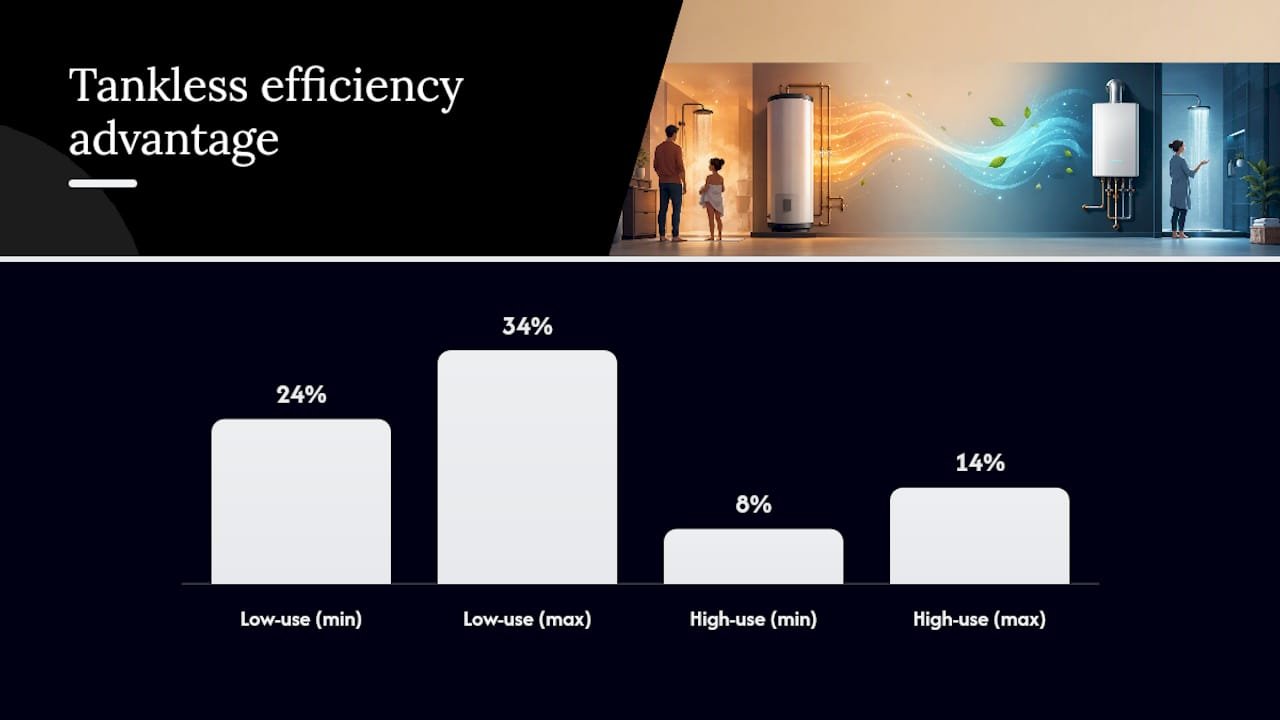
Table of Contents
- How do tankless and tank water heaters compare side by side?
- How do storage tank and tankless water heaters actually work?
- What are the real pros and cons of a storage tank water heater?
- What are the real pros and cons of a tankless water heater?
- What does a water heater replacement actually cost in the U.S.?
- How do you size a water heater correctly?
- How much energy does each type save, and when does tankless pay off?
- What maintenance does each type need, and how long will it last?
- What safety and code requirements apply to water heater installation?
- How do you choose between tankless and tank? A contractor-ready checklist
- What should you expect from a professional water heater installation?
- Sources
How do tankless and tank water heaters compare side by side?
Efficiency ranges and savings data sourced from DOE Energy Saver, NREL/Building America, and Consumer Reports testing.
How do storage tank and tankless water heaters actually work?
The core difference is simple: one stores hot water, the other makes it on demand.
Storage tank heaters: always ready, always burning energy
A storage tank heater keeps 30–80 gallons of water at a set temperature, typically 120°F, around the clock. A thermostat monitors the tank temperature and fires the burner (gas) or heating elements (electric) whenever the water cools below the setpoint. That constant reheating to offset heat lost through the tank walls is called standby loss, and it accounts for a meaningful share of your water heating bill whether you use hot water or not.
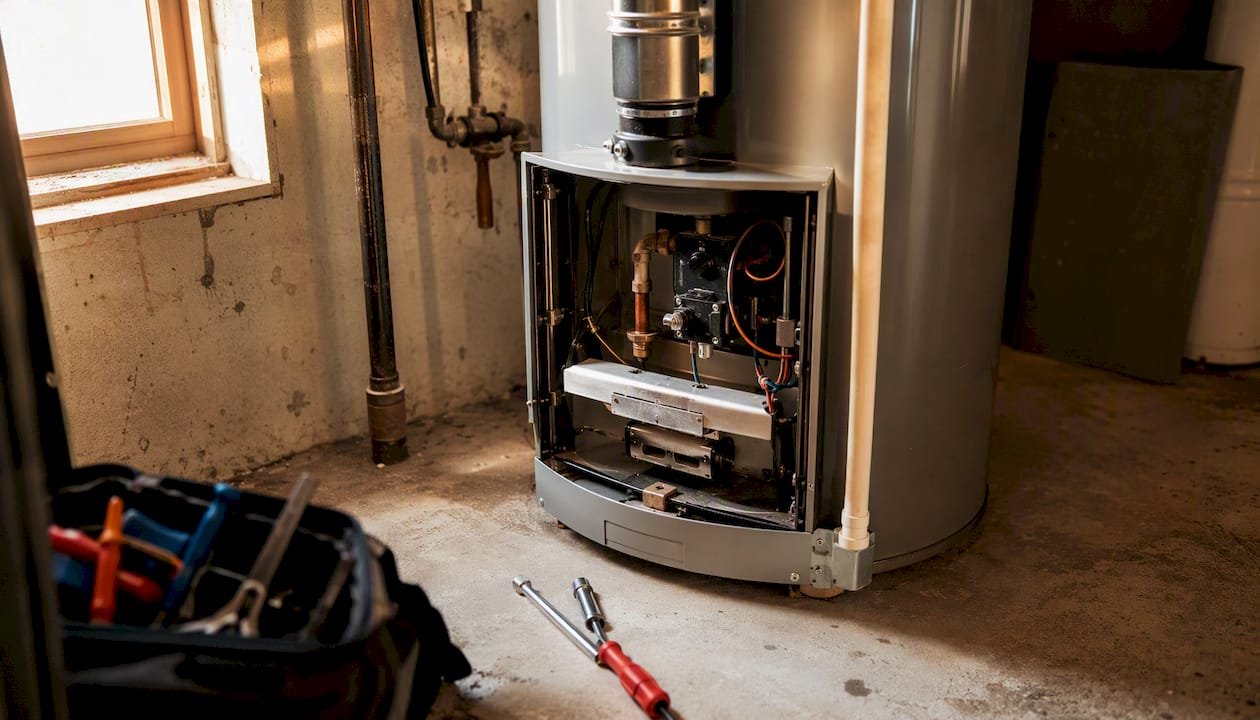
The first-hour rating (FHR) tells you how many gallons a tank can deliver in the first hour starting from a full, hot tank. Recovery rate, measured in gallons per hour, tells you how fast it reheats after depletion. A 50-gallon gas tank with a 40,000 BTU burner recovers faster than a comparable electric tank, which is why gas tanks remain popular in larger households.
Fuel options include natural gas, propane, and electric resistance. Heat pump water heaters (a type of electric storage tank) use refrigerant-cycle technology to move heat rather than generate it, achieving UEF ratings of 3.0–4.0, far above standard electric resistance tanks.
Tankless heaters: hot water on demand, with limits
A tankless unit, also called an on-demand or instantaneous water heater, has no storage. When you open a hot tap, a flow sensor triggers the burner or electric elements inside a heat exchanger. Water passes through and exits hot, typically within a few seconds of the initial cold-water purge.
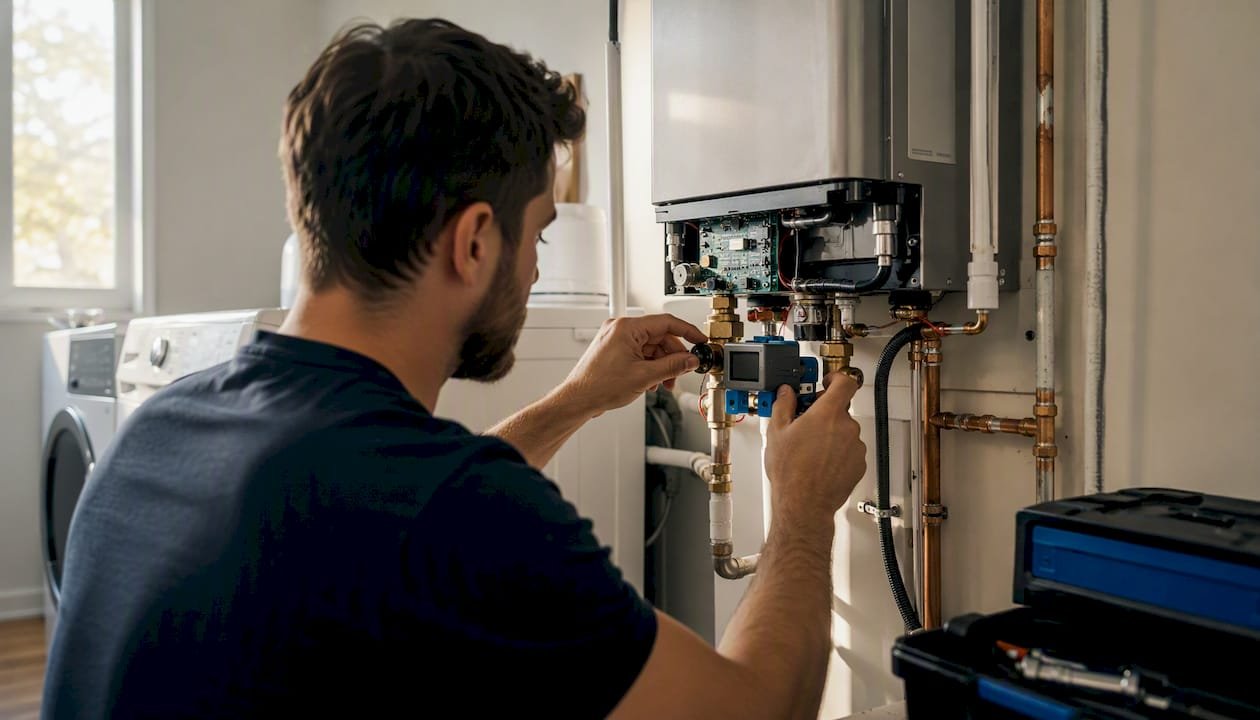
The critical spec is gallons per minute (GPM) at a given temperature rise. A gas tankless unit rated at 8 GPM at a 35°F rise will deliver less GPM if your incoming groundwater is 45°F and you want 120°F output (a 75°F rise). That’s why the box GPM number is often misleading. Installers should be asked for rated GPM at your local winter groundwater temperature, not just the headline spec.
Gas tankless units from brands like Rinnai, Navien, Noritz, and Rheem typically deliver 6–10 GPM and handle whole-home demand. Electric whole-home tankless units from Bosch (Tronic series), Stiebel Eltron Tempra, and Trutankless deliver 2–5 GPM and work best in warmer regions where incoming water is already 60°F or above. Consumer Reports found some electric models failed to reach 120°F at lower inlet temperatures, making them a poor fit for colder U.S. climates without significant oversizing.
Pro Tip: A tankless unit requires a minimum flow rate, typically 0.5–0.75 GPM, to activate the burner. Dripping faucets or very low-flow fixtures can prevent the unit from firing, which is one cause of a “tankless water heater not heating” complaint.
For a deeper look at how tankless systems operate day-to-day, the homeowner’s guide to tankless water heaters covers operation, maintenance, and suitability in plain language.
What are the real pros and cons of a storage tank water heater?
Storage tanks are the default for a reason: they work reliably, cost less to buy and install, and are simple to replace.
The upfront case for a tank is hard to argue with. A 50-gallon gas tank typically costs $500–$900 for the unit, and a like-for-like replacement by a licensed plumber runs $800–$1,500 installed, including disposal of the old unit. There are rarely surprise upgrade costs. The existing gas connection, venting, and electrical supply almost always accommodate a new tank of the same type.
Predictable performance is another genuine advantage. You know exactly how much hot water you have: the tank’s first-hour rating tells you the maximum available at any moment. For a household of two or three people with staggered shower schedules, a 40–50 gallon gas tank almost never runs short. Recovery time on a modern gas tank is fast enough that a second round of showers 30–45 minutes later is rarely a problem.
The downsides are real, though. Standby loss is constant. Even a well-insulated modern tank loses heat through its walls and connections, and the burner or elements cycle on to compensate, whether anyone is home or not. Over a year, that adds up. Tanks also have a finite supply: a large family running the dishwasher, two showers, and a load of laundry simultaneously can drain a 50-gallon tank faster than it recovers, leaving someone with a cold shower. That’s the classic “tankless water heater no hot water” complaint, but it applies to tanks too, just in a different form.
Tank failure is the other risk. A corroding tank can leak slowly or fail suddenly, and a 50-gallon failure in a finished basement is a serious water-damage event. Anode rod maintenance (more on that below) extends tank life, but most tanks are replaced at 10–12 years regardless.
Best fit for a storage tank:
- Homeowners replacing a failed unit on a tight timeline or budget
- Households of 1–4 people with predictable, non-simultaneous hot-water use
- Homes without adequate gas-line capacity for a high-BTU tankless unit
- Renters or owners planning to sell within 5 years, where payback on a tankless upgrade doesn’t make sense
What are the real pros and cons of a tankless water heater?
Tankless units deliver continuous hot water, use less energy, and last significantly longer than tanks. The catch is that they cost more to buy, often cost considerably more to install, and demand more maintenance in hard-water areas.
Key advantages:
- No standby heat loss: the unit only fires when you open a tap
- Expected lifespan of 18–25 years, roughly double a storage tank
- Compact wall-mounted footprint, freeing up floor space in utility closets or garages
- Continuous hot water supply, as long as demand stays within the unit’s GPM rating
- Eligible for federal tax credits and state rebates that can reduce net installed cost (check DSIRE for your state)
Key disadvantages:
- Higher purchase price, especially for whole-home gas units from Rinnai, Navien, or Noritz
- Installation often requires new venting (Category III stainless or PVC for condensing units), gas-line upsizing to 3/4" or larger, or a dedicated 240V circuit for electric models
- Annual descaling is non-negotiable in hard-water areas; skipping it shortens lifespan and can void the manufacturer warranty
- The “cold-water sandwich” effect: a brief burst of cold water between hot draws when a previous user left hot water sitting in the pipes
- A Navien tankless not heating, or any brand failing to fire, often traces back to a dirty inlet filter, a gas-pressure issue, or a flow sensor fault — all require a licensed technician to diagnose safely
Best fit for tankless:
- Households of 3–6 people who regularly run out of hot water with a tank
- Homeowners planning to stay 10+ years, giving the lifespan advantage time to pay off
- Homes with existing adequate gas infrastructure (3/4" gas line, proper venting chase) or a panel with capacity for a large dedicated circuit
- Vacation homes or seasonal properties where a tank sitting idle for months wastes energy continuously
For homes where space is a constraint, horizontal mounting options can solve tight utility-closet situations that a standard vertical tank can’t fit.
What does a water heater replacement actually cost in the U.S.?
The installed cost gap between a storage tank and a tankless unit is driven almost entirely by infrastructure upgrades, not the unit itself.
Typical U.S. installed cost ranges
Note: Venting and gas-line upgrade costs vary significantly by home age, layout, and local labor rates. Get itemized quotes.
What to get in writing before you sign
- The unit’s model number, UEF rating, and warranty terms
- A line-item breakdown of any infrastructure upgrades (venting type, gas-line size, electrical work)
- Permit fee included or excluded, and who pulls the permit
- Labor warranty (typically 1 year on workmanship)
- Disposal fee for the old unit
- Timeline: a like-for-like tank swap typically takes 2–4 hours; a conversion to tankless with venting and gas-line work can take a full day or more
Permit requirements vary by jurisdiction. Most U.S. cities require a permit for water heater replacement, and some require a licensed plumber or HVAC contractor to pull it. Skipping the permit can create problems at resale. For a full breakdown of what the permit and inspection process looks like, the water heater repair guide for homeowners covers local permit considerations in detail.
Pro Tip: Always check the Energy Star rebate finder and DSIRE before finalizing your purchase. State and utility rebates for high-efficiency tankless or heat pump water heaters can reduce net installed cost by $200–$800 in many U.S. markets, which meaningfully changes the payback calculation.
How do you size a water heater correctly?
Sizing a tank and sizing a tankless unit are completely different calculations, and getting either wrong means cold showers or wasted money.
The one-line rule: Tanks are sized by gallons and first-hour rating. Tankless units are sized by required peak GPM at your local winter incoming water temperature.
Sizing a storage tank
Match the tank’s first-hour rating to your household’s peak-hour demand. A family of four typically needs a first-hour rating of 60–80 gallons. The tank’s gallon capacity (40, 50, 80 gallons) is secondary to the FHR, which accounts for both stored volume and recovery rate.
Sizing a tankless unit: step-by-step
- List your simultaneous fixtures. What runs at the same time during peak demand? Two showers, a dishwasher, and a bathroom sink is a common scenario.
- Add up the GPM. A standard showerhead uses about 2.0 GPM; a low-flow showerhead uses 1.5 GPM; a dishwasher uses about 1.0–1.5 GPM; a bathroom faucet uses about 0.5–1.0 GPM.
- Calculate total peak GPM. Two showers (2.0 + 2.0) + dishwasher (1.0) = 5.0 GPM required.
- Determine your temperature rise. If your incoming groundwater in winter is 55°F and you want 120°F output, your required temperature rise is 65°F.
- Match to a unit’s rated GPM at that temperature rise. A unit rated at 8.0 GPM at a 35°F rise may only deliver 5.5 GPM at a 65°F rise. Check the manufacturer’s performance curve, not just the box spec.
Sample calculation: A Southern California home with 60°F winter groundwater needs 5.0 GPM at a 60°F rise. A Rinnai RU199iN or Navien NPE-240A2 rated at 9.8–11 GPM at a 35°F rise will comfortably cover that load. The same unit installed in Minnesota, where winter groundwater can be 40°F, faces an 80°F rise and delivers materially less GPM, which is why installers in cold climates often recommend upsizing or installing two units in parallel.
NREL/Building America testing found that real-world efficiency for gas tankless units correlates closely with draw volume: savings approach rated efficiency at draws of about 10 gallons or more, with the greatest measured savings near 50 gallons per day. Small, frequent draws reduce the real-world efficiency advantage.
How much energy does each type save, and when does tankless pay off?
The DOE’s finding: Tankless water heaters can be 24%–34% more energy efficient than storage tanks for homes using 41 gallons per day or less. For high-use homes at roughly 86 gallons per day, that gap narrows to 8%–14%.
The Uniform Energy Factor (UEF) is the standard efficiency metric on every EnergyGuide label. Higher UEF means lower operating cost. A gas storage tank typically carries a UEF of 0.58–0.70. A condensing gas tankless unit from Navien or Rinnai reaches 0.90–0.96. The difference in annual operating cost for a typical household is real, but it takes years to recover the higher upfront and installation cost.
Payback math: a realistic example
Assume a gas tankless unit costs $2,500 more installed than a comparable gas storage tank (a conservative estimate when venting upgrades are included). If the tankless unit saves $120 per year in gas costs, the simple payback is roughly 20 years. That’s longer than many manufacturer warranties on the tank components.
The math improves when:
- Infrastructure upgrades are minimal (existing adequate gas line and venting)
- The household uses moderate hot water daily (closer to the 41-gallon sweet spot)
- State or utility rebates reduce net installed cost
- The homeowner plans to stay in the home for 15+ years
Consumer Reports found that payback timelines often exceed typical warranties when installation upgrades are included in the calculation. Published payback analyses also frequently exclude annual maintenance costs (descaling, parts) over a 20-year period. Factor those in before accepting a contractor’s payback estimate at face value.
One more variable: real-world savings for tankless depend heavily on individual draw sizes. Small, frequent draws, like running the kitchen tap for 30 seconds, reduce the efficiency advantage because the unit fires and heats water that’s partially wasted in the purge. This is the core finding from NREL/Building America field testing.
What maintenance does each type need, and how long will it last?
Expected lifespans: Storage tanks typically last 10–15 years. Tankless units, properly maintained, last 18–25 years. That lifespan gap is a real advantage for tankless, but only if the maintenance actually happens.
Storage tank maintenance schedule
- Annual: Flush the tank to remove sediment buildup. Sediment insulates the bottom of the tank from the burner, reducing efficiency and accelerating corrosion. A DIY flush takes 30–45 minutes with a garden hose.
- Every 2–3 years: Inspect and replace the anode rod. The anode rod (magnesium or aluminum) sacrificially corrodes to protect the tank lining. A depleted anode rod is the single biggest cause of premature tank failure. Replacement costs $20–$50 for the part; a plumber charges $100–$200 for the service.
- Watch for: Rust-colored water, popping or rumbling sounds during heating (sediment), and moisture around the base (early tank corrosion).
For a complete schedule, the water heater maintenance guide walks through every task with timing and cost estimates.
Tankless maintenance schedule
- Every 6–12 months in hard-water areas: Descale the heat exchanger using a citric acid or white vinegar flush. Hard water deposits calcium on the heat exchanger, reducing efficiency and eventually causing failure. Professional descaling typically costs $100–$300 depending on your area and the unit’s accessibility.
- Annually: Clean the inlet filter screen. A clogged filter is a common cause of “tankless water heater not heating” or reduced flow complaints.
- Every 3–5 years: Inspect the burner assembly and venting connections (gas units). Check for corrosion at the condensate drain (condensing units).
Skipping descaling in hard-water areas doesn’t just reduce efficiency. It can void the manufacturer warranty on brands like Rinnai, Navien, Noritz, and Rheem, which typically require documented annual maintenance for warranty claims. If you’re in a hard-water region (much of Southern California, Texas, Arizona, and the Southwest), budget for professional descaling as a recurring cost, not an optional one.
Common water heater problems for both types, including sediment buildup, failed heating elements, and ignition faults, are worth understanding before a failure catches you off guard.
What safety and code requirements apply to water heater installation?
Storage tanks can fail slowly through corrosion and leak; tankless units draw very high instantaneous energy (up to 199,000 BTU for a large gas unit or 36 kW for a whole-home electric) and require careful venting and gas-line sizing. Neither is inherently dangerous when installed correctly, but both have specific code requirements that vary by jurisdiction.
Common installation requirements to know before getting quotes:
Venting: Gas storage tanks typically use B-vent (double-wall metal). Non-condensing gas tankless units require Category III stainless steel venting, which is more expensive. Condensing gas tankless units (Navien, Rinnai condensing series) can use PVC or CPVC venting, which is cheaper but requires a condensate drain. Mixing vent types is a code violation and a safety hazard.
Combustion air: In tight, well-insulated homes, the water heater needs a dedicated combustion air supply. Sealed-combustion (direct-vent) tankless units pull outside air directly, which is the cleanest solution for modern construction.
Gas-line sizing: A large gas tankless unit may require a 3/4" or 1" gas line from the meter. Many older homes have 1/2" lines that can’t supply adequate pressure at full BTU draw, causing the unit to underperform or throw error codes. This is a common cause of “Navien tankless not heating” complaints after installation.
Electrical: Electric whole-home tankless units typically require one or more dedicated 240V circuits at 40–60 amps each. A 200-amp panel may need to be evaluated before installation.
Seismic and drip pan requirements: California, Oregon, Washington, and Nevada require water heaters to be strapped to the wall for seismic restraint. Most jurisdictions also require a drip pan with a drain line under any water heater installed above a finished living space.
Before your quote, do this:
- Measure the existing vent pipe diameter and material
- Locate your gas meter and note the line size coming into the house
- Check your electrical panel’s rated amperage and available breaker slots
- Confirm whether your jurisdiction requires a permit for a like-for-like replacement (most do)
How do you choose between tankless and tank? A contractor-ready checklist
The single most important question to ask before choosing tankless: “Will my home require gas, electrical, or venting upgrades? If yes, what is the itemized cost of those upgrades?” Get that number in writing before you commit to a tankless unit. It’s the variable that most often surprises homeowners.
Checklist for evaluating a quote
- Infrastructure upgrades: Is the existing gas line sized for the new unit’s BTU rating? Is the venting compatible, or does it need replacement? Does the electrical panel have capacity?
- Flow-rate sizing: Has the installer calculated peak simultaneous GPM demand for your household? Is the unit’s rated GPM stated at your local winter groundwater temperature?
- Warranty documentation: What does the manufacturer warranty cover, and for how long? Does it require annual professional maintenance to remain valid?
- Permit inclusion: Is the permit fee included in the quote, and who is responsible for pulling it?
- Maintenance responsibilities: Has the installer explained descaling frequency and cost for your water quality?
- Payback estimate: Does the payback calculation include infrastructure upgrade costs and annual maintenance, or just energy savings?
Red flags in a quote
- GPM sizing based only on household size, not simultaneous fixture demand
- No mention of venting type or gas-line size in the scope of work
- Payback promise under 5 years for a full conversion with infrastructure upgrades
- Maintenance “not necessary” for a tankless unit in a hard-water area
- No permit line item for a jurisdiction that requires one
Quick decision flow
- Hot water runs out regularly + staying 10+ years + adequate infrastructure: Upgrade to tankless now.
- Hot water runs out regularly + infrastructure upgrades are expensive: Get upgrade costs in writing; compare total installed cost to a high-recovery tank (80-gallon or power-vent gas).
- Replacing a failed tank on a budget or short timeline: Replace with a similar storage tank; revisit tankless at the next planned renovation.
- Planning a major renovation in 1–3 years: Keep the existing tank; plan the tankless conversion as part of the renovation when walls are open and venting is accessible.
What should you expect from a professional water heater installation?
A professional installation is more than swapping the unit. It starts with a site assessment: the technician checks the existing venting, gas-line size, electrical supply, and clearances before quoting. Any required upgrades are scoped and priced as separate line items, not discovered mid-job.
For a like-for-like storage tank replacement, the typical process runs 2–4 hours: drain and disconnect the old unit, remove it, set and connect the new tank, test for leaks, verify temperature setting, and confirm proper venting draft. The homeowner receives a completed permit (where required), the manufacturer warranty card, and a brief walkthrough of the temperature and pressure relief valve location.
A conversion from tank to tankless takes longer, often a full day, because it involves running new venting, potentially resizing the gas line, and mounting the unit. A condensing tankless installation also requires routing a condensate drain to an appropriate discharge point. The homeowner should receive a written record of all work performed, the permit inspection result, and the unit’s serial number registered for warranty purposes.
What Appliancesrepairmdtech includes in a standard replacement quote:
- Site assessment and written scope with upgrade line items
- Permit fee and permit-pull responsibility clearly stated
- Licensed technician installation with workmanship warranty
- Manufacturer warranty registration assistance
- Post-installation testing and temperature verification
- Guidance on maintenance schedule and descaling requirements for your water quality
Understanding the benefits of professional installation goes beyond just having someone do the work: proper permitting, correct venting, and accurate sizing protect your warranty and your home.
What MDTECH has seen in the field
Most homeowners who regret choosing tankless made the decision based on the unit cost alone, without accounting for the full infrastructure scope. In Southern California, where incoming groundwater stays relatively warm year-round (55–65°F in most areas), gas tankless units perform close to their rated GPM and the efficiency gains are real. The climate is genuinely favorable for tankless compared to colder U.S. regions, and the longer lifespan matters more when you’re staying in a home for 15–20 years.
That said, the homes where a storage tank is still the right answer aren’t rare. A 1960s house with a 1/2" gas line, no accessible venting chase, and a 100-amp panel is a poor candidate for a whole-home gas tankless unit without a significant renovation budget. For those homes, a high-efficiency power-vent gas tank or a heat pump water heater often delivers better value than forcing a tankless conversion that requires $2,000+ in infrastructure work.
The advice that holds across almost every job: get the infrastructure upgrade costs itemized before you choose the unit type, not after.
Ready to replace or upgrade your water heater in Orange County or Los Angeles County?
Appliancesrepairmdtech handles water heater replacement and installation across Orange County and Los Angeles County, California, with licensed technicians who assess your home’s infrastructure before recommending a unit type.
Every quote includes a written scope with any required upgrade line items, permit handling, and a post-installation walkthrough so you know exactly what was installed and what maintenance it needs. Whether you’re replacing a failed tank on a tight timeline or planning a conversion to a high-efficiency Rinnai or Navien tankless system, the process starts with an honest site assessment, not a sales pitch.
For homeowners weighing repair vs. replacement on an aging water heater, the answer often depends on the unit’s age, the cost of the repair, and whether the existing infrastructure already supports an upgrade.
Book your installation or replacement appointment and get a written quote with no surprise upgrade costs on the day of service.
Sources
- Tankless water heaters vs storage tank water heaters — Consumer Reports
- Tank water heater options: Tankless or tank — Modernize