
If your oven smells like rotten eggs or you hear hissing near the appliance, stop what you’re doing, get everyone outside, and call 911 or your gas utility from a safe distance. A faint, brief odor that shows up right as the burner ignites and disappears within seconds is usually normal. Anything that lingers, gets stronger, or comes with a headache or dizziness is not something to investigate yourself.
TL;DR:
- Gas smells that linger beyond a few seconds or are accompanied by hissing, orange flames, or physical symptoms should be treated as potential leaks and require immediate professional inspection.
- Common benign causes include new oven break-in, food residue, liners or foil blocking vents, while mechanical issues like a weak igniter or damaged supply line pose safety risks.
- Always evacuate the household and call emergency services from outside if you detect a persistent sulfur smell, hissing, or if anyone feels dizzy or sick.
- Before calling a technician, turn off all knobs, remove foil and debris, and run a short bake cycle at 350°F with windows open to check for residue or igniter issues.
- Regular professional inspections are essential for unresolved or persistent odors, including electronic leak testing and combustion assessments to ensure safe operation.
Table of Contents
- Why Does My Oven Smell Like Gas? Common Causes
- Is It a Leak or Just Normal Ignition? How to Tell
- What To Do If You Smell Gas: Immediate Safety Steps
- Safe Checks You Can Try Before Calling for Repair
- When to Call a Professional for a Gas Smell
- The Gap Between “It’s Probably Fine” and “Call Someone Now”
- Get a Licensed Technician Out to Check Your Oven
- Where to Learn More
- Sources
Why Does My Oven Smell Like Gas? Common Causes
Not every gas smell means disaster. Several causes are completely benign, and a few demand immediate action.
- New-oven break-in: Fresh ovens off-gas manufacturing residues and protective coatings for the first few uses, producing a chemical or gas-like odor that fades after a couple of bake cycles.
- Burned food and heavy soiling: Grease and food debris baked onto interior surfaces can smell surprisingly similar to natural gas when they heat up.
- Oven liners, foil, or blocked vents: Aluminum foil and liners placed near burners or vents can block airflow and interfere with combustion, trapping odors that would otherwise dissipate.
- A weak or failing igniter: When the igniter is slow to spark, gas flows into the chamber for a moment before it catches, and that brief delay releases a noticeable, temporary odor.
- Loose fittings or a damaged supply line: This is the one that matters. A worn connector, a corroded valve, or a cracked line can leak gas continuously, and that’s a safety issue, not a maintenance quirk.
Most of these causes fall into two camps: normal chemistry that clears on its own, or a mechanical problem that needs a professional. Common triggers documented by major appliance manufacturers consistently point to break-in odors, food residue, and liners as the top non-hazardous culprits.
Is It a Leak or Just Normal Ignition? How to Tell
The giveaway smell for an actual leak is sulfur, often described as rotten eggs. That’s not the natural gas itself. Natural gas is odorless, and utilities add mercaptan specifically so people can detect leaks before they become dangerous.
Here’s the quick checklist worth running through the moment you notice an odor:
- Does the smell get stronger over time, or does it fade within a few seconds of the burner lighting?
- Do you hear any hissing near the oven, the range, or the wall connection?
- Has the flame changed color, especially to orange or yellow instead of blue?
- Does anyone in the room feel dizzy, nauseated, or have a sudden headache?
Statistic to know: there’s no universal percentage for how many “gas smell” calls turn out to be real leaks versus benign causes, but manufacturer guidance is consistent that any smell lasting beyond the first few seconds of ignition, or paired with physical symptoms, should be treated as a possible leak until proven otherwise.
Normal ignition odor behaves predictably: it shows up right as the burner lights, stays faint, and vanishes almost immediately. A leak doesn’t behave that way. It builds, it lingers, and it often comes with a sound.
What To Do If You Smell Gas: Immediate Safety Steps
If any of the warning signs above apply, treat it as an emergency. Here’s the order of operations.
- Stop using the oven immediately. Don’t try to turn it off if that means flipping switches near the smell. Just walk away.
- Get everyone out of the house. Kids, pets, everyone. Don’t stop to open windows or grab belongings.
- Call from outside, at a safe distance. Dial 911 first, then contact your local gas utility’s emergency line. Both are recommended because the utility can shut off gas at the meter while first responders assess the immediate danger.
- Do not flip light switches, use your phone right next to the house, or strike a match. Any spark near an accumulated gas leak is a real ignition risk.
- Don’t try to find the leak yourself. That’s a job for trained technicians with electronic detectors, not a homeowner with a flashlight.
Pro Tip: Even if the smell fades and nobody feels sick, don’t assume the danger has passed. Arrange for a professional inspection before you use the oven again. A leak that seals itself temporarily can reopen.
Safe Checks You Can Try Before Calling for Repair
Once you’ve ruled out the emergency scenario (no hissing, no lingering rotten-egg smell, nobody feeling ill), a few safe, non-invasive checks can often solve the mystery.
- Confirm every knob on the range and oven is fully off, including surface burners that might have been bumped.
- Pull out any foil, liners, or oven mats sitting near vents or burners. These trap heat and odor far more than most people expect.
- Wipe down heavy grease buildup and old spills on the oven floor, then ventilate the kitchen before running anything.
- Once you’re confident there’s no leak, run an empty bake cycle at 350°F with windows open. This burns off residue from a new oven or heavy soiling, a step several manufacturers recommend for break-in odors specifically.
- Watch how the burner lights. A long delay, clicking that repeats several times, or multiple failed attempts before ignition points to a weak or failing igniter, not something you should keep testing repeatedly.
Pro Tip: If the smell only shows up when you’re not running the oven at all, check other sources first. Sewer gas, a struggling water heater, and even certain drywall materials can produce a similar sulfur odor that has nothing to do with your gas line.
Our gas appliance safety checklist walks through this same sequence in more detail if you want a printable reference for next time.
When to Call a Professional for a Gas Smell
Stop troubleshooting and call for help the moment you notice a persistent sulfur smell, hissing, a flame that’s burning orange instead of blue, or anyone feeling dizzy or getting a headache. Call 911 or your gas utility first for anything that looks like an active leak. Once the immediate danger is cleared, schedule a licensed gas appliance technician for a full inspection.
A technician typically runs through:
- Electronic leak testing at every connection point, not just a visual check
- Tightening or replacing worn fittings and valves
- Testing and, if needed, replacing a weak igniter
- Checking combustion quality and venting to make sure gas is burning fully
Repair costs vary by region and how much needs replacing, but a fitting tighten is a very different job from a full igniter swap or supply line repair. Our gas range repair page covers what these visits usually involve, and our step-by-step gas line inspection guide breaks down what technicians look for before signing off on safe reuse.
The Gap Between “It’s Probably Fine” and “Call Someone Now”
Most people who smell gas from their oven fall into one of two camps: the ones who panic over a harmless break-in smell, and the ones who talk themselves out of calling for help when they actually have a leak. Neither instinct serves you well.
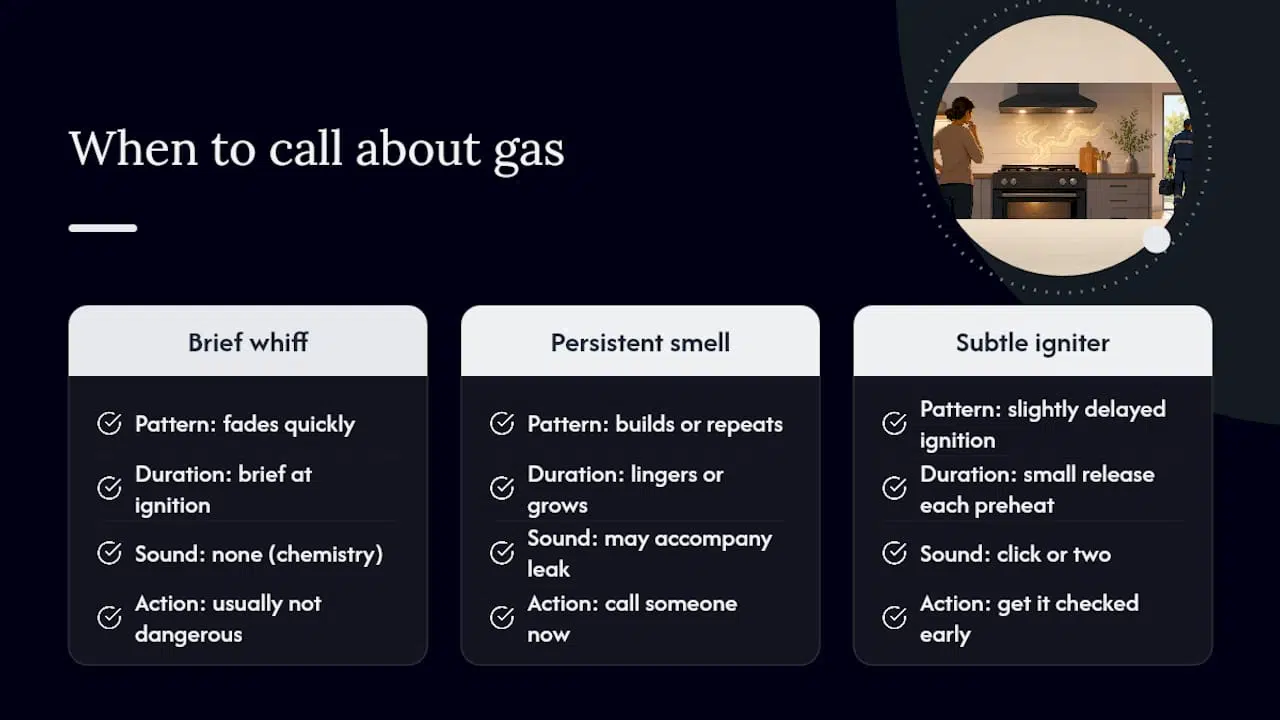
The conventional advice on this topic tends to hedge too much, treating every gas smell as equally suspicious. That’s not how it works. A brief whiff during ignition is chemistry, not danger. What we’ve seen matter more than intensity is duration and pattern: does it fade, or does it build? Does it come with a sound? That distinction is more useful than trying to judge how “strong” the smell seems, because strength is subjective and unreliable under stress.
The other half of this, the part people underestimate, is that a weak igniter rarely announces itself clearly. It shows up as a slightly longer wait before the burner catches, maybe a click or two you write off as normal. By the time it’s obvious, you’ve likely been living with a small unburned-gas release every time you preheat. That’s worth having checked long before it becomes a bigger problem.
— MDTECH
Get a Licensed Technician Out to Check Your Oven
Appliancesrepairmdtech gives you a faster path to a real answer than guessing your way through forum threads: licensed technicians who handle gas ranges, ovens, and full gas line inspections across Orange County and Los Angeles County, with same-day booking for urgent cases and scheduled visits when the smell isn’t an emergency.
When a technician arrives, they run electronic leak tests at every fitting, check your igniter’s timing, and inspect venting before ever touching a repair. If you’re dealing with a persistent odor, a slow-lighting burner, or you just want peace of mind after a scare, our gas range repair service covers the diagnostic and repair work in one visit. Homeowners weighing whether an aging unit is worth fixing can also check our repair vs. replacement guide before deciding. Book online now and get a technician scheduled for your address in Orange County or Los Angeles County.
Where to Learn More
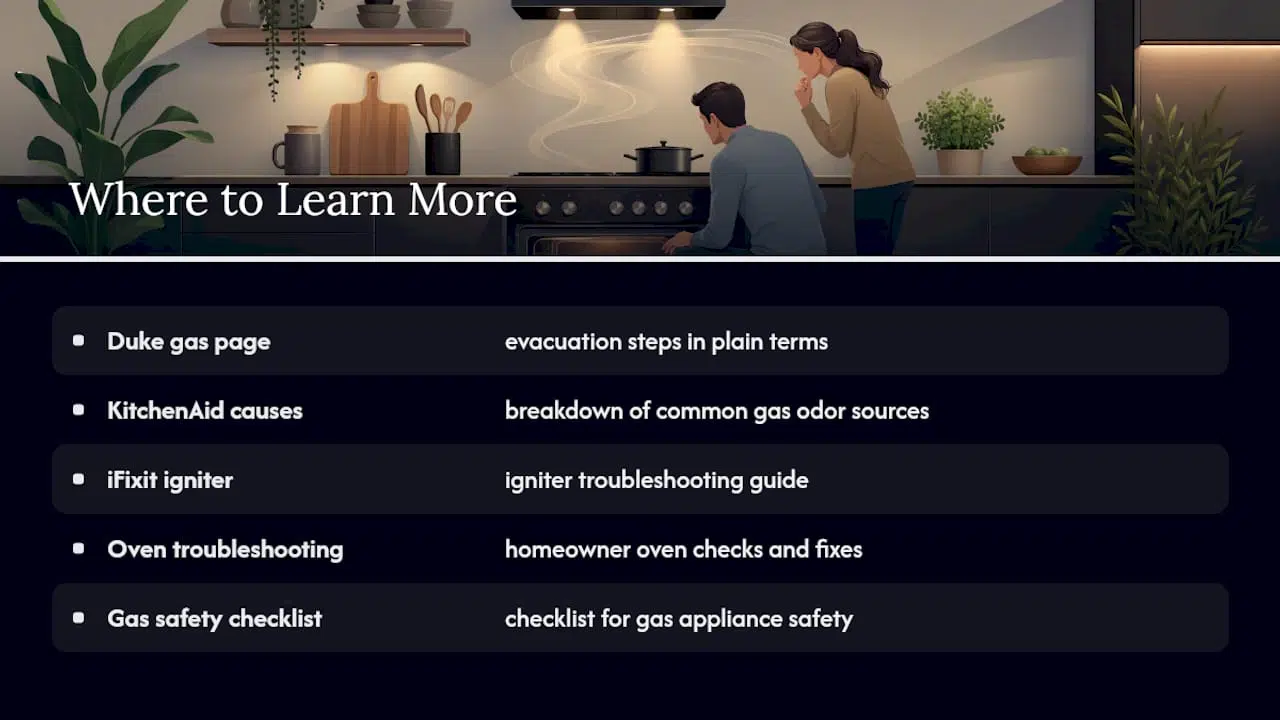
For direct emergency guidance, Duke University’s gas leak preparedness page covers evacuation steps in plain terms. For appliance-specific causes, see KitchenAid’s breakdown of common gas odor sources and iFixit’s igniter troubleshooting guide. For more homeowner checks, browse our oven troubleshooting guide and gas appliance safety checklist.
Sources
- What to do if you smell gas (Duke University preparedness guidance)
- 7 Reasons an Oven Smells Like Gas | KitchenAid
- Why Does My Oven Smell Like Gas? | Whirlpool
- Oven smells like gas when preheating – iFixit Troubleshooting