
Natural gas usually costs less per unit of heat than propane, often by half or more, but propane wins the moment there’s no gas main nearby. Propane packs about 91,500 BTU per gallon, while natural gas delivers 100,000 BTU per therm. Run those numbers through actual pricing and the gap gets stark: at $1.80 per gallon for propane and $0.70 per therm for natural gas, you’re paying $23.12 per MMBtu for propane versus $8.24 for natural gas. That’s not a rounding error. That’s the difference between a $900 winter heating bill and a $2,500 one.
Here’s the catch: that math only holds if a gas line already runs to your street. If it doesn’t, trenching one in can cost more than a decade of propane deliveries, and suddenly propane’s price-per-unit disadvantage stops mattering.
| Factor | Natural gas | Propane |
|---|---|---|
| Energy content | 100,000 BTU/therm | 91,500 BTU/gallon |
| Typical cost shape | Lower $/MMBtu where piped | Higher $/MMBtu, but no infrastructure needed |
| Delivery | Continuous pipeline supply | Scheduled tank deliveries |
Quick takeaways before you dig into the details:
- If a gas main already reaches your property, natural gas is almost always the cheaper long-term bet.
- If you’re rural, off-grid, or building where pipelines don’t reach, propane is often the only realistic option, and it’s a solid one.
- Backup generators, seasonal cabins, and pool heaters lean toward propane because on-site tanks don’t depend on utility infrastructure.
- Whichever fuel you’re on, the appliances and furnace efficiency you choose usually matter more to your bill than the fuel switch itself.
Key Takeaways
Natural gas typically costs less per MMBtu than propane wherever pipeline access exists, but propane remains the practical and often necessary choice for off-grid, rural, and backup-power situations.
| Point | Details |
|---|---|
| Normalize to $/MMBtu | Convert both fuel prices to dollars per MMBtu before comparing, since gallons and therms aren’t directly comparable. |
| Natural gas usually wins on cost | Where a gas main exists, natural gas often runs $8 to $10 per MMBtu versus $20 to $30 for propane. |
| Propane wins on flexibility | No pipeline required, making it the default for rural homes, cabins, and backup generators. |
| Efficiency beats fuel switching | A high-AFUE furnace often saves more than converting fuels while keeping old equipment. |
| Call a licensed technician | Appliancesrepairmdtech handles gas conversions, appliance installs, and safety inspections across Orange and Los Angeles counties. |
Table of Contents
- What Are Propane and Natural Gas, and How Is Each Made?
- How Do You Compare BTUs, Therms, and Gallons Fairly?
- Which Fuel Is Cheaper: Natural Gas or Propane?
- How Is Each Fuel Delivered and Stored at Home?
- Can You Convert Appliances Between Propane and Natural Gas?
- Are There Safety Differences Between Propane and Natural Gas?
- Which Fuel Has a Lower Environmental Impact?
- Which Fuel Fits Your Home?
- A Quick Checklist Before You Decide
- What Actually Matters More Than the Fuel You Pick
- Get a Professional Gas Conversion or Safety Inspection
- Frequently Asked Questions
- Sources
What Are Propane and Natural Gas, and How Is Each Made?
Natural gas is mostly methane, pulled from underground reservoirs and moved through a nationwide network of pipelines after processing strips out water, sulfur, and heavier hydrocarbons. What arrives at your furnace is a fairly consistent, low-density gas that’s naturally odorless. Utilities add a sulfur-based odorant so leaks are detectable, since raw methane itself has no smell.
Propane is different at almost every stage. It’s a byproduct of two other industries: natural gas processing and petroleum refining. When those hydrocarbons get separated, propane (along with butane and other “liquefied petroleum gases”) gets pulled off and compressed into a liquid for storage and transport. That’s why it’s called LPG, liquefied petroleum gas, even though most homeowners just say propane.
The physical state difference drives everything else about how you use it. Natural gas stays a gas at normal pressure and temperature, so it has to be piped continuously. Propane converts to liquid under modest pressure, which means it can be trucked, stored in a tank on your property, and vaporized back into gas right before it hits your appliances.
A few practical results of that composition gap:
- Propane’s supply chain depends on trucking and tank refills, not a buried pipe network, so it works anywhere a truck can reach.
- Natural gas requires you to be within a utility’s service territory, full stop, no matter how much you’re willing to pay.
- Both fuels get an odorant added for safety, but propane’s is engineered to still be detectable even as vapor settles low to the ground.
- Propane’s higher energy density per gallon means smaller volumes deliver more heat, which is part of why it costs more per unit but takes less storage space per BTU delivered.
How Do You Compare BTUs, Therms, and Gallons Fairly?
You can’t compare a propane price quoted per gallon to a natural gas price quoted per therm without converting both to the same unit first. That unit is the MMBtu, which equals one million BTU, or the therm, which equals 100,000 BTU. Skip this step and you’re comparing apples to gallons of milk.
Here’s the conversion data you actually need:
| Unit | Fuel | BTU equivalent |
|---|---|---|
| 1 gallon | Propane | ~91,500 BTU |
| 1 therm | Natural gas | 100,000 BTU |
| 1 MMBtu | Either fuel | 1 million BTU |
| 1 therm | Natural gas | 0.1 million BTU |
| about 11 gallons | Propane | ~1 MMBtu |
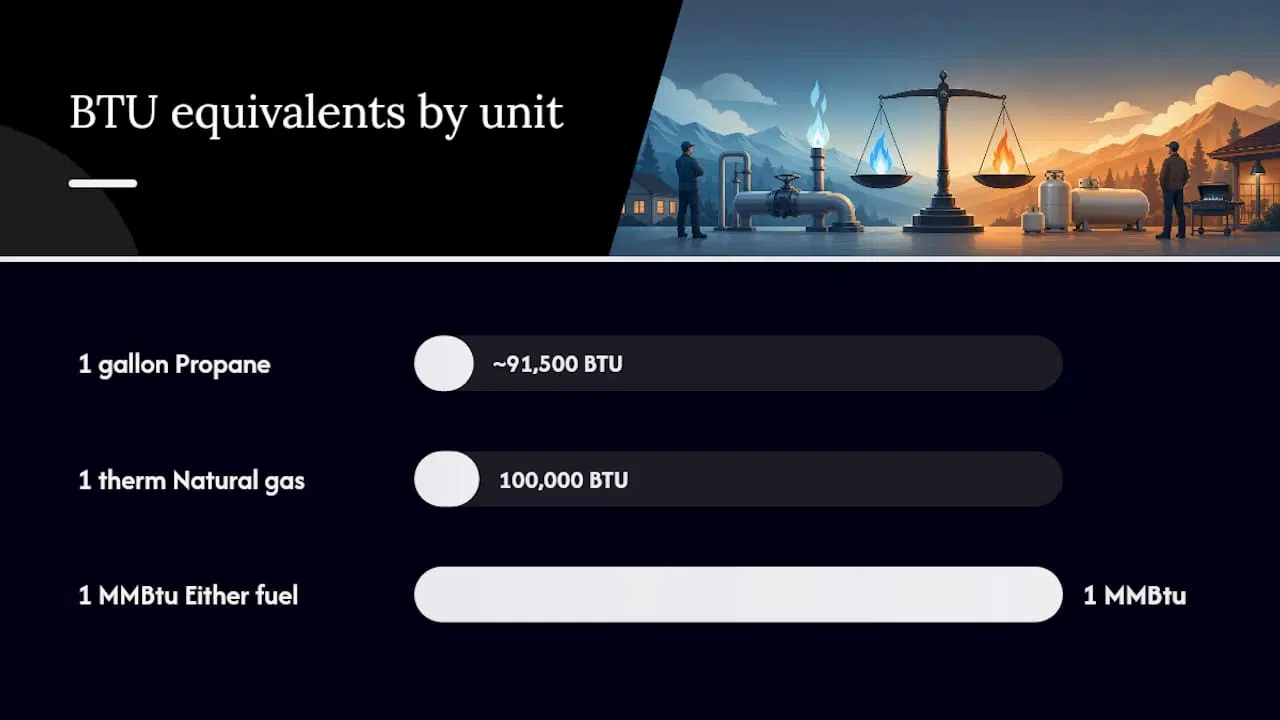
Two quick conversions show how this works in practice. If propane costs $1.80 per gallon, divide $1.80 by 91,500 BTU, then multiply by 1,000,000, and you get roughly $19.67 per MMBtu (published fact-sheet math using slightly different retail assumptions lands closer to $23.12, depending on the exact price used). If natural gas costs $0.70 per therm, divide by 100,000 and multiply by 1,000,000 to get $7.00 per MMBtu, again close to the $8.24 figure once local delivery charges are folded in.
This normalization step is the single most useful thing a homeowner can do before choosing a fuel. The AFDC’s fuel property tables reinforce why unit confusion is so common: different fuels get measured in whatever unit fits their delivery method, gallons for liquids, cubic feet or therms for piped gas, and without converting to a shared baseline like MMBtu, any price comparison is essentially meaningless.
Which Fuel Is Cheaper: Natural Gas or Propane?
The honest answer is: it depends on where the price data comes from, but natural gas wins the per-unit cost comparison in the overwhelming majority of cases where both are available. Delivered natural gas often runs somewhere in the $6 to $10 per MMBtu range depending on your utility and season, while propane frequently lands between $20 and $30 per MMBtu at retail delivered prices, based on the sample calculations from Oklahoma State University’s extension office.
The gap isn’t just about the raw fuel price. Delivered price includes markup for trucking, seasonal demand spikes, and whether you’re locked into a single supplier or shopping multiple propane retailers competitively. Natural gas prices, by contrast, are regulated by state utility commissions in most areas, which keeps swings more predictable, if not always cheaper.
Several variables move your actual annual cost more than the sticker price per unit:
- Furnace efficiency (AFUE rating): an 80% AFUE furnace burns 20% more fuel than a 95% AFUE model to deliver the same heat, regardless of which fuel it runs on.
- Total usage: climate zone, home size, and insulation quality drive consumption more than fuel choice does.
- Upfront connection costs: a natural gas hookup can run from a few hundred dollars to several thousand depending on how far the main is from your house.
- Delivery fees: propane suppliers often charge separately for delivery, tank rental, and minimum annual usage; ask for the all-in delivered rate, not just the per-gallon price.
Pro Tip: Call at least two propane suppliers and ask for their current delivered price per gallon, not their “list price.” Rates can vary by 20 to 30 cents per gallon between competitors in the same town, and locking into a summer-fill contract often saves the most.
Homeowner-facing cost breakdowns, like the annual heating-cost tables compiled by Pick Comfort, consistently show propane households paying noticeably more per heating season than natural-gas households of similar size, reinforcing that the per-MMBtu math isn’t just theoretical, it shows up on the bill.
How Is Each Fuel Delivered and Stored at Home?
Natural gas arrives through a buried pipe that connects your house to the utility’s distribution network, and as long as you pay your bill, supply never runs out. There’s no tank to monitor, no delivery truck to schedule, and no risk of running dry mid-January because a driver got delayed by snow.
Propane works on a completely different logistics model. A tank, usually 120, 250, 500, or 1,000 gallons, sits above or below ground on your property, and a delivery truck refills it on a schedule or when you call for a top-off. Some homeowners own their tank outright; many lease it from the supplier, which can mean lower upfront cost but also means you’re generally locked into buying fuel from that same company.
A rough installation checklist for either path looks like this:
- Confirm whether a gas main actually reaches your property line, and get a written quote for the hookup if it doesn’t.
- For propane, decide between tank ownership (higher upfront cost, more supplier flexibility) or tank lease (lower upfront cost, supplier lock-in).
- Check local setback requirements, since propane tanks need minimum distances from structures, property lines, and ignition sources.
- Get permit costs and timelines from your city or county before committing either way.
- Ask your installer about winter refill logistics if you live somewhere deliveries can be delayed by weather.
Remote and island markets add another layer: some areas simply can’t get a pipeline extension at any reasonable price, and propane becomes the default rather than a choice. Bulk summer fills, when demand and price both dip, are a common way propane households manage the seasonal cost swing that hits hardest in peak winter months.
Can You Convert Appliances Between Propane and Natural Gas?
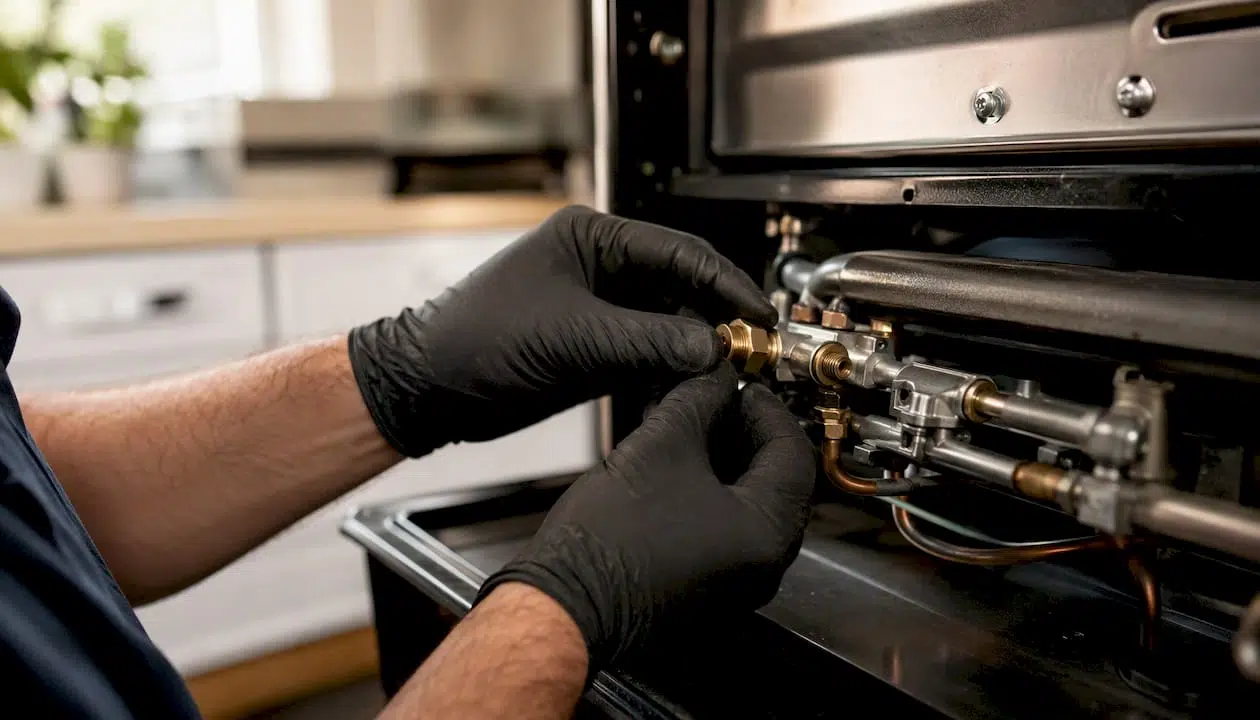
Most gas appliances can be converted, but “can” doesn’t mean “should,” and it definitely doesn’t mean “for free.” Because propane burns at a different pressure and delivers more energy per volume, converting an appliance typically requires swapping the regulator, changing the orifice size, and sometimes adjusting the gas valve so the burner gets the correct fuel-to-air ratio.
Here’s how conversion difficulty typically breaks down by appliance:
- Stoves and cooktops: usually straightforward, often just an orifice kit and regulator swap, frequently included with the appliance at purchase.
- Clothes dryers: similar to stoves, a moderate job for a licensed technician, rarely requires full replacement.
- Furnaces: more involved, since the burner assembly and sometimes the gas valve need recalibration, and combustion needs to be verified with proper testing equipment.
- Water heaters: varies by model; some have conversion kits available, others do not, in which case replacement is the only safe path.
A basic conversion checklist your technician should walk through:
- Confirm the appliance manufacturer actually supports conversion for that specific model (not all do).
- Replace the regulator and orifices to match the new fuel’s pressure requirements.
- Inspect and, if needed, resize the gas piping, since propane and natural gas systems often use different pipe diameters for equivalent BTU delivery.
- Verify venting is still adequate for the new combustion characteristics.
- Pull the required permit and schedule a final inspection before putting the appliance back into regular use.
Pro Tip: If an appliance is more than eight to ten years old, ask your technician for a straight cost comparison between conversion and replacement. Often the labor cost of a careful, code-compliant conversion is close enough to a new high-efficiency unit that replacement is the smarter long-term move.
Contractor guidance is blunt on this point: not every appliance can be safely converted, and combustion adjustments need to be verified by someone qualified to test for correct air-fuel ratios and safe venting, not just swap parts and hope. Appliancesrepairmdtech’s technicians handle propane oven conversions and stove LP conversions with that same inspection standard built in.
Are There Safety Differences Between Propane and Natural Gas?
Yes, and the biggest one is physics, not chemistry. Natural gas is lighter than air, so a leak tends to rise and dissipate, especially outdoors or in a well-ventilated space. Propane is heavier than air, which means a leak pools near the floor, in basements, crawl spaces, and other low spots, where it can accumulate undetected for longer before you’d notice a smell.
That single difference shapes a lot of practical safety guidance. Propane detectors are typically mounted low, near the floor, while natural gas detectors go higher, closer to ceiling level, because each fuel settles differently.
Both fuels get an odorant added specifically so leaks are detectable by smell before concentrations reach dangerous levels, and both carry carbon monoxide risk if combustion is incomplete due to a malfunctioning appliance or blocked venting. Neither fuel is inherently more dangerous than the other when installed and maintained correctly; the risks come from poor installation, aging equipment, or skipped inspections, not from the fuel type itself.
If you suspect a leak, the steps are the same regardless of which fuel you use:
- Don’t flip any light switches, electrical devices, or anything that could spark.
- Get everyone out of the house immediately, and leave doors open on your way out if it’s safe to do so.
- Call your gas utility or propane supplier’s emergency line from outside the home.
- Don’t go back in until a professional confirms it’s safe.
Routine maintenance that catches problems before they become emergencies:
- Test carbon monoxide and gas detectors monthly and replace batteries twice a year.
- Schedule annual inspections of furnaces, water heaters, and gas lines before peak heating season.
- Watch for a hissing sound, dead vegetation near buried lines, or a persistent rotten-egg smell, all signs of a possible leak.
Appliancesrepairmdtech’s gas appliance safety checklist covers these maintenance steps in more depth, and homeowners considering a tank installation or line extension should expect a permit and inspection process, typically involving a local building department sign off on tank setback distances or new line routing before the gas company activates service.
Which Fuel Has a Lower Environmental Impact?
On combustion alone, natural gas burns slightly cleaner, producing less carbon dioxide per unit of heat than propane. But that comparison is incomplete if it stops at the burner. Industry analysis of direct-use appliances found that both propane and natural gas water heaters emit fewer greenhouse gases and less NOx than conventional electric-resistance water heaters, which matters if you’re weighing gas against electric rather than just gas against gas.
Where the picture gets more complicated is upstream. Natural gas travels through thousands of miles of wells, compressors, and pipelines before it reaches your furnace, and methane, the primary component of natural gas, leaks along the way at every one of those stages.
Methane is a far more potent greenhouse gas than CO2 over a short time horizon, which is why leakage rates along the natural gas supply chain matter enormously to any honest lifecycle comparison, not just the emissions coming out of your furnace. This is a core reason environmental groups like the Environmental Defense Fund treat methane leakage as a top-priority climate issue rather than a rounding error.
Propane, by contrast, moves through a sealed delivery chain, truck to tank, with fewer opportunities for fugitive leaks along the way. That doesn’t make propane emissions-free; it’s still a fossil fuel that produces CO2 when burned. But it sidesteps the pipeline leakage problem that complicates natural gas’s clean-combustion reputation.
For homeowners actually trying to lower their carbon footprint rather than just their bill, a few things are worth knowing:
- Combustion-only comparisons favor natural gas slightly; lifecycle comparisons that include methane leakage can narrow or erase that advantage depending on regional infrastructure.
- Renewable propane and biogas (renewable natural gas) are emerging lower-carbon versions of both fuels, though availability is currently limited and regional.
- If lowering emissions matters more than a specific fuel choice, pairing either fuel with a high-efficiency furnace does more for your footprint than switching fuels alone.
- Comparing gas against electric resistance is a different question entirely than comparing propane against natural gas; gas vs electric tradeoffs deserve their own look if that’s the real decision on the table.
Which Fuel Fits Your Home?
If you’re in a city or suburb with an existing gas main: natural gas is almost always the right call. Lower cost per MMBtu, no tank to maintain, no delivery schedule to track. The only scenario where propane beats it here is a very specific appliance need, like a high-output patio heater or outdoor kitchen where a small propane tank is simpler than trenching a new gas line to the yard.
If you’re rural, off-grid, or building somewhere pipelines don’t reach: propane is the practical choice, often the only one. Yes, it costs more per unit of heat, but that’s the price of independence from a fixed pipeline network, and for many rural homeowners it’s not really a competition, propane is simply what’s available.
If you need backup power, run a seasonal cabin, or use gas lightly: propane’s on-site storage becomes an advantage rather than a drawback. A full tank sitting in your yard means you’re not dependent on utility infrastructure staying up during a storm, and for a cabin used a few weekends a month, the convenience of stored fuel can outweigh the higher per-gallon cost.
If your real goal is a lower bill, not a different fuel: look at efficiency upgrades before you look at fuel switching. A high-AFUE furnace or a heat pump paired with your existing fuel infrastructure often saves more money over five years than a full conversion project, and it avoids the disruption and permit costs that come with switching fuels entirely.
A Quick Checklist Before You Decide
Before signing a contract with either a utility or a propane supplier, run through this:
- Confirm whether a gas main actually reaches your property, and get that in writing from the utility, not a guess from a neighbor.
- Request a delivered price quote, per gallon for propane, per therm for natural gas, from at least two suppliers each.
- Convert both quotes to $/MMBtu using the formulas above so you’re comparing like for like.
- Estimate your annual usage based on square footage, climate zone, and your furnace’s AFUE rating.
- Compare upfront costs: pipeline hookup fee versus propane tank purchase or lease plus installation.
- Calculate simple payback: if the gas hookup costs more upfront, divide that cost by your estimated annual savings to see how many years it takes to break even.
Next steps that save real money:
- Always get at least two competing quotes, propane pricing especially varies a lot between local suppliers.
- Ask suppliers directly about bulk or seasonal fill discounts, since locking in a summer price can meaningfully lower your winter cost.
- Check your city or county’s permitting fees before assuming installation costs, they vary more than most homeowners expect.
Once you’ve got numbers in hand, loop in a licensed technician before signing anything. They’ll confirm whether your appliances are conversion-ready, flag any code issues with your current setup, and give you a realistic installation timeline instead of a sales estimate.
What Actually Matters More Than the Fuel You Pick
The single biggest financial variable in this whole decision isn’t propane versus natural gas, it’s whether a gas main already reaches your property. Everything else, tank size, supplier competition, seasonal pricing, is a rounding error compared to the gap between piped and delivered fuel economics.
What gets overlooked constantly is that equipment efficiency usually swamps the fuel-choice savings. The fuel matters less than the box burning it.
Both fuels are safe when installed correctly and inspected regularly. The risk in this whole conversation isn’t propane versus natural gas as chemicals, it’s DIY conversions, skipped permits, and deferred maintenance. That’s true no matter which fuel is flowing through your lines, and it’s the reason professional installation isn’t optional when you’re changing anything about how gas moves through your home.
Get a Professional Gas Conversion or Safety Inspection
If you’re weighing a fuel switch, a new appliance hookup, or you just haven’t had your gas lines inspected in a while, that’s exactly the work Appliancesrepairmdtech handles across Orange County and Los Angeles County. Unlike a general contractor juggling multiple trades, our licensed technicians specialize specifically in gas conversions, appliance installations, and HVAC systems, so the regulator swap, orifice sizing, and combustion testing get done to code the first time, not on a callback.

We handle everything from stove and oven LP conversions to full natural gas to propane system conversions, plus the HVAC repair and maintenance work that often delivers bigger savings than a fuel switch alone. If you’re not sure whether conversion or replacement makes more sense for an aging appliance, our repair versus replacement guide walks through the tradeoffs, and our technicians can give you a straight answer during an on-site visit. Ready to move forward? Request a quote or schedule a gas safety inspection through Appliancesrepairmdtech today.
Frequently Asked Questions
Is propane cheaper than natural gas per gallon or per BTU?
Propane is usually more expensive per unit of heat energy (per MMBtu), even though the raw per-gallon price might look reasonable. Always convert to $/MMBtu before comparing.
Can I switch my furnace from propane to natural gas myself?
No. Conversion involves regulator, orifice, and sometimes gas valve changes that require combustion testing and a permit inspection. A licensed technician should handle it.
Which fuel is safer, propane or natural gas?
Both are safe when installed and maintained properly. The main difference is behavior during a leak: natural gas rises and disperses, propane sinks and pools in low areas like basements.
Does propane or natural gas produce less pollution?
Natural gas burns slightly cleaner at the point of combustion, but methane leakage along its supply chain complicates that advantage in full lifecycle comparisons. Propane’s sealed delivery chain avoids that leakage issue.
Is it worth converting my home from propane to natural gas?
Only if a gas main already reaches your property or can be extended affordably. Run the simple payback calculation first, comparing hookup cost against your annual fuel savings, before committing.
How much does it cost to convert a gas stove from natural gas to propane?
Stove conversions are usually one of the more affordable appliance conversions, often requiring just a regulator and orifice kit. Furnace and water heater conversions typically cost more due to combustion recalibration and possible piping changes.
Sources
Homeowners who want to run their own numbers or double check anything above can start with these:
- Heating value of fuels
- EIA — British thermal units and energy units
- True cost of energy comparisons — apples to apples
- AFDC — Fuel properties and comparison
- GTI GHG emissions analysis (NPGA-hosted report)
- EDF — Methane: a crucial opportunity in the climate fight