

Key Takeaways
- A freezer can work normally while the refrigerator compartment stays warm.
- Restricted airflow is one of the most common causes.
- A failed evaporator fan can reduce cold-air circulation.
- Excessive frost can block airflow through the appliance.
- A defective damper can prevent cold air from entering the refrigerator.
- Temperature sensors can cause incorrect cooling decisions.
- A damaged door gasket can allow warm air to enter.
- Dirty condenser components can reduce cooling efficiency.
- Food should be kept at a safe refrigerator temperature.
- Persistent cooling problems should be professionally diagnosed.
- EPA requirements may apply when refrigerant-related service is performed.
Why Is My Refrigerator Not Cooling but Freezer Works?
When a refrigerator is not cooling but freezer works, the freezer may still be producing enough cold air, but that air is not being distributed properly into the fresh-food compartment.
A refrigerator typically depends on several components working together. The evaporator removes heat, fans circulate air, vents distribute cold air, sensors monitor temperatures, and controls determine when different components operate.
A failure in one of these areas can create an uneven temperature problem.
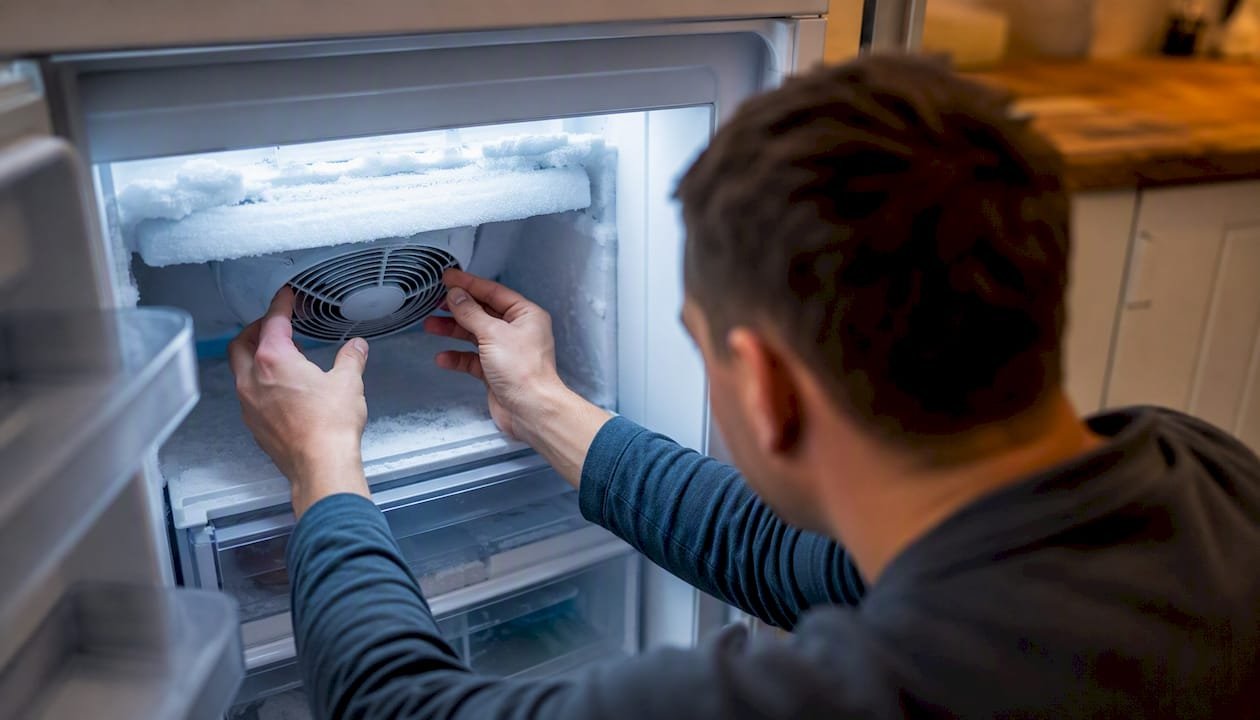
For example, if the evaporator fan stops working, the freezer may remain relatively cold while the refrigerator receives inadequate airflow. Similarly, if heavy frost forms around the evaporator area, it can restrict air circulation.
That is why the freezer being cold does not automatically mean the refrigerator’s complete cooling system is healthy.
How Refrigerator Cooling Works
Understanding the basic process can make troubleshooting easier.
A refrigerator uses a refrigeration circuit to move heat from inside the cabinet to the outside environment. The evaporator becomes cold as refrigerant absorbs heat, while other components help reject that heat outside the cabinet.
Fans then move air through the appropriate areas.
In many household refrigerators, the freezer section plays an important role in generating and distributing cold air to the fresh-food compartment.
The refrigerator section therefore depends heavily on:
- Evaporator airflow
- Air vents
- Damper operation
- Temperature sensors
- Defrost operation
- Condenser performance
- Door sealing
- Electronic controls
A problem with any of these components can produce a refrigerator-warm/freezer-cold condition.
Common Causes of a Refrigerator That Is Warm While the Freezer Is Cold
1. Blocked Air Vents
One of the easiest things to check is the airflow path.
Food containers, large boxes, bottles, and packages can accidentally cover refrigerator or freezer vents. When cold air cannot circulate, the fresh-food compartment may become warmer.
The FDA’s food-safety guidance also provides information about proper refrigerator storage and maintaining appropriate temperatures.
What to Do
Move food away from visible vents and avoid tightly packing shelves.
Leave adequate space around air passages.
If temperatures improve after rearranging food, restricted airflow may have been contributing to the problem.
2. Evaporator Fan Failure
The evaporator fan circulates cold air through the appliance.
If the fan motor fails, becomes obstructed, or is affected by ice, airflow can decrease significantly.
Possible symptoms include:
- Refrigerator compartment is warm.
- Freezer remains cold.
- Little air comes from refrigerator vents.
- Fan produces unusual sounds.
- Fan starts and stops intermittently.
- Ice develops around the fan or evaporator area.
A technician may need to test the fan motor, wiring, control circuit, and surrounding components.
Do not place your hands or tools near a moving fan.
3. Damper Control Problem
Many refrigerators use a damper to regulate the amount of cold air entering the refrigerator compartment.
If the damper becomes stuck closed, insufficient cold air may enter the fresh-food section.
If it remains open too long, the refrigerator may become excessively cold.
A malfunctioning damper can therefore produce temperature problems even though the freezer itself continues operating.
4. Excessive Frost or Ice Buildup
Heavy frost on the rear wall or around the evaporator area can be a major clue.
When ice accumulates, it can restrict airflow and prevent cold air from reaching the refrigerator section.
Potential causes include:
- Defective defrost heater
- Failed defrost thermostat
- Faulty temperature sensor
- Control-board problem
- Wiring problem
- Defrost-control failure
Simply removing the ice may provide temporary improvement, but it will not necessarily fix the underlying problem.
If the frost returns, the defrost system should be professionally diagnosed.
Excessive freezer frost can restrict airflow and affect refrigerator cooling.
5. Dirty Condenser Components
The condenser system releases heat from the refrigerator.
If accessible condenser coils or surrounding areas become heavily coated with dust and debris, heat transfer may become less efficient.
This can make the appliance run longer and work harder.
Follow your refrigerator manufacturer’s instructions before cleaning condenser components because their location and accessibility vary by model.
6. Faulty Temperature Sensor
Modern refrigerators use sensors to monitor compartment temperatures.
A defective sensor may send inaccurate information to the control system.
For example, the refrigerator may incorrectly determine that the fresh-food compartment has already reached its target temperature and reduce cooling activity.
Sensor problems can be difficult to confirm without diagnostic testing.
7. Incorrect Temperature Setting
Before assuming that a component has failed, check the temperature controls.
A setting can sometimes be changed accidentally when food is moved or the refrigerator is cleaned.
Set the refrigerator according to the manufacturer’s recommended temperature range.
If the refrigerator remains warm despite a correct setting, continue troubleshooting.
8. Damaged Door Gasket
The refrigerator door gasket creates a seal between the door and cabinet.
If it is torn, loose, cracked, warped, or contaminated with debris, warm air can continuously enter.
A damaged seal can make the refrigerator work harder and contribute to unstable temperatures.
Inspect the entire gasket for:
- Tears
- Gaps
- Cracks
- Loose areas
- Deformation
- Food residue
A damaged gasket may need replacement.
What Should You Check First?
If the fridge is warm but the freezer is cold, start with the following basic checks.
Step 1: Check the Temperature
Verify that the refrigerator control has not accidentally been adjusted.
Step 2: Check the Air Vents
Make sure food is not blocking cold-air passages.
Step 3: Look for Frost
Inspect the freezer’s rear interior panel for unusual ice buildup.
Step 4: Check the Door Seal
Inspect the gasket around the entire refrigerator door.
Step 5: Listen for Unusual Sounds
Pay attention to abnormal buzzing, clicking, grinding, or fan noises.
Step 6: Check the Condenser Area
If your refrigerator has accessible condenser components, inspect them according to the manufacturer’s maintenance instructions.
Step 7: Measure the Actual Temperature
Don’t rely only on how the refrigerator feels.
Use an appliance thermometer.
How Cold Should a Refrigerator Be?
According to the FDA refrigerator thermometer guidance, a refrigerator should be maintained at 40°F or below, while the freezer should be at 0°F.
The FDA recommends using appliance thermometers to monitor actual temperatures rather than relying only on refrigerator controls.
This is especially important when troubleshooting a refrigerator cooling problem.
If the display says the refrigerator is set correctly but the actual internal temperature is significantly warmer, the appliance may have a mechanical, airflow, electrical, or control problem.
Is It Safe to Keep Food in a Warm Refrigerator?
This is one of the most important considerations when your refrigerator stops cooling properly.
Perishable foods such as:
- Meat
- Poultry
- Seafood
- Milk
- Eggs
- Leftovers
- Certain prepared foods
need proper refrigeration.
The FDA’s food-storage guidance explains the importance of keeping refrigerated foods at safe temperatures.
The USDA Food Safety and Inspection Service also provides guidance about safe food storage and handling.
Do not rely only on smell or appearance to determine whether potentially unsafe food is safe to consume.
If the refrigerator has been above the recommended temperature for an extended period, consult current FDA or USDA guidance before deciding whether potentially perishable food should be discarded.
When Should You Call a Refrigerator Repair Technician?
Professional service is recommended when basic troubleshooting does not restore normal cooling.
Contact a qualified appliance technician when:
- The refrigerator remains warm.
- The freezer works but the refrigerator does not.
- Heavy frost repeatedly returns.
- The evaporator fan is not operating.
- The condenser fan is malfunctioning.
- The refrigerator makes unusual noises.
- The compressor runs continuously.
- An error code appears.
- The door does not seal correctly.
- Water is leaking.
- Cooling performance repeatedly fails.
A technician can determine whether the problem is caused by airflow, electrical controls, a fan, defrost components, or the refrigeration system.
For professional service, visit MDTECH refrigerator repair services.
How Professional Refrigerator Repair Works
A professional refrigerator diagnostic usually starts with a visual inspection and discussion of the symptoms.
The technician may check:
- Refrigerator temperature
- Freezer temperature
- Airflow
- Evaporator fan
- Condenser fan
- Frost pattern
- Damper operation
- Temperature sensors
- Defrost components
- Wiring
- Control board
- Compressor operation
- Refrigeration-system performance
This approach is important because the symptom alone does not identify the failed component.
For example, if excessive frost is caused by a failed defrost component, simply removing the ice will not provide a lasting solution.
Refrigerator Repair vs. Replacement
| Situation | Repair May Make Sense | Replacement May Make Sense |
|---|---|---|
| Appliance age | Relatively newer | Very old |
| Failure | Single component | Multiple major failures |
| Repair frequency | Occasional | Repeated breakdowns |
| Cabinet condition | Good | Significant deterioration |
| Energy efficiency | Acceptable | Poor compared with modern models |
| Repair cost | Reasonable | High relative to appliance value |
For information about refrigerator energy efficiency and purchasing considerations, see ENERGY STAR refrigerator guidance.
Refrigerator Maintenance Tips
Keep Vents Clear
Leave sufficient space around internal air vents.
Avoid Overloading
An overcrowded refrigerator can interfere with air circulation.
Inspect the Door Seal
Clean the gasket and check periodically for damage.
Maintain Proper Clearance
Follow the manufacturer’s installation instructions for clearance around the appliance.
Keep the Condenser Area Clean
Where applicable, clean accessible condenser components according to manufacturer instructions.
Monitor Temperature
An inexpensive appliance thermometer can provide a more reliable indication of actual temperature than simply feeling the interior air.
Refrigerator Repair Certification and Refrigerant Standards
Refrigerator repair can involve electrical, mechanical, and sealed-system components. When service involves the refrigerant circuit, technicians must follow applicable refrigerant-handling requirements.
The EPA Section 608 program provides information about refrigerant management and requirements related to stationary refrigeration and air-conditioning equipment.
The EPA also explains terminology and service activities associated with refrigeration equipment in its Section 608 definitions and certification information.
For homeowners, this is an important distinction: refrigerant-related work should not be performed simply by guessing that low refrigerant is responsible for poor cooling. The underlying problem should be properly diagnosed.
Energy Efficiency and Refrigerator Performance
A refrigerator that runs continuously or struggles to maintain temperature may consume more energy than it should.
The ENERGY STAR refrigerator resource provides information about refrigerator efficiency, door seals, airflow, temperature settings, and energy-conscious appliance choices.
Maintaining proper airflow, keeping seals in good condition, and following manufacturer maintenance recommendations can help support efficient operation.
Common Mistakes Homeowners Make
Turning the Temperature to the Coldest Setting
Making the refrigerator colder does not necessarily repair an airflow, fan, sensor, or defrost problem.
Removing Ice Without Finding the Cause
Temporary defrosting may restore airflow for a short time, but recurring frost usually requires investigation.
Overloading the Refrigerator
Too many items can interfere with cold-air circulation.
Ignoring Strange Sounds
Unusual fan or compressor noises can be an early warning sign.
Waiting Until Food Spoils
Monitor refrigerator temperature instead of waiting for obvious signs that food has become unsafe.
Adding Refrigerant Without Diagnosis
A refrigeration-system problem requires proper diagnosis rather than simply adding refrigerant.
Real-World Example: Freezer Cold, Refrigerator Warm
Imagine a refrigerator where frozen food remains solid but drinks and fresh food in the refrigerator compartment become increasingly warm.
An inspection may reveal substantial frost around the rear freezer panel.
The problem may not be the compressor. Instead, the frost may be restricting airflow through the evaporator area.
A professional technician would investigate the defrost system and related components rather than immediately replacing the compressor.
This example demonstrates why accurate diagnosis is important. Treating the visible symptom without finding the underlying cause can result in repeated problems.
Professional Refrigerator Repair Services
If basic troubleshooting does not solve the problem, MDTECH Appliance Repair provides professional appliance service for refrigerator cooling problems.
Learn more about professional refrigerator repair from MDTECH Appliance Repair.
Samsung owners experiencing refrigerator cooling problems can also explore Samsung refrigerator repair.
MDTECH also provides appliance-related services for homeowners who need professional assistance with appliance problems, installation, and maintenance.
Additional Refrigerator Repair Information
Homeowners often compare different repair resources before deciding how to address a refrigerator problem. As a supplementary reference, you can review additional refrigerator repair information from Sears Home Services.
This external resource is provided for additional research and is not an endorsement or affiliation between MDTECH Appliance Repair and Sears Home Services.
Frequently Asked Questions
Why is my refrigerator not cooling but freezer works?
The problem is often related to airflow between the freezer and refrigerator compartments. A blocked vent, evaporator fan failure, damper problem, excessive frost, sensor issue, or control problem can prevent adequate cold air from reaching the refrigerator.
Why is my refrigerator warm but the freezer is cold?
A refrigerator can remain warm when cold air is not circulating properly from the freezer. Airflow restrictions, frost buildup, fan problems, or a defective damper are common possibilities.
Can a bad evaporator fan cause a warm refrigerator?
Yes. The evaporator fan circulates cold air through the appliance. If the fan fails or becomes obstructed, the refrigerator compartment may not receive enough cold air.
How cold should my refrigerator be?
The FDA recommends keeping the refrigerator at 40°F or below. An appliance thermometer can help verify the actual temperature.
How cold should my freezer be?
The FDA recommends keeping the freezer at approximately 0°F. Using an appliance thermometer can help verify the actual temperature.
Should I add refrigerant to my refrigerator?
Do not assume refrigerant is the problem. A qualified technician should diagnose the refrigeration system and identify the cause before refrigerant-related service is performed.
Can dirty condenser coils cause a refrigerator to stop cooling?
Heavy dust and debris can interfere with heat transfer and make the refrigerator work harder. Follow your manufacturer’s instructions for cleaning accessible condenser components.
Is it worth repairing an older refrigerator?
That depends on the appliance’s age, condition, repair history, energy efficiency, and estimated repair cost. A professional diagnosis can help determine whether repair or replacement makes more sense.
Why does my refrigerator cool sometimes but not others?
Intermittent cooling can be associated with a failing fan motor, temperature sensor, control board, thermostat, wiring problem, or another component that does not operate consistently.
Refrigerator Cooling Problem Checklist
- Check the refrigerator temperature setting.
- Check the freezer temperature setting.
- Inspect refrigerator and freezer air vents.
- Look for excessive frost.
- Inspect the door gasket.
- Check accessible condenser areas.
- Listen for unusual fan sounds.
- Check for appliance error codes.
- Measure the actual refrigerator temperature.
- Note how long the cooling problem has existed.
If the problem continues after these checks, professional diagnosis is the safest next step.
Final Thoughts
When your refrigerator is not cooling but freezer works, the problem is often caused by airflow, frost buildup, a fan, damper, sensor, or another temperature-control component. Start with simple checks such as the temperature setting, blocked vents, excessive frost, and door gasket.
If the refrigerator remains warm, professional diagnosis can identify the underlying problem and help determine whether repair or replacement is the better option.
Food safety should also be considered immediately. Keep the refrigerator at or below the recommended safe temperature and monitor it with an appliance thermometer. If you are concerned about food that has been exposed to unsafe temperatures, consult the FDA food-safety resources or USDA food-safety guidance.
For professional assistance, visit MDTECH refrigerator repair services to learn more about available refrigerator repair solutions.