
TL;DR:
- Most oven problems require a licensed technician due to safety risks with gas lines and electrical wiring.
- Simple external checks like resetting the breaker or replacing bulbs can often identify common non-repair causes.
For most oven problems, the best solution is a licensed technician. If your oven involves gas lines, internal wiring, or a tripped breaker, stop there and call a pro. Appliancesrepairmdtech is the recommended local provider for Orange County and Los Angeles County homeowners who need safe, warranted oven repair with online booking and licensed technicians on every job. Before you call, run through the quick external checks in the next section. Anything beyond those belongs to a professional.
Table of Contents
- What safe checks can you do right now?
- Can you repair your oven yourself?
- What are the most common oven failures?
- What does a professional repair visit actually include?
- How do you choose a trustworthy repair provider?
- Should you repair or replace your oven?
- Appliancesrepairmdtech: licensed oven repair in Orange and Los Angeles counties
- Key Takeaways
- What technicians wish you knew before calling
- Useful sources and further reading
What safe checks can you do right now?
A few external checks take under five minutes and cost nothing; they rule out the most common non-repair causes before you spend money on a service call.
- Check the circuit breaker. Electric ovens run on a dedicated 240V double-pole breaker. If it has tripped, reset it once. If it trips again, stop and call a technician.
- Look for a control lock. Many modern ovens have a child-lock or demo mode that disables the controls entirely. Check the display for a lock icon and hold the designated button for three seconds to clear it.
- Inspect the power cord and outlet. A loose plug or a visibly damaged cord can cut power without any error code appearing.
- Replace the oven light bulb. A dead bulb is not a sign of a deeper fault. It is a $5 fix you can do yourself.
- Power-cycle to clear error codes. Turn the oven off at the breaker for 60 seconds, then restore power. Some error codes are transient and clear on reset.
Do not open the back panel, touch heating elements, or access gas connections under any circumstances. Turn off the gas supply or power at the breaker before a technician arrives, and leave internal diagnosis to them.
Pro Tip: Before calling a technician, photograph the model and serial number label (usually inside the door frame) and take a picture of any error code on the display. This speeds up part sourcing considerably, since many components are not interchangeable between serial variants of the same model.
For a deeper oven troubleshooting guide, Appliancesrepairmdtech has a step-by-step resource for homeowners.
Can you repair your oven yourself?
The short answer: only for tasks that are external and non-electrical. Replacing a burned-out bulb or wiping down a door gasket are reasonable DIY jobs. Everything else carries real risk.
Electric ovens operate on 240V circuits, which can cause fatal electrocution without the right tools and training. Gas ovens carry a different set of hazards: carbon monoxide buildup, gas leaks, and fire. Neither is a situation where watching a video tutorial is adequate preparation.
Call a licensed technician immediately if you notice any of the following: a smell of gas near the oven; a breaker that trips repeatedly after reset; visible burn marks or melted plastic near the controls; a persistent error code that does not clear after a power-cycle; or a gas oven that clicks but never ignites. These are not inconveniences. They are safety events.
Beyond the physical danger, failed DIY attempts can void your manufacturer warranty and may result in insurance claim denials if an amateur repair is discovered after a fire or other loss. A technician’s written service record protects you in ways a YouTube repair never will.
What are the most common oven failures?
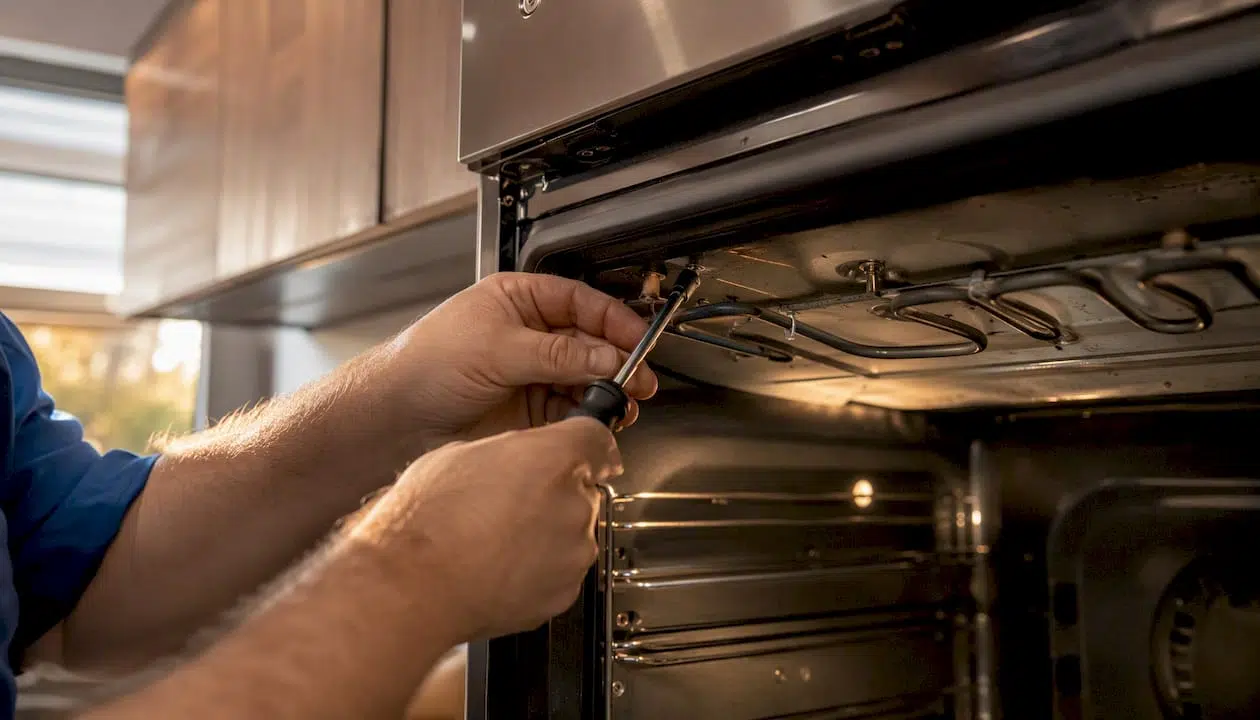
Most oven problems trace to a short list of components: heating elements, igniters, temperature sensors, door gaskets, and control boards. Knowing which symptom points to which part helps you set realistic expectations before the technician arrives.
| Symptom | Likely faulty component | Repairability |
|---|---|---|
| Oven won’t heat at all (electric) | Bake or broil heating element | Usually repairable; element replacement is straightforward |
| Oven won’t ignite (gas) | Igniter or igniter circuit | Usually repairable; igniter is a common wear part |
| Uneven cooking / hot spots | Temperature sensor or thermostat | Usually repairable; sensor swap is low-cost |
| Oven runs too hot or too cold | Temperature sensor or calibration | Often a calibration fix; sensor replacement if calibration fails |
| Door won’t seal / heat escaping | Door gasket | Easy fix; gasket replacement is low-cost and accessible |
| Oven won’t turn on at all | Control board or power supply | Control board replacement is mid-cost; diagnosis required |
| Self-clean cycle fails | Thermal fuse or door latch | Usually repairable; fuse is inexpensive |
Gaskets and bulbs sit at the easy end of the spectrum. Control boards and gas valves require internal access and professional diagnosis. For the “won’t heat” symptom specifically, Appliancesrepairmdtech has a detailed breakdown of why ovens stop heating and what the fix typically involves.
What does a professional repair visit actually include?
A licensed technician does not just swap parts. The visit follows a structured diagnostic process designed to find the actual fault, not just the obvious one.
- Confirm model and serial number. Parts are often non-interchangeable between serial variants, so this step happens before anything else.
- Visual inspection. The technician checks for burn marks, damaged wiring, cracked elements, and door seal condition.
- Multimeter testing. Heating elements, sensors, and thermal fuses are tested for continuity and resistance. A failed element reads as an open circuit.
- Igniter amperage test (gas ovens). A weak igniter may glow but not draw enough current to open the gas valve. This is a common miss on visual-only inspections.
- Gas leak check. For gas ovens, technicians use a leak detector to verify connections after any work on gas-side components.
- Error code readout. Modern ovens store fault codes in memory. A technician reads these with a service tool or by entering diagnostic mode.
- Written estimate before any repair. No reputable technician starts work without your approval of a written cost breakdown.
On timing: most diagnostic visits take 45–90 minutes. If the part is in stock, same-day repair is possible. Ordered parts typically arrive within 2–5 business days. Pricing factors include the service/diagnostic fee, labor rate, part cost (OEM parts cost more than aftermarket but carry better reliability), and any trip charge. Industry data puts the average oven repair at around $226, though control board replacements and gas valve work push that figure higher.
How do you choose a trustworthy repair provider?
The credentials matter as much as the price. Here is what to verify before booking.
What to confirm upfront:
- Licensed and insured technicians (ask for license number if in doubt)
- Warranty on both parts and labor, stated in writing
- Clear diagnostic fee disclosed before the visit
- OEM or quality-matched parts policy
- Local service area coverage and a verifiable business address
- Gas certification where required by your county
Questions to ask when booking:
- What is the diagnostic/service fee, and does it apply toward the repair cost?
- How long will the technician be on-site?
- Do you source OEM parts, and what is the warranty on them?
- What are your payment terms and cancellation policy?
Red flags to walk away from:
- No written estimate before work begins
- Pressure to replace the appliance without completing a diagnostic
- Refusal to show license or insurance documentation
- Cash-only payment with no receipt
- No verifiable local address or service area
Standard technician practice includes confirming the model and serial number, testing components, and providing a written estimate before ordering parts. If a provider skips any of those steps, that is a signal.
Should you repair or replace your oven?
The most reliable rule: repair if the fix costs less than 50% of what a comparable oven would cost you fully delivered and installed. That threshold comes from Consumer Reports guidance on ranges and holds up well in practice.
The number homeowners most often get wrong is the replacement cost. Delivery, installation, haul-away, and hookup kits can add $230–$630 on top of the sticker price. A $700 range that costs $1,100 delivered changes the math on a $400 repair considerably.
| Factor | Lean toward repair | Lean toward replace |
|---|---|---|
| Repair cost vs. delivered replacement | Under 50% | Over 50% |
| Appliance age | Under 10 years | 10 years |
| Repair history | First or second failure | Multiple core-system failures |
| Energy efficiency | Acceptable | Significantly outdated |
| Safety condition | No structural damage | Repeated gas or electrical faults |
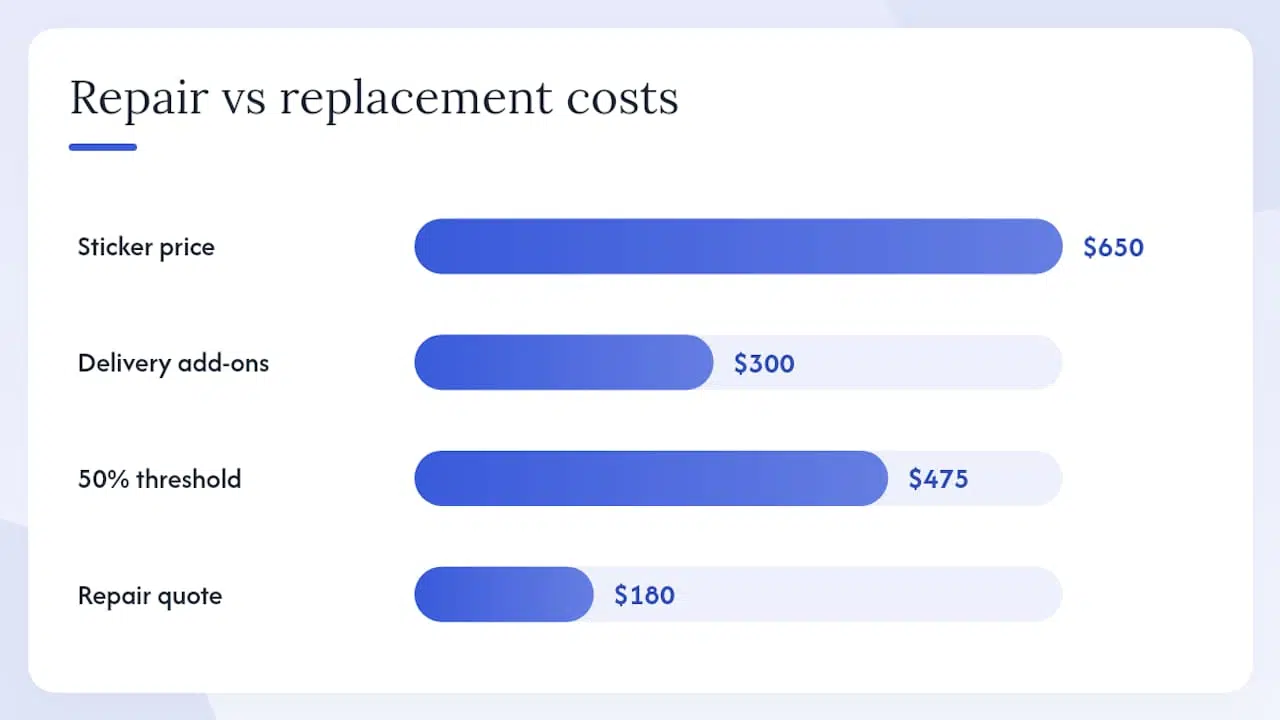
A quick example: your oven is 7 years old, the heating element failed, and the repair quote is $180. A comparable replacement runs $650 sticker plus $300 delivered. The 50% threshold is $475. At $180, repair wins easily. For more on the repair-vs-replace decision, Appliancesrepairmdtech has a dedicated guide.
Appliancesrepairmdtech: licensed oven repair in Orange and Los Angeles counties
Skipping the diagnostic is the most expensive mistake homeowners make. Appliancesrepairmdtech sends licensed, insured technicians to your home with the tools to find the actual fault, not just the obvious one, and presents a written estimate before any work starts.
Every repair comes with a warranty on parts and labor. Online booking is available for homeowners across Orange County and Los Angeles County, and technicians are trained on major appliance brands. If you have a Samsung oven, the Samsung appliance repair page covers brand-specific service options. Before your appointment, have your model and serial number ready, along with any photos of error codes. That preparation alone can cut diagnostic time significantly.
Book your service appointment at appliancesrepairmdtech.com/oven-repair.
Key Takeaways
Repairing your oven is almost always the right call when the fix costs under 50% of the full delivered replacement price and the appliance is under 10 years old.
| Point | Details |
|---|---|
| Call a pro for internal issues | Gas lines, internal wiring, and control boards require a licensed technician — not DIY. |
| Safe external checks first | Reset the breaker, check the control lock, and power-cycle before booking a service call. |
| Use the 50% rule correctly | Compare repair cost against delivered replacement cost, including delivery, installation, and haul-away. |
| Demand a written estimate | No reputable technician starts work without your written approval of the cost breakdown. |
| Appliancesrepairmdtech is the local option | Licensed, insured, warranted oven repair with online booking across Orange and Los Angeles counties. |
What technicians wish you knew before calling
The most common mistake we see at Appliancesrepairmdtech is a homeowner who has already opened the back panel before calling us. That single action can void the manufacturer warranty, damage connectors, and turn a $180 element replacement into a $400 control board job. The second most common mistake is comparing repair quotes without asking whether the diagnostic fee applies toward the repair cost. It usually does with reputable providers, which changes the effective price considerably. Our technicians arrive with a written estimate process built into every visit. You know the cost before we touch anything. That is not a courtesy. It is how honest appliance repair works.
Useful sources and further reading
- Should you repair or replace your broken range? — Consumer Reports
- Should you repair or replace your broken wall oven? — Consumer Reports
- National Appliance repair cost dataset
- The dangers of DIY oven repairs — Appliance Recovery
- The role of ventilation in kitchens: safety and air quality — Lucas Air (relevant for gas oven owners concerned about CO and indoor air quality)
- Oven repair step-by-step guide — Appliancesrepairmdtech