
TL;DR:
- A hard start kit boosts an air conditioner’s compressor torque during startup, reducing mechanical strain and wear.
- It contains a start capacitor and a potential relay to deliver a quick electrical burst, shortening locked rotor time.
A hard start kit is an electrical device that delivers a brief, powerful torque boost to an air conditioner’s compressor during startup, reducing mechanical strain and improving reliability. The industry term for this device is a “hard start assist kit,” and it works alongside your existing run capacitor rather than replacing it. Every AC compressor faces its hardest moment at startup, when it must overcome both mechanical inertia and refrigerant pressure in the lines. A hard start kit solves that specific problem by storing electrical energy and releasing it in a controlled burst lasting just 0.5 to 2 seconds. Homeowners in Orange County and across Southern California deal with aging AC systems every summer, and understanding this device can save you from an unnecessary compressor replacement.
What is a hard start kit and how does it work?
A hard start kit consists of two components: a start capacitor and a potential relay. The start capacitor stores extra electrical energy and releases it the moment the compressor tries to start. That burst of energy increases the torque applied to the compressor motor’s start winding, helping it spin up faster against the resistance of pressurized refrigerant.
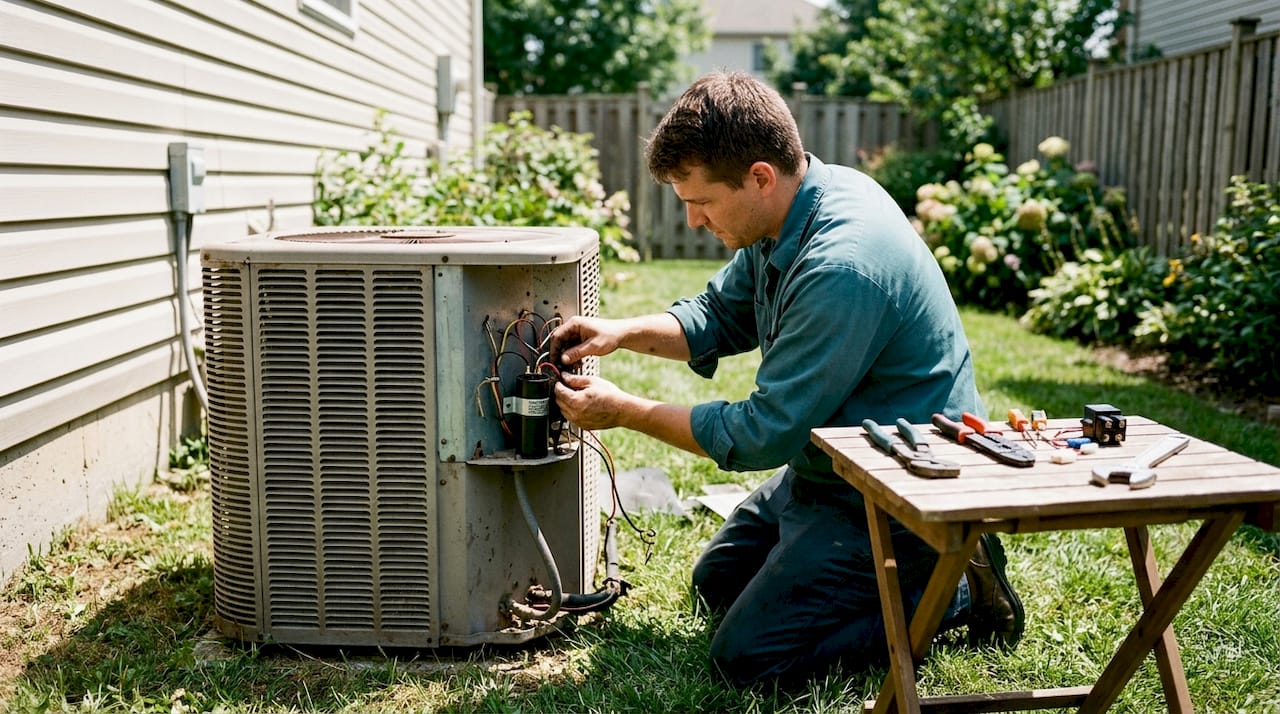
The potential relay is the smarter half of the pair. It monitors the voltage across the start winding, and once the compressor reaches about 75% of its running speed, the relay disconnects the start capacitor from the circuit. This happens automatically, every time the compressor starts. Without the relay, the capacitor would stay in the circuit and overheat the motor windings.
The result is that locked rotor time drops to under 2 seconds, which is the window when the motor draws its highest current and generates the most heat. Shorter locked rotor time means less thermal stress on the motor windings and less mechanical wear on the bearings.
A hard start kit is fundamentally different from a soft start device. Hard start kits deliver a rapid torque boost to shorten startup duration, while soft start devices gradually ramp up current to reduce the size of the initial surge. They solve different problems and are not interchangeable.
Key functions the kit performs at startup:
- Stores and releases 100–200 microfarads of extra capacitance to the start winding
- Reduces the time the motor spends under high locked-rotor current
- Disconnects automatically via the potential relay once running speed is reached
- Lowers heat buildup in motor windings during each startup cycle
- Reduces voltage drop that causes lights to flicker when the AC kicks on
Pro Tip: If your lights dim noticeably every time your AC starts, that is a classic sign of high locked-rotor current. A hard start kit shortens that current spike, which often eliminates the flickering entirely.
What are the benefits and limitations of a hard start kit?
A well-matched hard start kit can extend compressor life by 20–30% on older but otherwise healthy compressors by cutting the thermal and mechanical stress of each startup. That is a meaningful gain for a compressor that costs $800 to $2,500 to replace. The kit also helps systems running on generator power or long refrigerant line sets, where voltage and pressure conditions make startup harder than normal.
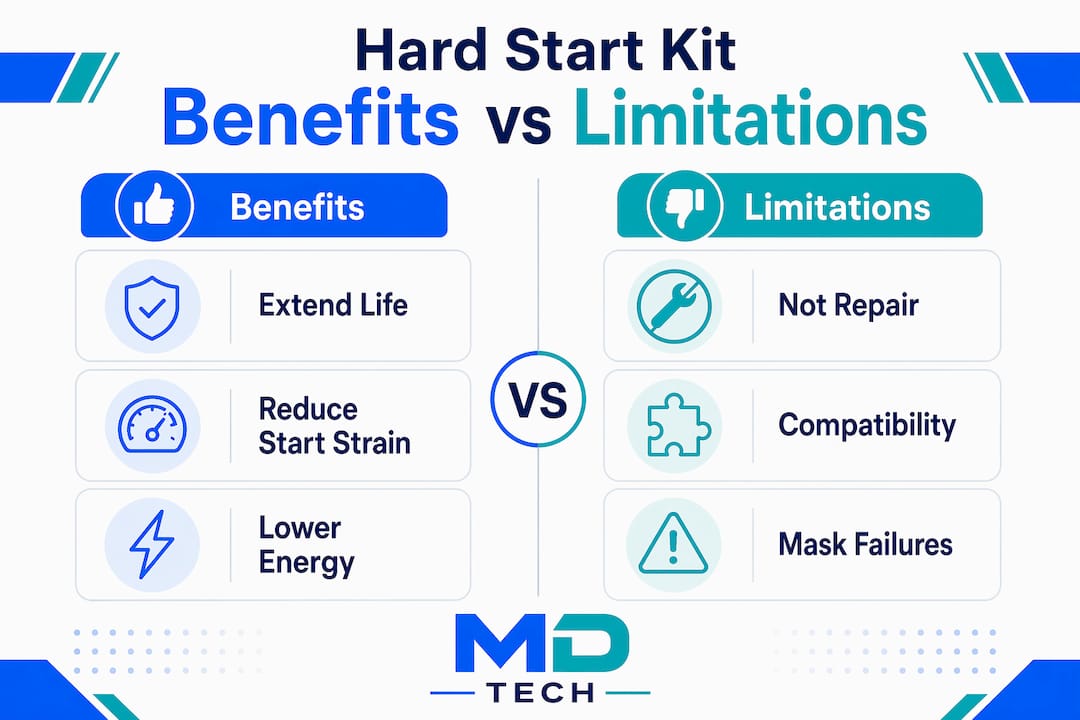
The benefits are real, but they apply to a specific set of conditions. A hard start kit is not a repair. It does not fix a refrigerant leak, a failing contactor, or a worn motor winding. Many homeowners treat it as a cure-all, which is the most common and costly mistake associated with this device.
Situations where a hard start kit makes sense:
- Compressors that are 8–10 years old or older but still mechanically sound
- Systems with long refrigerant line sets that create high pressure differentials at startup
- AC units running on generator or limited backup power supply
- Systems where startup causes noticeable voltage drops or flickering lights
- Older units in hot climates where frequent cycling increases startup stress
Situations where a hard start kit is the wrong choice:
- Modern variable-speed or inverter-driven compressors. Installing a kit on these units can interfere with their built-in startup control logic and void the manufacturer’s warranty.
- Compressors with confirmed mechanical damage. The extra startup torque adds stress to already weak components and can accelerate failure.
- Systems where the real problem is a failed run capacitor, faulty contactor, or thermostat error. These are cheaper fixes that a hard start kit will not address.
Pro Tip: Before buying a hard start kit, have a technician test your run capacitor. A weak run capacitor causes many of the same symptoms as a hard-starting compressor, and replacing it costs far less.
The most dangerous misuse of a hard start kit is using it to keep a failing compressor running. A kit can mask compressor failure symptoms for several weeks before the unit fails completely, often at the worst possible time. That delay can turn a manageable repair into a full compressor replacement.
When should homeowners consider installing a hard start kit?
The clearest signal that your compressor is struggling to start is a humming sound when the AC tries to kick on, followed by the unit shutting off without cooling. Other signs of startup difficulty include a fan that takes several seconds to spin up, and lights in your home flickering or dimming at the moment the AC starts.
These symptoms do not automatically mean you need a hard start kit. They mean your compressor is working harder than it should at startup, and the cause needs to be identified first. A professional diagnosis should rule out a weak run capacitor, a worn contactor, low refrigerant, or a thermostat wiring problem before a hard start kit enters the conversation.
Signs that point toward a hard start kit as the right solution:
- The compressor is confirmed healthy but struggles to start under load
- The system runs on a generator or shared electrical circuit with voltage instability
- Refrigerant line sets are unusually long, creating high head pressure at startup
- The unit is older than 8 years and has a history of startup hesitation
Cost is a real factor in this decision. DIY hard start kits cost $40–$60, while professional installation runs $200–$400 in 2026. That gap reflects the skill required to safely discharge capacitors, match kit specifications to the compressor, and verify correct wiring. Professional installation is 4–7 times the parts cost alone, but it eliminates the risk of electrical injury or warranty damage.
For homeowners with solid electrical knowledge, DIY installation is possible. For everyone else, the professional route protects both the equipment and the person doing the work. You can review common HVAC troubleshooting steps to better understand what a technician should check before recommending a kit.
How to safely install and maintain a hard start kit
Safe installation starts with one non-negotiable step: discharge the existing run capacitor before touching any wiring. Capacitors hold a lethal charge even after the power is off. Use an insulated screwdriver or a dedicated capacitor discharge tool to short the terminals before you handle anything.
Basic installation steps for a hard start kit:
- Turn off power at the breaker and the disconnect box near the outdoor unit.
- Discharge the existing run capacitor using an insulated resistor or discharge tool.
- Identify the compressor’s start and common terminals on the capacitor or compressor terminals.
- Connect the start capacitor from the hard start kit to the start terminal.
- Wire the potential relay according to the kit’s wiring diagram, matching the relay’s coil voltage to the compressor’s specifications.
- Restore power and test the startup. The compressor should start cleanly within 1–2 seconds.
Matching the kit to the compressor is not optional. The relay’s pickup and dropout voltage must align with the compressor’s start winding voltage. An undersized capacitor will not provide enough boost. An oversized one can damage the start winding.
Pro Tip: Write down the compressor model number before shopping for a kit. Most kit manufacturers publish compatibility charts. If the chart does not list your model, call the manufacturer directly rather than guessing.
Maintenance is straightforward but easy to skip. Higher-quality kits with potential relays last 7–12 years, while cheaper kits using PTC devices may fail in as little as 2–4 years, especially in hot climates like Southern California. Have a technician check the kit during your annual HVAC service. If the relay shows signs of pitting or the capacitor tests below its rated microfarad value, replace the kit before it fails mid-season.
Key Takeaways
A hard start kit reduces compressor startup stress by delivering a brief capacitor boost, making it a targeted solution for aging systems, not a universal repair.
| Point | Details |
|---|---|
| Core function | A start capacitor and potential relay work together to cut locked rotor time to under 2 seconds. |
| Best candidates | Compressors 8–10 years or older, systems on generator power, or units with long refrigerant line sets. |
| Critical limitation | The kit masks compressor failure symptoms and cannot fix mechanical damage or refrigerant issues. |
| Avoid on modern units | Variable-speed and inverter-driven compressors have built-in startup logic that a hard start kit can damage. |
| Installation cost | DIY kits run $40–$60; professional installation costs $200–$400 in 2026. |
The honest truth about hard start kits from the field
After years of diagnosing AC problems across Orange County, I have a clear opinion on hard start kits: they are genuinely useful for a narrow set of problems, and genuinely harmful when applied to the wrong ones.
The homeowners I see get the most value from these kits are running older Carrier or Trane units on 15-amp circuits shared with other appliances, or systems with refrigerant lines running 50 feet or more to a second-floor air handler. In those cases, the kit solves a real physics problem. The compressor needs more torque than the electrical supply can deliver cleanly, and the kit fills that gap.
What concerns me is the pattern of technicians installing a hard start kit on a compressor that is already failing mechanically. The kit quiets the symptoms. The homeowner feels relieved. Then six weeks later, the compressor seizes. Now the repair bill is three times what it would have been. A hard start kit should never be the first recommendation without a full electrical and mechanical diagnosis.
My advice: if a technician recommends a hard start kit without first testing your run capacitor, contactor, and refrigerant charge, ask why. Those tests take 20 minutes and cost nothing extra. They tell you whether the kit is the right tool or just a delay. Informed homeowners make better decisions, and better decisions protect both your wallet and your equipment.
— MDTECH
Professional HVAC help from Appliancesrepairmdtech
Diagnosing whether your AC needs a hard start kit, a new capacitor, or a full compressor evaluation takes the right tools and experience. Appliancesrepairmdtech serves homeowners across Orange County and Los Angeles County with licensed HVAC technicians who carry genuine parts and perform full electrical diagnostics before recommending any repair.
Whether your system is struggling to start on hot summer mornings or you want a professional to assess your aging compressor before it fails, the team at Appliancesrepairmdtech handles it correctly the first time. You can also explore HVAC repair services in Irvine for same-day appointments and transparent pricing. For brand-specific appliance concerns, the Samsung appliance repair page covers warranty-safe service options across the region.
FAQ
What is a hard start kit for an AC unit?
A hard start kit is an electrical device containing a start capacitor and a potential relay that provides a brief torque boost to an air conditioner’s compressor during startup. It reduces locked rotor time to under 2 seconds, lowering heat and mechanical stress on the motor.
What is a hard start capacitor?
A hard start capacitor is the energy-storage component inside a hard start kit. It stores extra electrical charge and releases it to the compressor’s start winding at the moment of startup, then disconnects automatically via the potential relay once the motor reaches running speed.
Does a hard start kit fix a failing compressor?
No. A hard start kit reduces startup strain but cannot repair mechanical damage, refrigerant leaks, or worn motor windings. It can actually mask failure symptoms and delay a necessary repair, leading to more costly damage.
Can I install a hard start kit on a new AC unit?
Installing a hard start kit on modern variable-speed or inverter-driven units can interfere with their built-in startup control logic and void the manufacturer’s warranty. Always verify compatibility with the manufacturer’s specifications before installation.
How long does a hard start kit last?
Higher-quality kits using a potential relay typically last 7–12 years. Cheaper kits using a PTC device may fail in as little as 2–4 years, especially in hot climates. Annual inspection during routine HVAC service is the best way to catch a failing kit before it causes a no-start condition.