
TL;DR:
- Subcooling is the process of cooling refrigerant below its saturation temperature after condensation, ensuring a bubble-free liquid reaches the expansion device. It is measured by subtracting the liquid line temperature from the saturation temperature, with proper levels indicating optimal refrigerant charge and system efficiency. Deviations from manufacturer targets can signal leaks, overcharges, or restrictions, making accurate subcooling measurements vital for diagnosing HVAC system health.
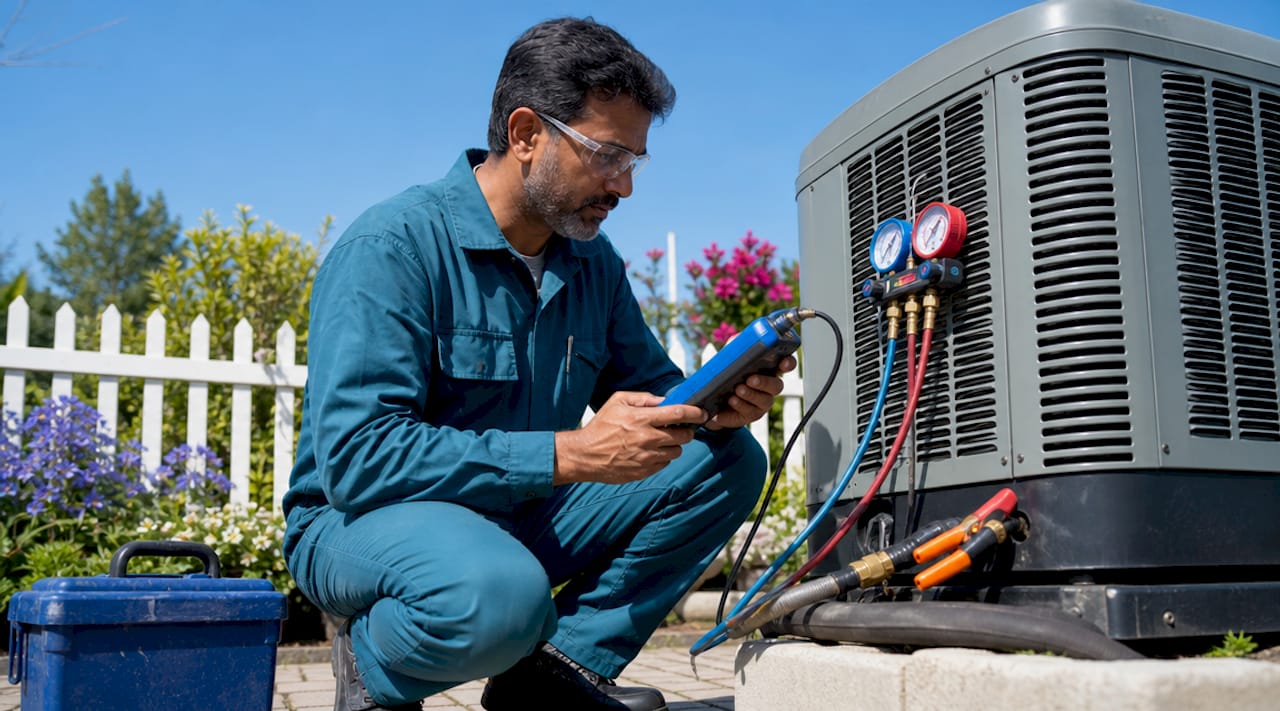
Subcooling is defined as the process of cooling liquid refrigerant below its condensation temperature after it exits the condenser, keeping it fully liquid before it reaches the expansion device. Every residential AC system and heat pump relies on this principle to deliver consistent cooling without wasting energy. Technicians measure it using a pressure/temperature manifold on the liquid line service port and a clamp-on temperature sensor. Understanding what is subcooling gives you a real advantage when talking to a technician, reading a service report, or deciding whether your system needs attention. Subcooling is a key diagnostic tool that can detect refrigerant leaks and help you avoid compressor failure before it becomes a costly repair.
What is subcooling and how does it work in refrigeration?
Subcooling occurs at a specific stage in the refrigeration cycle: after the refrigerant has already condensed from a hot gas into a liquid inside the condenser coil, but before it reaches the expansion valve. At that condensation point, the refrigerant sits at its saturation temperature, the temperature at which liquid and vapor coexist at a given pressure. Subcooling pushes the liquid temperature a few degrees lower than that saturation point, creating a thermal buffer that guarantees no vapor bubbles survive into the expansion device.
Why does that matter? Flash gas at the expansion device reduces system efficiency because vapor cannot transfer heat the way liquid refrigerant can. When flash gas enters the metering device, the system loses cooling capacity and the compressor works harder to compensate. Adequate subcooling eliminates that problem entirely by delivering a solid, bubble-free liquid column to the expansion valve.
Here is what happens physically during subcooling:
- The condenser rejects heat from the refrigerant, converting it from vapor to liquid at saturation temperature.
- Additional heat rejection continues past that saturation point, dropping the liquid temperature further.
- The refrigerant arrives at the expansion valve as a dense, fully liquid column with no vapor content.
- The expansion valve meters that liquid precisely, producing the pressure drop needed for evaporation.
Pro Tip: Think of subcooling like chilling a soda past the point where it stops fizzing. The extra cooling locks in the liquid state and prevents premature vaporization at the worst possible moment.
Subcooling also improves overall system efficiency by reducing energy consumption and prolonging compressor life, two outcomes every homeowner and property manager cares about directly.
How is subcooling measured and calculated?
Subcooling is calculated using a straightforward formula: Subcooling = Saturation Temperature minus Liquid Line Temperature. The saturation temperature comes from reading the high-side pressure on a manifold gauge and cross-referencing it on a pressure/temperature (P/T) chart for the specific refrigerant in your system, such as R-410A or R-22. The liquid line temperature comes from a clamp-on thermometer attached directly to the liquid line near the service valve.
Measurement tools include a pressure manifold connected to the liquid line service port and a clamp-on temperature sensor to record the actual liquid line temperature. Both readings must be taken at the same time under stable operating conditions, meaning the system has been running for at least 15 minutes.
Here is the step-by-step process a technician follows:
- Connect the high-side manifold gauge to the liquid line service port and allow the system to stabilize.
- Record the high-side pressure reading from the gauge.
- Look up that pressure on the P/T chart for your refrigerant type to find the saturation temperature.
- Clamp the temperature sensor onto the liquid line as close to the service port as possible.
- Record the actual liquid line temperature from the sensor.
- Subtract the liquid line temperature from the saturation temperature. The result is your subcooling value in degrees Fahrenheit.
Pro Tip: Always insulate the temperature clamp from ambient air with a small piece of foam or tape. Exposed sensors read ambient temperature instead of the line temperature, which throws off your calculation by several degrees.
The formula Subcooling = Saturation Temp minus Liquid Line Temp sounds simple, but accuracy depends entirely on stable system conditions and proper sensor placement. A reading taken during startup or with a loose clamp is not a reliable diagnostic number.
What are normal subcooling ranges and what do readings mean?
Industry-standard target subcooling for TXV-based AC systems is typically 10 to 15°F, with values below 5°F suggesting undercharge and values above 20°F indicating overcharge or a flow restriction. These numbers are not arbitrary. They represent the thermal margin that keeps refrigerant liquid through the entire liquid line run, even on a hot Southern California afternoon when ambient temperatures push 100°F.
| Subcooling reading | System status | Likely cause |
|---|---|---|
| Below 5°F | Undercharged | Refrigerant leak or insufficient charge |
| 8 to 15°F | Normal operation | Proper charge and no restrictions |
| 16 to 20°F | Borderline high | Possible mild overcharge or partial restriction |
| Above 20°F | Overcharged or restricted | Excess refrigerant or clogged filter drier |
One critical nuance: manufacturer-specific subcooling targets vary, and some high-efficiency units specify 8 to 12°F rather than the typical 10 to 15°F range. Always check the data plate on your outdoor unit before accepting a generic target as gospel. A Carrier, Trane, or Lennox unit each publishes its own specification, and charging to the wrong number causes real damage.
What each range tells you about your system:
- Below 5°F: The system is likely low on refrigerant. A leak is the most common cause. The compressor is working with insufficient liquid, which raises discharge temperatures and accelerates wear.
- 8 to 15°F: The system is properly charged and operating as designed. Cooling capacity and efficiency are at their peak.
- Above 20°F: The system has too much refrigerant or a restriction is blocking liquid flow. Both conditions force the condenser to work harder and raise head pressure.
Incorrect charging based on generic targets rather than manufacturer specs can cause compressor failure or reduced efficiency. That is not a theoretical risk. It is the most common cause of premature compressor replacement in residential systems.
Subcooling vs superheating: what is the difference?
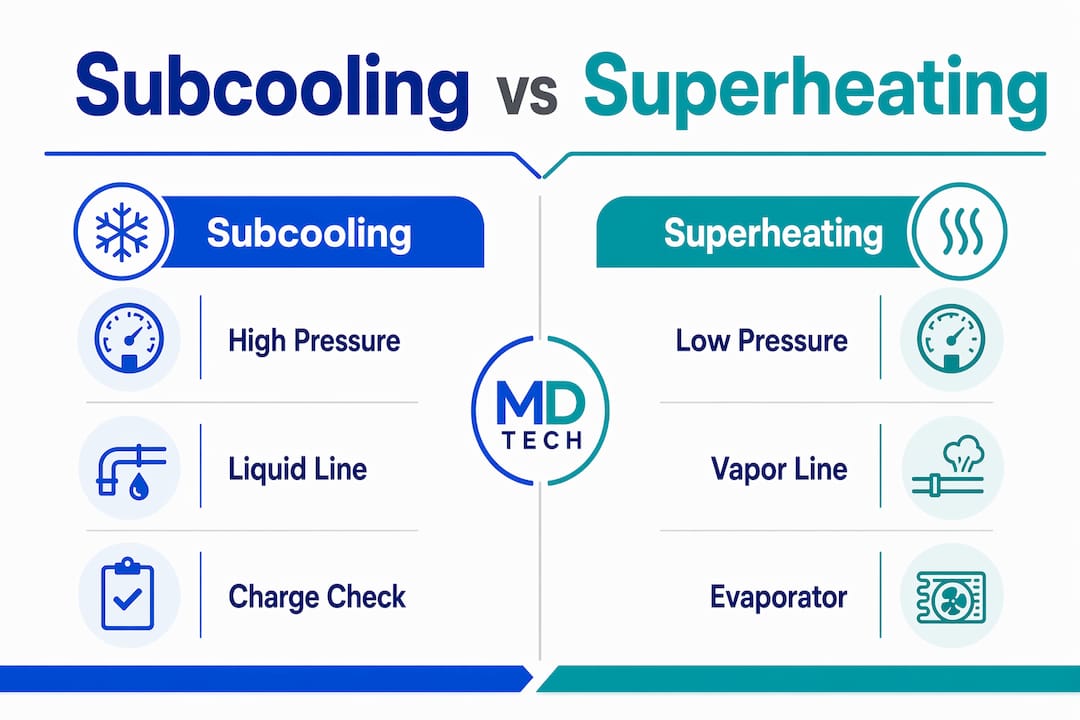
Subcooling and superheating are two sides of the same diagnostic coin, and understanding both gives you a complete picture of your system’s health. Subcooling occurs on the high-pressure side post-condenser and serves as the primary charge indicator for TXV systems. Superheat occurs on the low-pressure side at the evaporator outlet and protects the compressor from liquid refrigerant ingestion.
| Measurement | Location in system | Primary purpose |
|---|---|---|
| Subcooling | High-pressure side, liquid line | Confirms proper refrigerant charge |
| Superheat | Low-pressure side, suction line | Protects compressor from liquid slugging |
Superheat measures how far above its boiling point the refrigerant vapor has risen by the time it leaves the evaporator. If superheat is too low, liquid refrigerant can reach the compressor and destroy it. If superheat is too high, the evaporator is starved of refrigerant and cooling capacity drops. Subcooling and superheat work together: one guards the liquid side, the other guards the vapor side.
The dual focus on subcooling and superheat provides a balanced approach to diagnosing and optimizing HVAC operation, protecting both energy use and equipment health. A technician who checks only one of these measurements is working with half the diagnostic picture. For TXV systems specifically, subcooling is the primary charge method, while fixed-orifice systems rely more heavily on superheat for charge diagnostics.
How homeowners can use subcooling to troubleshoot HVAC problems
You do not need to own a manifold gauge set to benefit from subcooling knowledge. Understanding what the numbers mean lets you ask better questions, evaluate a technician’s diagnosis, and recognize when a system problem is being misdiagnosed. The HVAC troubleshooting process becomes far more productive when you understand what subcooling readings indicate.
Here are the most common subcooling-related problems and what they signal:
- Low subcooling (below 5°F): Points to a refrigerant undercharge, almost always caused by a leak somewhere in the system. Do not let a technician simply add refrigerant without finding and repairing the leak first. Adding charge to a leaking system is a temporary fix that delays a larger repair bill.
- High subcooling (above 20°F): Excessive subcooling can indicate a flooded condenser from overcharge or a liquid line restriction like a clogged filter drier. Before a technician removes refrigerant, they should verify there is no pressure drop across the filter drier, because the fix for a restriction is replacing the drier, not adjusting charge.
- Fluctuating subcooling: Unstable readings that swing more than 3 to 4°F during steady operation suggest a partially blocked metering device or a failing TXV. This is not a charge problem, and adding or removing refrigerant will not solve it.
- Normal subcooling with poor cooling: If subcooling reads in the correct range but the system is not cooling effectively, the problem lies elsewhere. Dirty condenser coils, a failing blower motor, or duct leaks are the more likely culprits. Clean condenser coils directly affect how well the condenser rejects heat and therefore how much subcooling the system can achieve.
Misconceptions about refrigerant charge often lead to overcharging systems, which causes excessive subcooling and increased mechanical stress on the compressor. Always insist that your technician reference the manufacturer’s data plate before adjusting charge, not a generic industry target.
Key takeaways
Subcooling requires accurate measurement, manufacturer-specific targets, and both subcooling and superheat readings together to diagnose an HVAC system correctly.
| Point | Details |
|---|---|
| Subcooling definition | Cooling refrigerant below saturation temperature after the condenser to prevent flash gas. |
| Normal range for TXV systems | Target is 10 to 15°F, but always verify against the manufacturer’s data plate first. |
| Low subcooling signals | Readings below 5°F indicate refrigerant undercharge, usually caused by a system leak. |
| High subcooling signals | Readings above 20°F point to overcharge or a clogged filter drier restricting liquid flow. |
| Subcooling vs superheat | Subcooling confirms charge on the high side; superheat protects the compressor on the low side. |
Why subcooling is the number I always check first
After years of diagnosing residential HVAC systems across Orange County and Los Angeles County, I can tell you that subcooling is the single most misunderstood measurement in home cooling. Homeowners hear “your system is low on refrigerant” and accept it without question. But that diagnosis is only valid if the technician actually measured subcooling and compared it to the manufacturer’s specification. A system running at 4°F subcooling on a unit that calls for 12°F is genuinely undercharged. A system running at 4°F subcooling because the technician forgot to let it stabilize for 15 minutes is not.
What I have found is that subcooling should be treated as a dynamic reading, not a static number. Ambient temperature, indoor load, and airflow all shift the value. Subcooling is a dynamic diagnostic tool rather than a fixed value, and that distinction matters enormously when you are deciding whether to add refrigerant or replace a filter drier. The wrong call costs hundreds of dollars and shortens compressor life.
My honest advice: ask your technician to show you the subcooling reading and the manufacturer’s target before they touch the refrigerant charge. If they cannot produce both numbers, that is a red flag worth acting on. Understanding compressor failure causes starts with understanding why improper subcooling is so often the root issue.
— MDTECH
Get your HVAC system checked by certified technicians
Subcooling readings outside the manufacturer’s target range are not a problem you want to ignore through a Southern California summer. Appliancesrepairmdtech provides certified HVAC technicians across Orange County and Los Angeles County who measure subcooling precisely, reference your unit’s data plate, and adjust refrigerant charge correctly the first time. Whether your system is running cold, cycling too often, or simply not keeping up on hot days, a proper subcooling check is the fastest way to find the real cause. Book a service appointment through our HVAC repair page and get a technician on-site who knows the difference between a charge problem and a restriction problem before touching your system.
FAQ
What is subcooling in simple terms?
Subcooling is the extra cooling applied to liquid refrigerant after it condenses, dropping its temperature below the saturation point to prevent vapor bubbles from forming before the expansion valve.
What is a normal subcooling value for a home AC system?
For TXV-based systems, the normal subcooling range is 10 to 15°F, though some high-efficiency units specify 8 to 12°F. Always check the manufacturer’s data plate for the exact target.
What does low subcooling indicate?
Low subcooling below 5°F typically indicates a refrigerant undercharge caused by a leak in the system. Adding refrigerant without repairing the leak first is a temporary fix that leads to repeat service calls.
How is subcooling different from superheat?
Subcooling is measured on the high-pressure liquid side and confirms proper refrigerant charge. Superheat is measured on the low-pressure vapor side and protects the compressor from liquid refrigerant damage. Both readings together give a complete system diagnosis.
Can high subcooling damage my HVAC system?
Yes. High subcooling above 20°F signals overcharge or a clogged filter drier, both of which raise head pressure, increase mechanical stress, and accelerate compressor wear if left unaddressed.