
A washing machine that shakes is usually telling you one of four things: the load is lopsided, the washer isn’t level, shipping hardware is still installed, or a worn part inside needs a technician. The first three you can check in about 15 minutes with no tools beyond a level and a wrench. If the shaking continues after that, the cause is almost certainly mechanical, and guessing is where repair bills grow.
This guide walks through the checks in the order manufacturers recommend, explains what normal movement looks like, and tells you where DIY should stop.
TL;DR
- Start with the load. Whirlpool says an off-balance load during spin can cause noise, vibration, reduced spin speed and clothes that stay wet.
- Check the installation next: all four feet firmly on the floor, the washer level, jam nuts tight, and no shipping bolts left in a new or recently moved machine.
- Some movement is normal. Repeated walking, thumping or banging every cycle is not.
- If shaking persists with a balanced load and a level machine, suspension parts, bearings or the drain pump may be involved. That is the point to book a diagnosis.
- Stop using the washer and call a pro if you hear grinding, see the machine hitting the walls or cabinet, or smell burning.
Table of Contents
- Is your washer’s shaking normal?
- Step 1: Fix the load
- Step 2: Remove shipping bolts on a new or moved washer
- Step 3: Level the washer and lock the feet
- Step 4: Rule out the drain pump and simple blockages
- When shaking points to a worn part
- When severe shaking is a safety issue
- What a repair visit usually costs
- Our perspective
- Need a technician in Orange or LA County?
- Prevent the shaking from coming back
- FAQ
- Sources
Is your washer’s shaking normal?
Every washer vibrates a little at top spin speed. The question is how much and how often.
GE notes that some movement can be normal in certain out-of-balance situations, and mentions about 1/4 inch on occasion. Its UltraFast Combo is even designed to move about 1/4 inch to reduce the force sent into your floor.
Use this as a rough sorting tool:
| What you see | Likely meaning | What to do |
|---|---|---|
| Gentle hum and slight movement at top spin | Normal | Nothing |
| Shaking only with one bulky load (comforter, towels, jeans) | Unbalanced load | Redistribute or wash fewer items |
| Rocking when you push a corner | Not level or feet not locked | Level the washer |
| New or just-moved washer shakes violently | Shipping bolts or poor setup | Check the rear panel and the leveling |
| Walks across the floor every cycle, even with small loads | Worn suspension, or an installation problem you haven’t found | Book a diagnosis |
| Loud banging or grinding with shaking | Possible bearing or drum damage | Stop and call a technician |
Step 1: Fix the load
An unbalanced load is the most common reason a washer shakes during spin. Maytag’s guidance is to start with load and installation before assuming anything is broken, because those two causes are the most frequent.
Whirlpool describes the classic signs: loud noises during spin, excessive shaking and clothes that come out still wet. Many washers will try to correct the imbalance themselves. Maytag notes the machine may stop spinning if it detects imbalance.
What to do:
- Pause the cycle and open the lid or door.
- Spread the clothes evenly around the drum. Untangle sheets and towels that have wound into a single rope.
- For a single heavy item, such as a bath rug, a pillow or a comforter, add a few towels so the weight is spread out.
- Do not overpack. Clothes should move freely.
- Restart the spin.
GE also suggests that on some front-load models you run a rinse and spin with no load. If the empty drum spins smoothly, the problem is how you load it. If it still shakes, you are looking at the washer itself.
A caution about absorbent items: a single soaked rug or heavy jacket can throw off a load far more than its size suggests. Wash those with a few lighter items, not alone.
Step 2: Remove shipping bolts on a new or moved washer
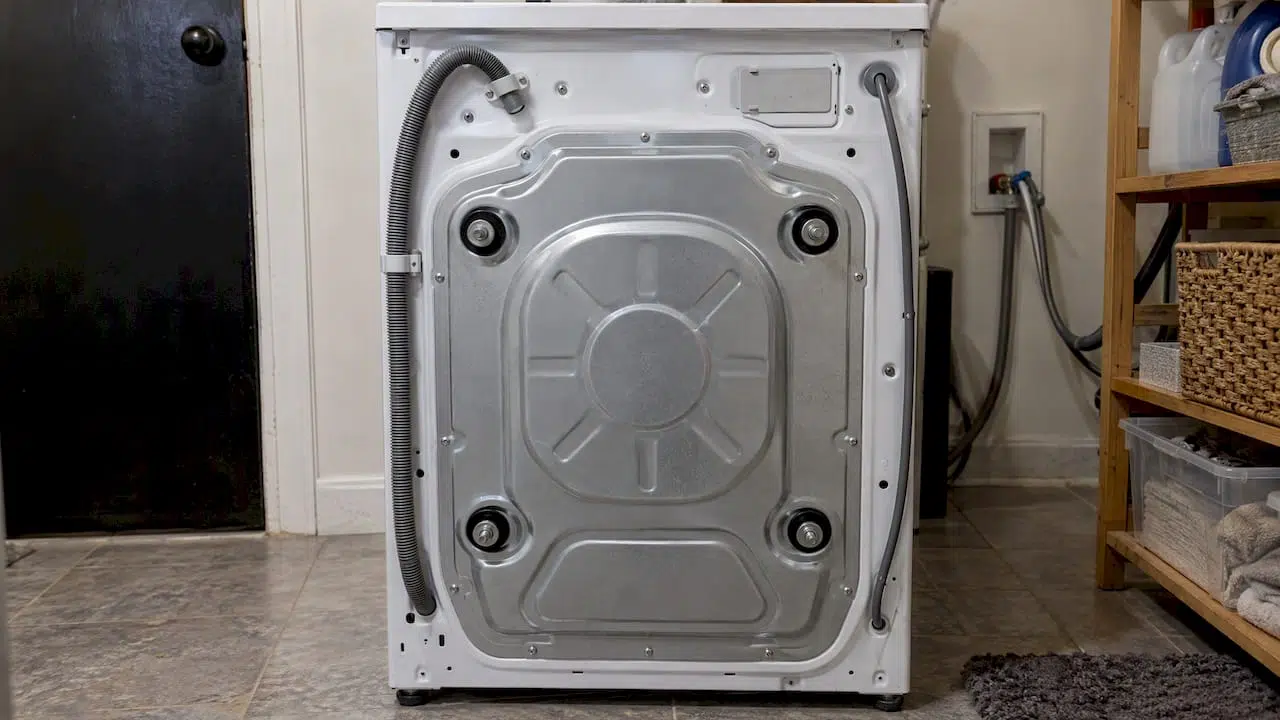
If the washer is new, or you recently moved it, look at the back panel. Whirlpool instructs owners to remove any shipping bolts still in place and warns that leaving them can make the washer shake forcefully and may cause damage. Maytag gives the same warning for front-load washers.
These bolts lock the drum for transport. They are meant to come out before the first wash. Your manual shows how many there are and where. Use the right wrench, keep the bolts and the plastic plugs, and store them for the next move.
Speaking of moves: a washer that shook violently right after a relocation is a very common call. If you are planning one, these prep steps for moving a washer cover what to secure before it goes on the truck, so the drum arrives undamaged and ready to set up.
Step 3: Level the washer and lock the feet
This is the fix that solves the most stubborn shaking. Both Whirlpool and Maytag stress that all four feet need firm contact with the floor and that the washer must be level.
Here is how to check it properly:
- Put a small bubble level on top of the washer, front to back, then side to side.
- Grab the top corners and rock the machine diagonally. Do it both ways. If either diagonal gives, a foot is floating.
- Turn the leveling feet by hand or with pliers until the machine stops rocking.
- Tighten the jam nut on each foot against the base so the foot can’t drift. Whirlpool’s step guide includes checking jam nuts and, on pedestal setups, pedestal screws.
- Run a short spin and check again.
Two practical details. First, GE warns that the more the legs are extended, the shakier the washer will be, especially in spin. Keep the feet as short as the floor allows. Second, do not trust your eyes. A washer can look level and still rock slightly because a jam nut is loose.
Floors matter in older Southern California homes
A washer on a second-floor laundry closet or a slightly sloped garage slab behaves differently from one on a flat ground-floor slab. Wood-framed upper floors flex under a spinning drum, which can amplify even a small imbalance. If the washer is level and the load is even but the floor itself bounces, a technician can tell you whether the issue is the machine or the surface it sits on. Moving the washer to a firmer spot isn’t always possible, so the goal is to keep the machine as balanced as it can be.
Step 4: Rule out the drain pump and simple blockages
GE flags a clogged drain pump as a possible cause of shaking and vibration. If the washer leaves water at the bottom, drains slowly, or you’ve found coins and socks in the filter before, this is worth checking. Many front-loaders have a small access panel near the bottom front with a filter you can open. Place a shallow pan and towels under it first, because water will come out.
If you find nothing, or the pump hums but doesn’t drain, leave it there and get a diagnosis. Pump and drain problems often show up together with spin problems, and our guides on why a washing machine does not spin and step-by-step washer troubleshooting cover the overlap.
When shaking points to a worn part
Suppose you’ve balanced the load, removed shipping hardware, leveled the washer and locked the feet. If it still shakes or walks every cycle, the likely causes move inside the cabinet.
- Suspension rods, springs or dampers. These hold the tub steady. When they wear, the drum swings freely and the cabinet bangs. Whirlpool’s own guidance puts drum and bearing issues after stability checks, which is a sensible order.
- Drum bearings. Usually announced by a rumbling or grinding noise that rises with spin speed, not just shaking.
- Shock absorbers or snubber pads. Common in many top-load and front-load designs. The parts and the labor vary by brand.
- A cracked or loose counterweight or tub component. Less common, but serious. Stop using the washer.
You can see why “my washer shakes” doesn’t have one answer. Consumer Reports warns homeowners against vague diagnoses and suggests asking for a written estimate that specifies the type of parts (new, used, genuine or aftermarket). The reason matters for shaking in particular, because the same symptom comes from several different root causes, and a technician who just swaps parts may miss the real one.
Our list of washer repair warning signs is a quick way to match what you’re hearing to what may be failing.
When severe shaking is a safety issue
Most shaking is a nuisance. Occasionally it is a hazard. Consumer Reports, summarizing a federal safety agency announcement, reported that Samsung recalled about 2.8 million top-loading washers after reports of excessive vibration and the top detaching. The same report counts 733 such reports, with injuries including a broken jaw, covering 34 models sold between March 2011 and November 2016. Owners could get a free in-home repair or a rebate toward another washer, depending on model and options.
What that means for you:
- If your washer is a top-loader from that period and has ever thrown its lid or top panel, look up the model number on the recall notice before running it again.
- Never stand on, lean on or hold down a shaking washer to “calm” it.
- If the washer hits the wall, tears at its hoses or leaks while shaking, shut off the water, unplug it and call a technician. Moving a shaking washer with hoses attached risks a flood.
Because the washer is plumbed and wired, a bad vibration can also loosen water supply fittings. If you see water around the base, shut the supply valves and call.
What a repair visit usually costs
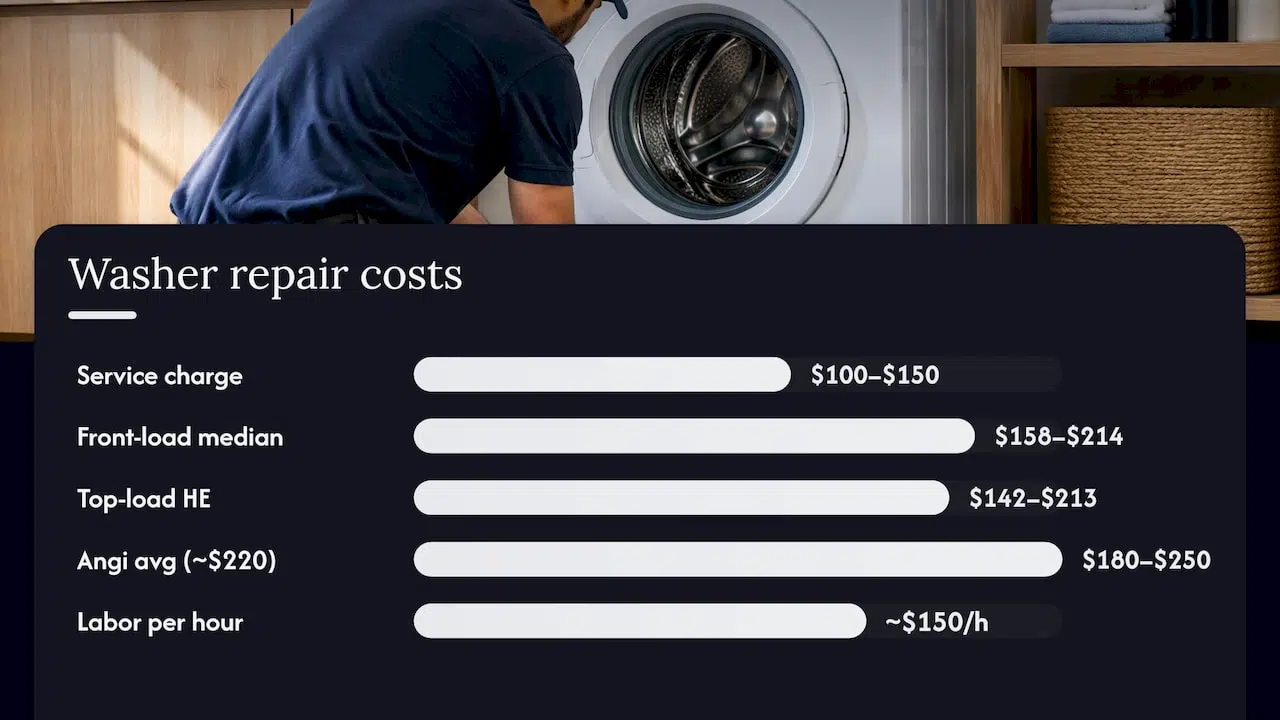
Owners often delay a repair because they don’t know what to expect. National figures help set expectations. Consumer Reports quotes a service charge of at least $100 to $150 from an appliance service company president, and reports median out-of-pocket repair costs of $158 to $214 for front-loaders and $142 to $213 for top-load HE washers. Those ranges don’t include the quote fee.
Angi’s 2026 update puts average washer repair costs between $180 and $250 nationally, with most homeowners paying around $220, and says labor can run about $150 per hour with extra charges for emergency or after-hours calls.
We don’t publish fixed prices because a shaking washer can be a five-minute leveling fix or a bearing job, and the quote depends on the diagnosis. What we can tell you: ask what the diagnostic fee covers, whether it applies toward the repair, and for the estimate in writing. Our explainers on how to judge a washer repair quote and diagnostic fees go through what to ask.
If the washer is old and the quote is high, repair versus replacement is the next conversation. A technician should be willing to say honestly when replacing is the better call.
Our perspective
We get plenty of calls from Orange County and Los Angeles County homeowners who say the washer “is broken” and it turns out to be one of three things: one foot a half-turn off the floor, a jam nut never tightened after installation, or a load of towels wound into a ball. We would rather you know that than book a visit you don’t need. If a quick check solves it, great.
But when it doesn’t, we see a pattern. Shaking that has been tolerated for months is where the secondary damage starts: a cabinet cracked from banging, hoses worn at the connection, a bearing run until it fails. The washer that was a suspension fix becomes a bigger job. If you’ve done the level, load and shipping-bolt checks and the machine still walks, we’d rather diagnose it early.
We also look hard at installation, because many “repair” calls are really setup problems. A technician should check the floor, the feet, the hoses and the drain, not just the drum. That is the standard we aim for with every licensed technician we send.
— MDTECH
Need a technician in Orange or LA County?
If the washer still shakes after the checks above, we can diagnose it. Our technicians repair residential washers, dryers, refrigerators, ovens and dishwashers across Orange County and Los Angeles County, and you can book online. See our appliance repair services to schedule a visit. If the washer is new or was just moved and the setup looks wrong, our appliance installation services cover proper leveling and hookup.
When you call, tell us the brand and model, whether the shaking is only in spin, when it started, and what you’ve already tried. It shortens the visit.
Prevent the shaking from coming back
- Wash bulky items in small batches and mix them with lighter clothes.
- Don’t overload. Leave room for the clothes to move.
- After any move, cleaning behind the washer or a floor repair, re-check the level with the rock test.
- Re-tighten the jam nuts once or twice a year.
- Clean the drain pump filter as your manual describes.
- Keep the manual’s shipping-bolt instructions with the bolts, so they’re ready when you next move.
For seasonal checks, see our washer troubleshooting tips for Orange and LA homeowners.
FAQ
Why does my washer shake only during the spin cycle?
Spin is when the drum reaches top speed, so any imbalance shows up there first. Most often it’s a lopsided load or a washer that isn’t level. If it keeps happening with small, evenly spread loads, worn suspension parts become more likely.
How do I balance a washing machine drum?
Pause the cycle, redistribute the clothes evenly around the drum, and untangle anything wound into a clump. Add a few towels if you’re washing one heavy item. Then restart the spin, and if the washer still reports an imbalance, check the leveling.
How do I level my washing machine?
Place a level on top, then rock the washer corner to corner. Adjust the feet until nothing rocks, and tighten each jam nut against the base. Keep the feet as short as possible, since longer legs make the washer shakier.
Can I keep using a washer that shakes violently?
Not for long. Repeated violent shaking can damage the drum, hoses and cabinet, and it can loosen connections. Stop the load, redistribute it, and check the setup. If it still shakes badly, unplug it and have a technician look at it.
Sources
- Vibration or Out of Balance Loads, Whirlpool Product Help
- How to Stop a Washer From Shaking, Whirlpool
- Washer is Vibrating, Walking or Moving, Maytag Product Help
- Vibration, Walking or Off Balance, Front Load Washer, Maytag
- Maytag Product Help
- Front Load Washer, Walking, Vibrating, Shaking, or Moving, GE Appliances
- GE Profile UltraFast Combo, Excessive Noise or Shaking
- Consumer Reports: Samsung top-loading washer recall
- Consumer Reports: Should you repair or replace a broken washing machine
- Consumer Reports: The how-to-get-anything-fixed guide
- Angi: How much does washer repair cost