
Most wet dishes come down to five things: the wrong dry setting, too little rinse aid, loading that lets water pool, water that is not hot enough, or plastics that never dry well. All five are free to check. If you have ruled them out and the tub still stays cool at the end of a heated-dry cycle, the problem is probably a part, usually the heating element, and it is time for a technician.
This guide walks through the checks in the order that saves the most time, shows how to test the heat yourself, and explains where a do-it-yourself fix stops being sensible.
TL;DR
- Turn on a heated-dry option such as Heated Dry, Extended Dry or Sanitize, and skip Eco or Quick cycles when drying matters.
- Fill the rinse aid dispenser and adjust the setting. It is the most common fix.
- Run the kitchen faucet until the water is hot, because incoming water of about 120°F helps drying.
- Some wetness on plastics is normal, especially in models that dry by condensation.
- No warmth after a 1-hour heated-dry cycle, a blinking Sanitize light, a tripped breaker or an error code means it is time to schedule service.
Table of Contents
- Why dishes come out wet in the first place
- Step 1: Check the cycle and dry option
- Step 2: Rinse aid, the most common fix
- Step 3: Load so water can run off
- Step 4: Make sure the water is hot
- Step 5: Open the door and unload in the right order
- Is the heating element bad? A simple test
- Signs that mean stop troubleshooting
- Our perspective: what we see in the field
- Need a technician? Here is how we help
- FAQ
- Sources
Why dishes come out wet in the first place
Drying is the hardest job a dishwasher does. A Consumer Reports dishwasher-test expert, Larry Ciufo, explains that dishes trap water, and humid air condenses on them as the machine cools. Plastics are worse, because they hold less heat than glass, ceramic or metal.
That is why a little moisture is not always a fault. Samsung states that service is not needed for condensation drying that is working as designed. LG makes a similar point: wet plastics alone do not necessarily signal a problem, since they cool faster.
So the first question is whether the whole load is wet or only the plastics and the dips in cup bottoms. If glass and ceramic are bone dry and a few plastic containers are damp, your dishwasher is probably fine. If everything is wet and the tub feels cold, keep reading.
Why it may have changed
If your dishwasher used to dry well and no longer does, think about what changed. Possible explanations include a different cycle selection, an empty rinse aid dispenser, a new way of loading, a weaker hot-water supply, or more plastic in the load, according to KitchenAid’s product help. Those are quick to test. A sudden change with no obvious cause points more toward a part that has failed.
Step 1: Check the cycle and dry option
This takes thirty seconds and solves more cases than you would expect.
- Select a heated-dry option. Whirlpool recommends Heated Dry or Extended Heat Dry, and KitchenAid suggests Extended Dry if needed.
- Try Sanitize or Sani Rinse. Whirlpool notes that these options can raise the final-rinse temperature, which helps dishes dry. Bosch likewise advises selecting Sanitize or Extra Dry when available.
- Avoid Eco and Quick cycles when drying is the priority. Whirlpool says they may reduce heat and drying time.
- On LG models, Extra Dry or Night Dry may be available, and LG suggests using them if they are.
If you have been running an economy cycle every night to save energy, this is the likeliest explanation. Switch to a normal cycle with heated dry for a few loads and see whether the problem disappears.
Step 2: Rinse aid, the most common fix
Rinse aid changes how water behaves on a surface. KitchenAid explains that it helps water drain from dishes instead of forming droplets that cling and dry into spots. Its dispenser holds 5 oz (150 mL), which typically lasts one to three months.
Here is what to do:
- Open the door and look at the rinse aid dispenser, usually next to the detergent cup. Many have a small indicator window.
- Refill it if it is low. Wipe up any spill, because excess rinse aid can cause suds.
- Check the adjustment dial. If it is set to the lowest level, raise it one step and run a load. Increase only gradually.
One ranking manufacturer guide goes further: a rinse aid dispenser that is empty or malfunctioning may stop the machine from finishing its drying phase properly. If the dispenser is full, the dial is adjusted and results are still poor, move on rather than pouring in more.
If you use all-in-one detergent tablets and assume they contain rinse aid, try adding it separately anyway. It costs a few dollars and is the single most frequent recommendation across the manufacturer guides.
Step 3: Load so water can run off
Water that sits on a surface will not dry in time. Bosch recommends leaving space between dishware and cutlery, and Consumer Reports recommends spacing items apart so heat and air reach every surface.
Practical loading habits:
- Tilt cups, bowls and containers so their openings face down and at an angle. A flat-bottomed cup facing up holds a puddle.
- Do not nest bowls or stack plates tightly. Water gets trapped between them.
- Keep plastics away from the lower rack. KitchenAid says to place plastics on the third-level rack if your model has one, rather than the bottom.
- Do not let tall items block the spray arm or sit over concave surfaces where water pools.
- Mind the cutlery basket. Mix forks, spoons and knives so they do not nest together.
A load with dishes packed shoulder to shoulder may wash fine, but it will drip dry badly. If you have to choose, run two lighter loads while testing.
Step 4: Make sure the water is hot
Dishwashers rely on hot incoming water. KitchenAid says incoming water should be at least 120°F (49°C), and Whirlpool says about 120°F at the tap is ideal for drying. Samsung gives a supply range of 120°F to 149°F.
The easy habit: before starting the dishwasher, run the kitchen faucet for 30 to 60 seconds, as Whirlpool recommends, so hot water is already in the line. This matters most if the dishwasher is far from your water heater, which is common in larger homes and in condos with long pipe runs.
If the faucet never gets properly hot, the issue may be your water heater setting or a plumbing problem, not the dishwasher. We also handle plumbing repair and installation, so that is something we can look at during the same visit.
Step 5: Open the door and unload in the right order
Three cheap habits help even a healthy machine:
- Open the door after the cycle. Samsung recommends opening it about 1 inch within an hour of completion. LG suggests opening it once drying finishes so remaining humidity can escape. Consumer Reports suggests a few inches.
- Unload the bottom rack first. Water pooled on cup bottoms in the upper rack can drip onto dishes below if you empty the top first, a tip from Consumer Reports.
- Use a towel on the stubborn spots, usually plastic lids and the bases of cups.
These do not fix a broken machine, but they take a “mostly dry” result to a “fully dry” one.
Is the heating element bad? A simple test
When all the settings and habits above are right and dishes are still wet and cool, the next suspect is the heat itself. KitchenAid describes two simple tests in its guide to the causes of poor drying.
If your model has a Sanitize light: run a Sanitize cycle. A steady Sanitize light is a positive sign. A blinking one may indicate a broken heating element.
If it does not: run a 1-hour or Quick Wash cycle with Heat Dry selected, then open the door when it finishes and check whether the dishes are warm. If they are not, KitchenAid says to consider calling a service professional.
Whirlpool adds a useful benchmark: after a heated-dry cycle the tub should feel warm and may contain steam. Cold and dry-looking does not mean working, it means no heat was added.
Be careful when you touch anything. Open the door after the cycle and feel the dishes and the inside wall, not the bottom of the tub where the element sits, which can stay hot.
Airflow, the other thing to check
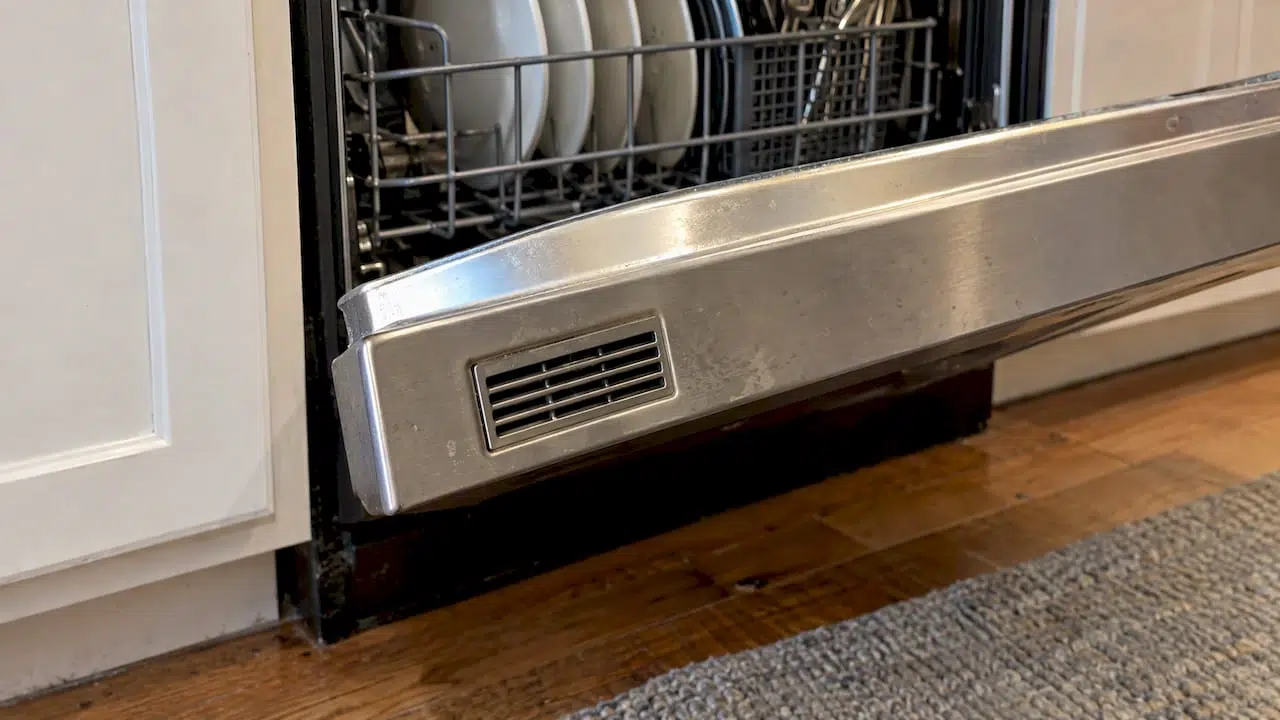
Some models also use a fan or vent for drying. LG suggests that during the last 30 minutes of the cycle you can feel near the lower-left door vent for airflow. If nothing moves, LG says service is required. Not every model has this vent, so check your owner’s manual first.
Signs that mean stop troubleshooting
Schedule service when you see any of these:
- The Sanitize light blinks, or dishes are not warm after a 1-hour heat-dry cycle (KitchenAid’s guidance).
- The tub has no heat at the end of a heated-dry cycle, a breaker trips, or an error code appears (Whirlpool’s guidance).
- The cycle stops early or shows a fault, which may point to something other than drying. Our guide to why a dishwasher stops mid cycle explains the usual causes.
- No airflow at the vent where your model has one.
A tripped breaker deserves particular respect. Do not keep resetting it. Leave the dishwasher off and have someone check the electrical side, because repeated trips can mean a short in a heating component.
If you would rather work through the whole machine methodically, our dishwasher troubleshooting steps and dishwasher repair workflow cover what a technician checks and in what order.
Our perspective: what we see in the field
We repair kitchen appliances across Orange County and Los Angeles County, and a dishwasher that does not dry is one of the most common calls that turn out not to be a repair at all. Often the machine is set to an economy cycle, the rinse aid has run out, or the load is packed so tightly that nothing could dry.
Our advice is to spend ten minutes on the free checks first. Fill the rinse aid, pick a heated-dry cycle, run the tap hot, and load with gaps. If that fixes it, you have saved a visit.
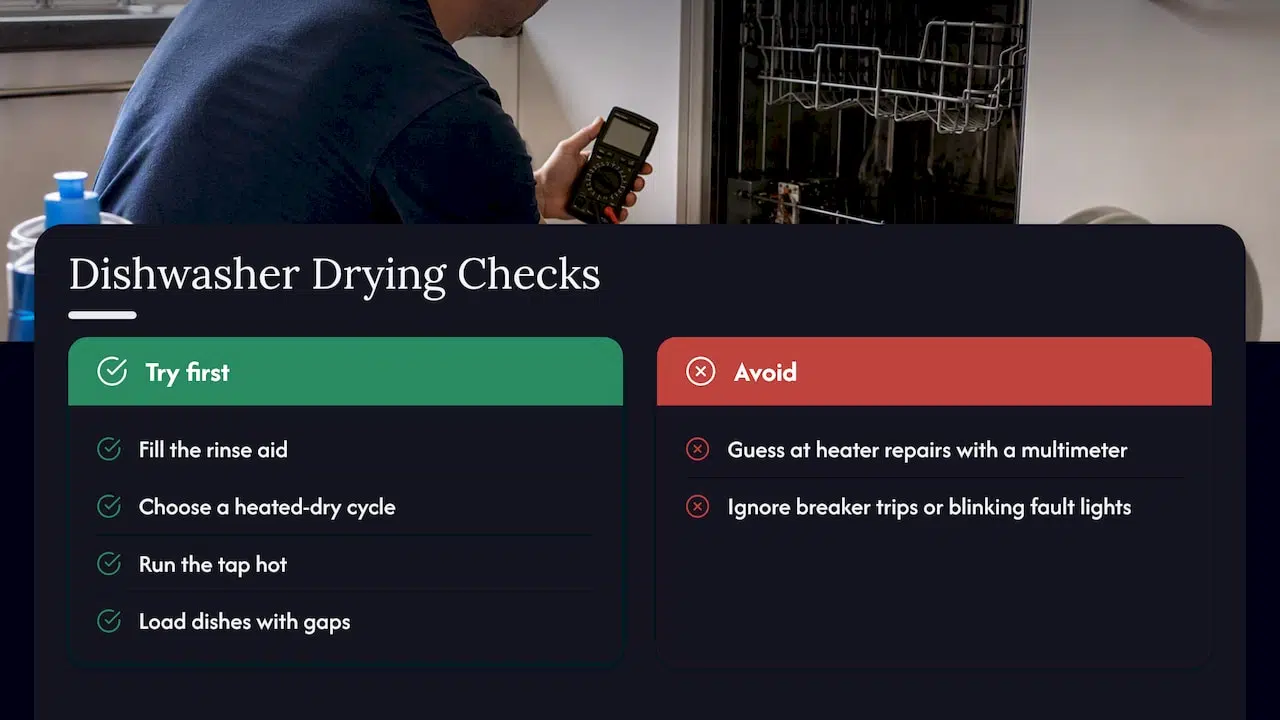
But we also do not want you to spend a weekend on a part that has failed. If the heat test fails, a heating element is a repair for a licensed technician, not a guessing game with a multimeter. Wet dishes are an annoyance, while a tripped breaker or a blinking fault light is a safety signal, and we treat the second group seriously.
Hard water is another contributor we see locally, because mineral buildup can affect how well water sheets off dishes and how components perform over time. Our guide to dishwasher hard water damage explains what to watch for, and our dishwasher care tips cover routine habits that help.
— MDTECH
Need a technician? Here is how we help
If your dishwasher fails the heat test, shows an error code, or you simply want it checked properly, our licensed technicians handle dishwasher and other kitchen appliance repairs for homeowners and property managers in Orange County and Los Angeles County. You can book online. We work on major and luxury brands, and we explain what we find before any work begins.
See our kitchen appliance repair page to book, or browse all appliance repair services. We do not publish fixed prices, so you will get a quote based on the actual diagnosis.
Not sure whether a fix is worth it on an older machine? Our guide to repair versus replacement lays out how to decide.
FAQ
How do you fix a dishwasher that is not drying?
Start with the free checks: add and adjust rinse aid, select a heated-dry option, load dishes so water drains, and make sure incoming water is at least 120°F. Put plastics on the top or third rack. If the dishes are still wet and cool after a 1-hour heat-dry cycle, schedule service.
Why is my dishwasher still wet after drying?
Some moisture is normal, especially on plastics, in dishwashers that dry by condensation. Check the rinse aid, run hot water before starting, and open the door after the cycle. If everything is wet and the tub is cold, the cycle may have stopped early or the heat may have failed.
How do I know if my dishwasher heating element is bad?
On models with a Sanitize light, a blinking light after a Sanitize cycle may indicate a broken element. Otherwise run a 1-hour heat-dry cycle and check whether the dishes are warm at the end. If they are cold, call a service professional.
Does the Eco cycle affect drying?
Yes. Whirlpool says Eco and Quick cycles may reduce heat and drying time. If drying matters to you, choose a normal cycle with heated dry or extended dry, or add Sanitize if your model has it.
Should I leave the door open after the cycle?
It helps. Samsung recommends opening it about 1 inch within an hour, and LG suggests opening it after drying finishes so humidity can escape. Unload the bottom rack first so water from above does not drip onto lower dishes.
Sources
- Not Drying – Dishwasher, KitchenAid Product Help
- Dishwasher Not Drying: 5 Causes and Fixes, KitchenAid
- Dishes Not Drying: Quick Fix Guide, Whirlpool Product Help
- Dishes Are Still Wet, Bosch Owner Support
- Ways to Improve a Dishwasher’s Drying Performance, Consumer Reports
- LG Dishwasher: Not Drying Properly
- Samsung dishwasher does not dry dishes