
If your oven burns the cookies in back and leaves the front pale, the cause is usually one of three things: how you load it, a calibration or sensor problem, or a failing part such as a bake element, igniter or convection fan. The first two you can often sort out in an afternoon. The third needs a technician. This guide shows you how to tell which one you have, what is safe to try yourself, and when to stop.
TL;DR
- Start with the free causes: foil blocking airflow, crowded racks, a door that does not seal, or opening the door too often. KitchenAid lists these among the main reasons for uneven baking.
- Test the oven before you touch anything. A biscuit bake test tells you more than a thermometer alone.
- A damaged exposed element, or a sensor that stays wrong after you reposition it, means it is time for a licensed professional.
- Slow preheating and uneven heating often share a cause, so fix them as one problem.
- If the range is over 10 years old, weigh repair against replacement.
Table of Contents
- What “uneven” really means
- Run the test first
- Free causes to rule out
- Parts that cause real unevenness
- Why the oven takes so long to preheat
- How to calibrate an analog oven safely
- Our view from the repair bench
- When to call a professional
- Repair or replace?
- Get your oven looked at in Orange or Los Angeles County
- Frequently asked questions
- Sources
What “uneven” really means
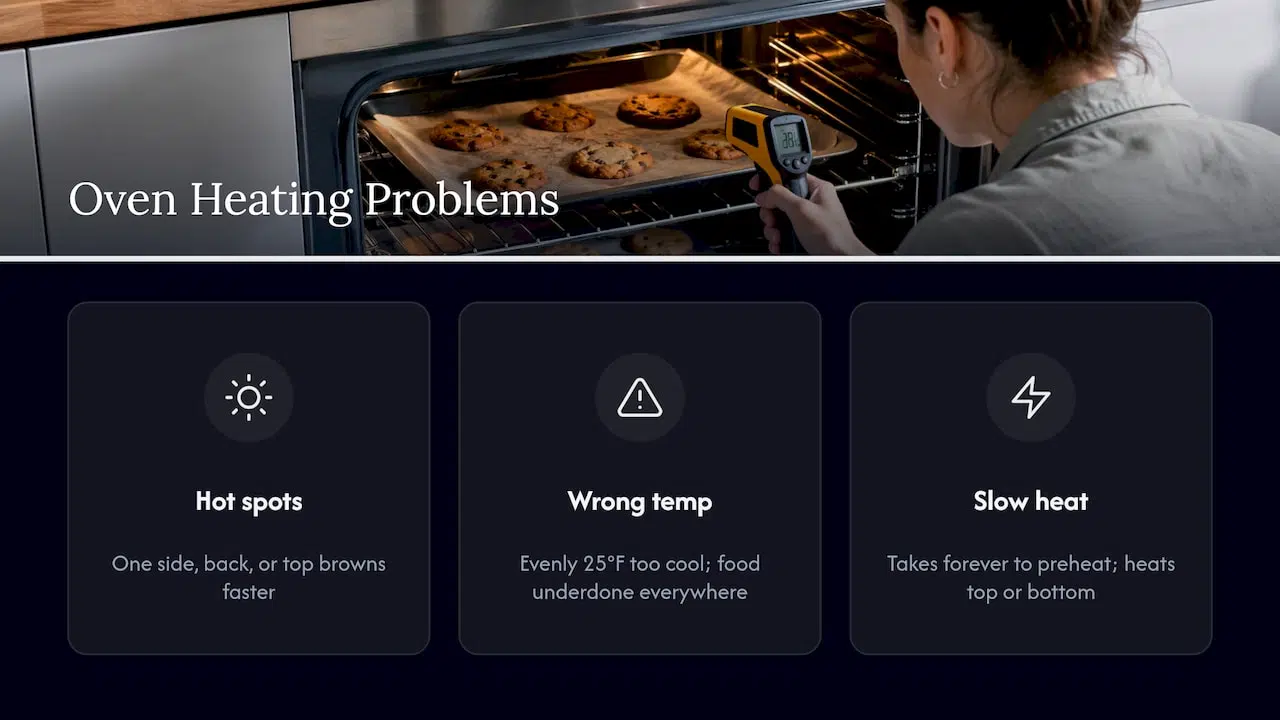
People use the phrase for three different problems, and each points to a different fix.
Hot spots. One side, the back or the top browns faster than the rest. Every oven has some of this. Wirecutter says every oven has some inconsistency, so a little variation is normal and you manage it by rotating pans.
Wrong overall temperature. The oven is evenly off, say 25°F too cool, so food is underdone everywhere. That is a calibration issue, not true unevenness.
Slow or incomplete heating. The oven takes forever to preheat, or heats from only the top or bottom. This usually means a part is failing.
Note which one you have before you start. It saves a lot of guessing.
Run the test first
Before you replace anything, find out how the oven really performs.
The biscuit test
GE Appliances says oven thermometers are not always the best way to check temperature and describes a canned biscuit test as a better way to tell whether the oven is heating properly. The steps:
- Buy a can of refrigerated biscuits and bake them on a cookie sheet following the package directions.
- Use the center rack and keep the door closed.
- Check the result: browning that is even across the tray means the oven is fine. One side much darker, or all biscuits pale or burned, points to a problem.
KitchenAid adds two details: if you use a dark or non-stick sheet, set the oven 25°F lower than the package says, and if the oven has no preheat indicator, preheat for 12 minutes.
The toast test for hot spots
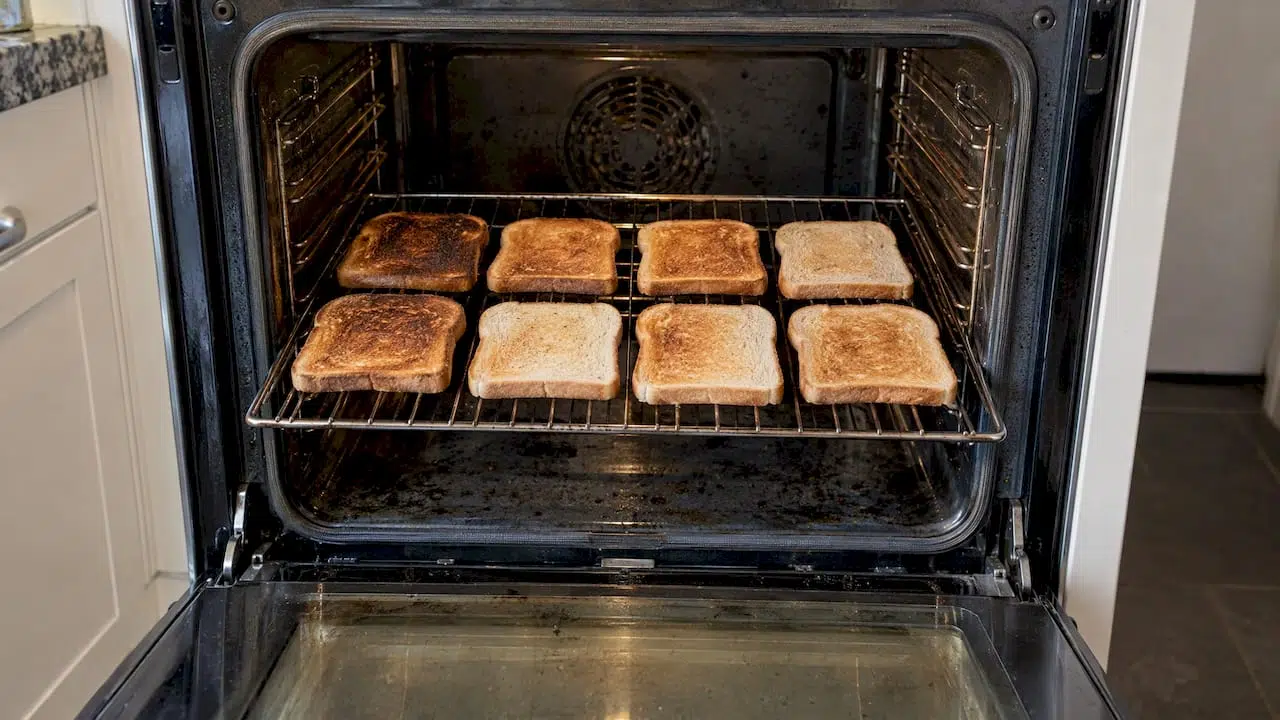
To map hot spots, Wirecutter suggests a toast test: cover a rack with slices of bread, bake, and look at which slices darken first. The pattern shows you where your oven runs hot, which helps you place pans.
Using a thermometer
A thermometer is still useful as a second check. The USDA’s Food Safety and Inspection Service notes that an oven thermometer can verify the oven is reaching the set temperature, and that the oven cycles on and off, especially after the door has been opened. So a single reading can mislead. GE also points out that the door opening and the thermometer’s placement affect the number you see. Take several readings over 20 to 30 minutes with the door shut.
Free causes to rule out
These cost nothing and fix a surprising share of cases.
Foil and crowded racks
KitchenAid names aluminum foil on the oven bottom or racks and overcrowded racks as common causes, because both block air circulation. Take foil off the floor of the oven and the rack edges. Leave an inch or two of space around pans and avoid filling three racks at once.
Opening the door
Every peek lets heat out. Amana states that opening the door during cooking changes the oven’s temperature. Use the oven light and the window, and rotate pans only once, about two-thirds of the way through the bake.
Your bakeware
Amana explains that pan material, shape and color affect browning: dark pans absorb heat and brown faster, while light, shiny pans reflect it. If the bottoms of your cookies burn but the tops are pale, try a light aluminum sheet before blaming the oven.
Rack position
Food close to the top element gets more direct heat, and food low in the oven gets more from the bottom. Center rack is the default for most baking. Move one rack position at a time and note the result.
The door itself
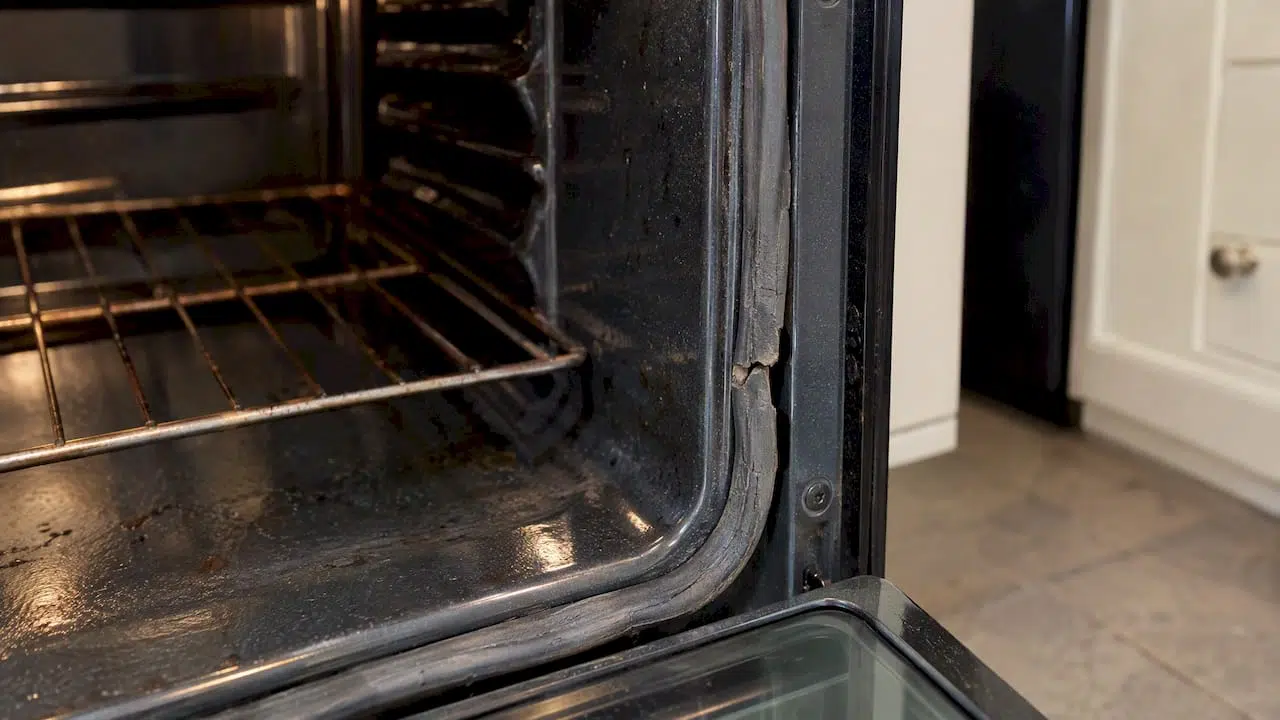
A door that is ajar or a worn gasket lets heat escape and creates cool zones near the door. KitchenAid lists an ajar door among the causes. Close the door and look around the edge: a torn, brittle or flattened gasket, or visible gaps, deserves attention. Do not run the oven with a door that will not latch.
Parts that cause real unevenness
If the basics are clean and the biscuit test still fails, a component is likely at fault. What follows is how each one typically behaves.
| Symptom | Likely part | Oven type |
|---|---|---|
| Food browns only from the top, bottom stays pale | Bake element not working | Electric |
| Element does not glow evenly, or shows a blister or break | Damaged heating element | Electric |
| Long preheat, oven never reaches the set temperature | Weak igniter or failing sensor | Gas |
| Hot spots that rotating cannot fix, convection mode worse than bake | Convection fan motor | Convection |
| Evenly too hot or too cool | Calibration or temperature sensor | Both |
The heating element (electric ovens)
A bake element that is partly or fully dead is a classic cause. One guide on this topic notes that when the bake element is burned out, only the broil element works and the oven heats from above only. GE advises looking at the element while the oven heats: an element that does not glow uniformly may be failing. KitchenAid tells homeowners to check exposed elements for breaks or blisters. If you see either one, stop using the oven and call a professional, because a damaged element is an electrical hazard.
The temperature sensor
The sensor is a thin probe inside the oven that tells the control board how hot the cavity is. KitchenAid lists a broken or misplaced sensor among the causes. If it has shifted, you can gently reposition it to a 90° angle, with the oven off and cool. If that does not solve the problem, the sensor itself or the control may need replacing.
The igniter (gas ovens)
Gas ovens depend on an igniter that glows hot enough to open the gas valve. As igniters age they can glow weakly, and the oven then heats slowly or in short bursts. This is not a do-it-yourself job for most homeowners, because it involves the gas supply. If you ever smell gas, follow our checklist of safe steps when an oven smells like gas and do not run the oven.
The convection fan
A convection oven uses a fan to even out heat. When the motor weakens, the fan slows or stops, and hot and cool pockets return. Listen when convection mode starts: a grinding, rattling or silent fan is a red flag. Replacement requires removing the back panel, so it is best left to a technician.
Calibration
Ovens drift over time. The USDA says that if the oven is consistently high or low by the same amount, such as 25°F, you can compensate by adjusting the set temperature. For a deeper look, see why regular oven calibration matters.
Why the oven takes so long to preheat
Slow preheating is the sister symptom, and a few causes overlap. According to Amana, slow preheating can come from opening the door while it preheats, leaving unused racks inside, a hidden bake element, or a range wired to 208V instead of 240V.
The first three are easy. Close the door, pull out spare racks and let it finish. The voltage issue is different: it points to the way the oven was installed, and it is a job for a licensed electrician or appliance technician. If the problem began right after a new installation or a move, ask about voltage first. If a part has failed instead, see our guide to why ovens won’t heat up.
How to calibrate an analog oven safely
If your oven has a dial rather than a digital display, and the biscuit test shows it runs consistently hot or cool, you may be able to calibrate it.
- Turn the oven off and let it cool.
- Pull the temperature knob straight off.
- Turn the screws on the back of the knob clockwise if the oven runs hot, counterclockwise if it runs cold, as Maytag explains.
- Go slowly. Maytag recommends about one-eighth of a turn at a time, because even a slight turn can change the temperature drastically.
- Retest with biscuits.
KitchenAid advises never calibrating more than 10 degrees at a time. Digital models have their own calibration menu, and the steps vary by brand, so check your manual.
Calibration only fixes a steady offset. It will not repair a dead element, a weak igniter or a failing fan.
Our view from the repair bench
We repair ovens across Orange County and Los Angeles County, and the calls about uneven heating follow a pattern. Many homeowners have already tried a thermometer, noticed it disagrees with the dial, and assume the oven is finished. Often it is not. A sensor, element or igniter is a bounded repair, and replacing one part is usually a better outcome than replacing the whole range.
Our advice is simple. Do the free checks and the biscuit test first, because they cost nothing and give a technician useful information. Then stop at the point where you would have to open a panel, touch wiring, or work near a gas line. Those steps are where a small repair turns into a safety problem. Our licensed technicians explain what they find before any work starts, so you can decide with the facts in hand.
If you want a broader walk-through, our oven troubleshooting guide for homeowners covers more symptoms.
— MDTECH
When to call a professional
KitchenAid’s guidance is that if an exposed heating element is damaged, or repositioning the temperature sensor does not resolve the issue, you should schedule service with a licensed professional. The USDA adds that when an oven does not hold the temperature you set, the thermostat must be adjusted by an authorized manufacturer representative.
In practice, call when:
- an element is blistered, broken or sparking;
- you smell gas or see the igniter glowing weakly with no flame;
- the biscuit test fails after you have cleared foil, racks and the door;
- the oven started heating badly right after an installation;
- convection mode is noisy or the fan does not turn.
For what a visit looks like, see our step-by-step guide to oven repair.
Repair or replace?
Amana says that if a range is more than 10 years old, it might be time for a replacement. Age is only one input. Consider:
- The part. A single element, sensor or igniter is a limited repair. Multiple failures or a dead control board change the math.
- The rest of the range. If the burners, door and controls are in good shape, repair makes sense.
- Your plans. If you are remodeling, replacement may fit better.
Our page on repair versus replacement goes through the decision in more detail.
Get your oven looked at in Orange or Los Angeles County
If the tests above point to a failing part, we can diagnose and repair it. Our technicians work on electric, gas and convection ovens, and you can book online. See our kitchen appliance repair page to request a visit. We do not publish flat prices for oven repair, so the cost depends on the part and the model, and we explain it before work begins.
You can also read about our oven repair service in Irvine and across both counties before you book.
Frequently asked questions
Why is my oven not heating properly even though the fan is working?
The fan only moves air. Heat comes from an element in an electric oven or from the igniter and burner in a gas oven, and either can fail while the fan runs. Watch the element glow during preheat, or check whether a gas flame lights. If neither happens, the part needs replacing.
How do I check my oven temperature?
Run the canned biscuit test that GE recommends, and use an oven thermometer as a second check. Take several readings with the door closed, because the oven cycles on and off. If the temperature is off by the same amount across settings, you can adjust the set temperature to compensate.
Can I fix uneven baking without a repair?
Often, yes. Remove foil, space out pans, keep the door shut, try lighter bakeware and rotate pans once during the bake. If the biscuit test still shows a pattern, a part is likely at fault.
Why does my oven take so long to preheat?
Common reasons are opening the door, leaving extra racks inside, a hidden bake element or incorrect 208V wiring on a 240V oven, according to Amana. A worn element or igniter can also slow it down. If simple changes do not help, have it inspected.
Is it safe to use an oven that heats unevenly?
Mild unevenness from loading or bakeware is safe to cook with. A visibly damaged element, a gas smell or a door that will not close is not, and you should stop using the oven until a licensed technician has looked at it.
Sources
- Oven Not Baking Evenly: Causes and Fixes, KitchenAid
- Oven Temperature and Baking Performance Issues, Amana
- Range & Wall Oven: Oven Temperature Is Not Correct, GE Appliances
- How to Evaluate if Temperature Calibration is Needed, KitchenAid
- Appliance Thermometers, USDA Food Safety and Inspection Service
- How to Calibrate Your Oven Temperature, Maytag
- The Toast Test for Oven Hot Spots, Wirecutter