
R-22 and R-410A are two different refrigerants, and they are not interchangeable. R-22 (often called Freon) is an older HCFC that depletes the ozone layer and is no longer produced in the U.S. R-410A is a newer HFC blend that runs at much higher pressure and needs a different oil and different equipment. If your air conditioner or heat pump was built before roughly 2010, it probably uses R-22. If it is newer, it most likely uses R-410A. The practical question is what that means for your repair bill and your next system.
TL;DR
- R-22 is a single-compound HCFC that harms the ozone layer. R-410A is a blend of R-32 and R-125 that does not deplete ozone, but it runs at pressures about 50% to 60% higher.
- You cannot drop R-410A into an R-22 system, or the reverse. The pressure, the lubricant and the components are all different.
- Since 2020, R-22 for service comes only from recycled, reclaimed or previously produced stock, so repairs that need refrigerant tend to cost more.
- R-410A is not banned, and existing R-410A systems can still be serviced. New residential systems are moving to other refrigerants.
- Check the nameplate on your outdoor unit first, then decide between repair and replacement.
Table of Contents
- The core difference between R-22 and R-410A
- Can you mix R-22 and R-410A, or swap one for the other?
- How to tell which refrigerant your system uses
- Why R-22 was phased out and what is available now
- Repair or replace an R-22 air conditioner
- Our perspective
- Get your system checked in Orange County or Los Angeles County
- FAQ
- Sources
The core difference between R-22 and R-410A
Both refrigerants move heat out of your home through the same basic cycle: evaporate, compress, condense, expand. They differ in chemistry, pressure and what the rest of the system has to be built from.
| R-22 | R-410A | |
|---|---|---|
| Type | Single compound (HCFC) | Blend of R-32 and R-125 (HFC) |
| Ozone depletion | Yes | No |
| Operating pressure | Lower | About 50% to 60% higher than R-22 |
| Lubricant | Mineral oil | Polyolester (POE) oil |
| How it is charged | Vapor or liquid | Liquid only |
| Status in the U.S. | Production and import ended in 2020 | Still serviceable, being replaced in new equipment |
Chemistry and ozone
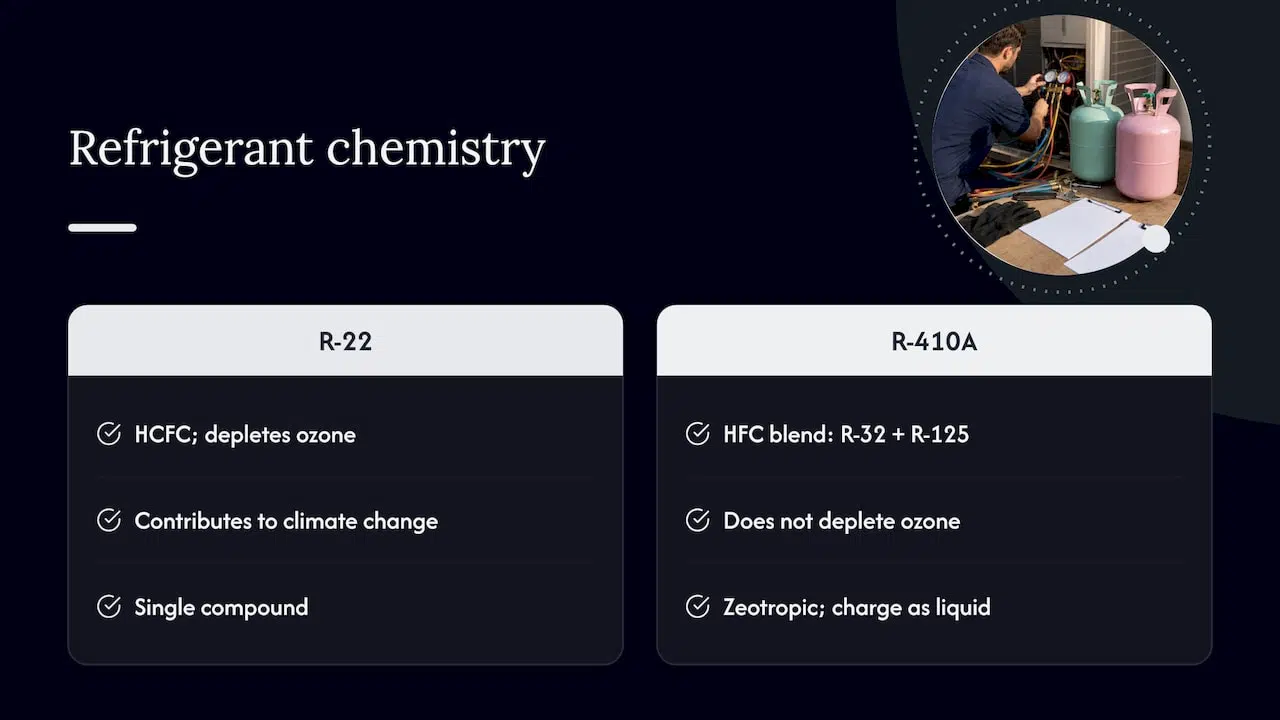
R-22 is an HCFC. EPA says it was phased out because HCFCs contribute to ozone depletion and climate change. R-410A is a non-ozone-depleting HFC blend of R-32 and R-125 used in new residential and commercial air-conditioning systems. That is why it took over in new equipment.
It is a blend, which matters in the field. R-410A is zeotropic, so it must be charged only as a liquid to prevent its components from separating. A technician who charges it as a vapor can leave the system with the wrong mix. R-22, being a single compound, does not have that problem.
Pressure
Pressure is the biggest practical gap. Typical R-410A operating pressures are 50% to 60% higher than R-22 at comparable conditions. So R-410A compressors, coils, line sets and service gauges are all built to withstand more. That is also why an R-410A system feels “tougher” than an R-22 one, with thicker-walled components.
Oil
R-22 systems use mineral oil. R-410A systems use polyolester (POE) oil, which absorbs moisture readily. That is one reason technicians are careful about keeping R-410A systems sealed and evacuated properly before charging.
Performance on hot days
Heat matters here in Southern California. In a NIST comparison, R-410A performance degraded more than R-22 performance as outdoor temperatures rose. Even so, R-410A operation stayed stable in every test, including tests up to 155°F with a customized compressor. In real homes, the design of the whole system (coil size, compressor, SEER rating) matters more than the refrigerant name alone.
Can you mix R-22 and R-410A, or swap one for the other?
No, and this is the most common and most expensive mistake.
Topping off the wrong system. R-410A is not a retrofit for R-22 equipment. Existing R-22 systems are not designed for R-410A’s higher pressures or its POE lubricant. Adding R-410A to an R-22 system risks damaging the compressor, and a system rated for R-22 pressures can be pushed past its limits.
Putting R-22 into an R-410A system. The reverse is also wrong. The compressor and oil are matched to R-410A, and the system’s controls and metering are sized for it.
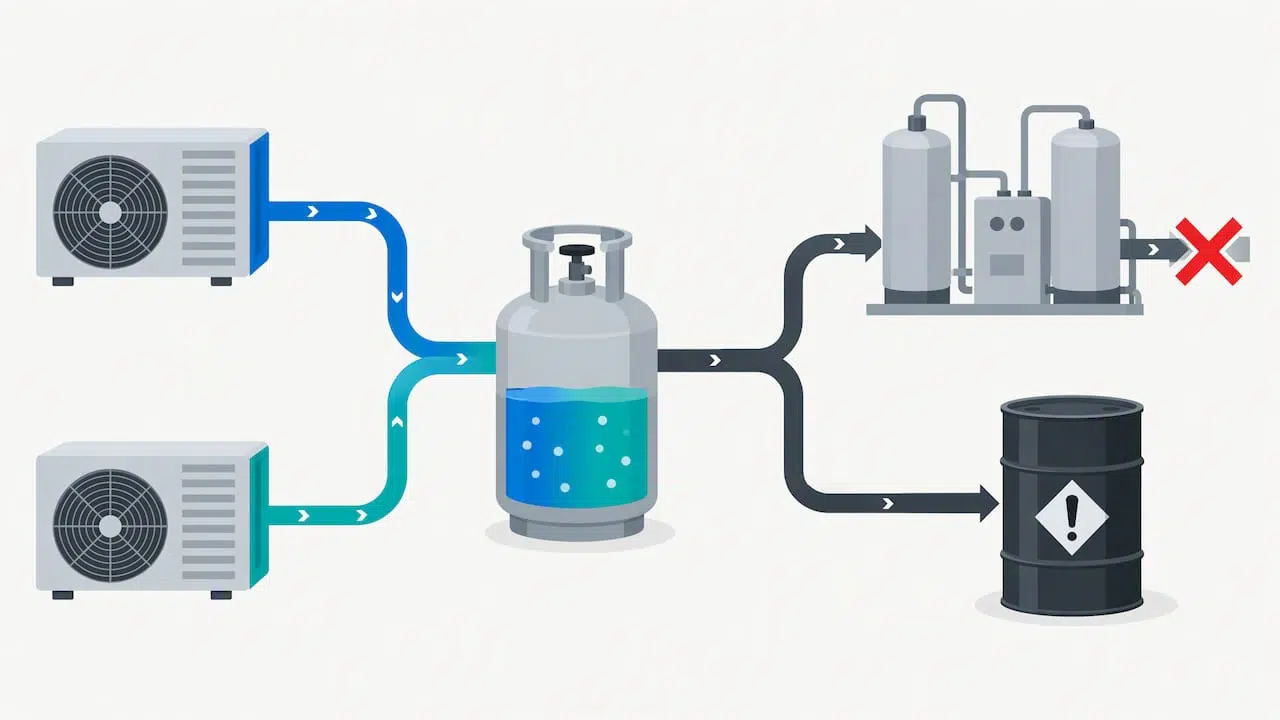
What happens if they do get mixed. The two will not react or form other compounds, but the mixture is hard to separate. A refrigeration engineering society handout goes further: the mixture cannot be separated by known on-site recovery devices or most off-site reclaimers, and incineration is recommended. In other words, a mix turns a recoverable charge into hazardous waste, which someone has to pay for.
Two more rules apply to any refrigerant work. Intentionally releasing refrigerant during repairs is illegal, and EPA advises homeowners to work with technicians certified to handle refrigerants under Section 608. This is not a job for a DIY kit from a hardware store.
How to tell which refrigerant your system uses
You do not need gauges to find out. Walk to the outdoor condensing unit and look for the data plate.
- Read the nameplate. It usually lists the refrigerant designation (R-22 or R-410A) and the factory charge in pounds and ounces. New residential air-conditioning and heat-pump equipment that uses HFCs must be labeled with the HFC or blend designation and date of manufacture.
- Look for trade names. R-410A is sold under names such as Gentron AZ-20, Suva 410A and Puron. Puron on a label means R-410A.
- Check the manufacture date. A unit built before about 2010 is a strong candidate for R-22. Units from the following years are mostly R-410A. The date on the plate is more reliable than a guess.
- Check inside the unit. Schematic diagrams and labels inside the unit can also give clues to the refrigerant type. Do not open the panel yourself if you are not trained to. Take a photo of the exterior plate and send it to your technician.
If the plate is faded or missing, a licensed technician can identify the system from the model number.
Why R-22 was phased out and what is available now
EPA announced that R-22 production and import would end in 2020 because it depletes the ozone layer. Recovered, recycled or reclaimed supplies remain available afterward. After 2020, only recycled, reclaimed or previously produced HCFC-22 can service existing equipment.
R-22 equipment is not illegal to own or run. You can keep using an R-22 system. The catch is the supply: as stocks shrink, refrigerant costs and repair costs rise. A small leak that was a cheap top-off years ago can now be a serious expense. For more on how a recharge works and why leaks matter, see our freon recharge basics for homeowners.
Is R-410A still available?
Yes. R-410A has not been banned. What changed is new equipment. Under EPA’s Technology Transitions program, new residential systems are moving to lower-global-warming-potential refrigerants. In September 2025 EPA proposed removing the installation deadline for equipment manufactured or imported before January 1, 2025, which would let industry sell through remaining R-410A equipment. That is a proposal, so ask your contractor which rules apply when you buy. Existing R-410A systems can still be serviced.
The long-term direction is clear, though. Federal research has already evaluated lower-GWP alternatives to R-410A for mini-split systems. If you are buying a new system today, expect to be offered one that uses a newer refrigerant, and ask your installer which one and what servicing it requires.
Repair or replace an R-22 air conditioner
This is where most homeowners with an older system get stuck. EPA’s guidance points to three things to compare: the cost of continued servicing and repairs, the efficiency gains from a new unit, and the likelihood of higher future service costs as R-22 stocks dwindle.
When repair usually makes sense
- The problem is not refrigerant-related, such as a failed capacitor, contactor, fan motor or thermostat.
- The system is otherwise in good shape and runs well.
- The leak is easy to locate and fix, and the refrigerant needed is small.
When replacement usually makes sense
- The compressor has failed. On an R-22 system, a compressor job plus refrigerant is hard to justify.
- The system leaks repeatedly. Every recharge is more R-22 at a rising price, and the leak is still there.
- The unit is well past the middle of its service life and your cooling bills are climbing.
- You also want better comfort, quieter operation or lower bills.
Efficiency is the other half of the decision. Newer models are rated by SEER, and ENERGY STAR qualified systems can save significantly on cooling costs. Our guide on how SEER rating affects HVAC repair decisions walks through the math, and our repair vs replacement guide covers the same trade-off for other appliances. If you are weighing efficiency tiers, inverter vs non-inverter AC is a useful comparison.
A practical checklist before you decide
- Get the refrigerant type and manufacture date from the nameplate.
- Ask the technician to find the leak before adding any refrigerant. Topping off without a leak test is money lost.
- Ask for the written cost of the repair, and a written cost of the refrigerant per pound.
- Ask what a replacement would cost, including the indoor coil and line set. An R-22 outdoor unit cannot simply be paired with a new R-410A coil.
- Compare the repair total with the cost of a new system, factoring in efficiency and expected years of service.
When you replace the system, you also have old equipment to get rid of. The refrigerant must be recovered by a certified technician, never vented. If your project includes an old refrigerator too, these refrigerator disposal options cover what to do with it.
Our perspective
Most calls we get about this topic start the same way: the air is not cold, and someone has told the homeowner the system “needs Freon.” Our view is that a refrigerant is never something that simply gets used up. If the charge is low, there is a leak, and the first job is to find it. That matters more with R-22, because the refrigerant is scarce and a repeated top-off is the most expensive way to avoid a decision.
We also see people confuse the two refrigerants because the labels are small and the units look alike. We would rather read the data plate with you than guess. A short call and a photo of the outdoor unit usually settles it before a technician is dispatched.
Our advice is simple. If your R-22 system has a minor, non-refrigerant fault, repair it. If it has a refrigerant leak, a failed compressor, or both, put the repair estimate next to a replacement quote and decide with the numbers in front of you. If you have an R-410A system, there is no urgency to replace it because of the refrigerant alone. Keep it maintained, and have leaks fixed properly.
Our technicians work on residential air conditioning and HVAC across Orange County and Los Angeles County, and we explain the options before any work starts. For more background, see our guide to what refrigerant is in HVAC.
— MDTECH
Get your system checked in Orange County or Los Angeles County
If you are not sure which refrigerant your air conditioner uses, or you are deciding between repairing and replacing it, we can inspect it, identify the refrigerant, locate the problem and give you the options in plain terms. Our team handles air conditioning and HVAC repair and air conditioning installation, and you can book online.
For what to expect on a visit, see our HVAC repair process for homeowners.
FAQ
Is R-410A better than R-22?
For new equipment, yes in most respects. It does not deplete the ozone layer, and it is what R-22 systems were replaced with. It does run at higher pressure and needs POE oil, so the equipment is built differently. Which refrigerant you have matters less than the condition of the system.
Can I replace R-22 with R-410A in my existing air conditioner?
No. R-410A is not a drop-in replacement. Existing R-22 equipment is not built for its higher pressure or its POE lubricant. Switching refrigerants means replacing the major components, which is why most homeowners replace the system instead.
Why was R-22 banned?
It was phased out because HCFCs contribute to ozone depletion and climate change. Production and import ended in 2020. It is not illegal to run an existing R-22 system, and reclaimed supplies can still service it.
Can I buy R-410A and charge my AC myself?
We do not recommend it. R-410A must be charged as a liquid, the pressures are high, and EPA advises working with Section 608 certified technicians. Adding refrigerant without fixing a leak also does not solve the problem.
What happens if R-22 and R-410A are accidentally mixed?
They will not react chemically, but the mixture is very difficult to separate. The charge usually has to be disposed of, and the system performs poorly in the meantime. Call a certified technician rather than trying to correct it yourself.
Sources
- A Comparison of an R22 and an R410A Air Conditioner (NIST)
- Forane R-410A Tech Digest
- HVAC Contractors’ Guide to Troubleshooting Cooling Systems (ACHR News)
- R-410A Info (RSES)
- Purchasing and Repairing Home Air-Conditioners or Heat Pumps (EPA)
- Phasing Out HCFC Refrigerants to Protect the Ozone Layer (EPA)
- Technology Transitions Proposed Rule Summary (EPA, September 2025)
- Alternative Refrigerant Evaluation for Mini-Split Air Conditioners (DOE)
- Labeling Fact Sheet (EPA, December 2024)
- Appliances Quick Start Guide (EPA)