
The most common sign of a gas leak is a smell like sulfur or rotten eggs. Other signs are a hissing or roaring sound near a gas line, bubbles in standing water, dead patches of grass or plants, and symptoms like headache or dizziness. If you notice any of them, do not investigate. Leave the home, then call your gas utility and 911 from a safe distance.
This guide covers each sign in detail, why the smell sometimes fails, which body symptoms matter, and the exact order of steps to take. It is written for homeowners and property managers in Orange County and Los Angeles County, but the warning signs apply anywhere natural gas is used.
TL;DR
- Natural gas has no smell of its own. Utilities add an odorant that smells like rotten eggs or sulfur, so that smell means leave.
- Other signs: hissing or roaring, bubbling water, blowing dirt, dead vegetation, a white mist, and unexplained headache, nausea or dizziness.
- If you suspect a leak, get everyone out first. Do not use switches, phones inside, or appliances, and do not try to find the source.
- Call your gas utility and 911 from outside. In Southern California Gas territory, the utility’s leak line is 1-800-427-2200.
- Do not go back in until the utility or emergency crews say it is safe.
Table of Contents
- The smell: what a gas leak actually smells like
- The sounds: hissing, whistling and roaring
- The sights: signs inside and outside the house
- Body symptoms of gas exposure
- What to do if you smell gas
- Common causes of gas leaks at home
- Appliance-specific warning signs
- Gas detectors: an added layer
- Getting it fixed after the all-clear
- Book a licensed technician in Orange and Los Angeles counties
- FAQ
- Sources
The smell: what a gas leak actually smells like
Natural gas in its natural state is odorless. According to the American Public Gas Association, utilities add mercaptan, a safe, non-toxic odorant, to give it a smell similar to sulfur or rotten eggs. PHMSA adds that distribution systems, the pipes that serve homes, are odorized, while larger transmission and gathering pipelines are not.
People describe the smell in different ways: rotten eggs, sulfur, a skunk-like or cabbage-like odor. What matters is that it is out of place. A faint whiff near a stove just after you light a burner can be a brief puff of unburned gas. A smell that lingers, grows stronger, or shows up in a room with no burner running is a different matter.
Why you cannot rely on your nose alone
The smell can fade. Con Edison explains that odor fade can occur through adsorption, absorption, oxidation, newly installed piping, rust, moisture, gas composition, pressure, flow, or underground soil conditions. In plain terms, the odorant can get stripped out before the gas reaches you, so a leak may smell weaker than you expect or not at all.
Southern California’s utility says the same thing: because of odor fade, do not rely only on your sense of smell to alert you to a leak. Treat the other signs below as equally serious.
A few situations make smell less reliable:
- A diminished sense of smell, from a cold, allergies, age or medication.
- Newly installed gas piping or a recently converted appliance.
- A home that has been closed up for days, where you may adapt to a low odor.
For anyone with a diminished sense of smell, the D.C. Public Service Commission recommends buying a residential gas leak detector as an added layer of safety.
The sounds: hissing, whistling and roaring
Gas escaping under pressure makes noise. Puget Sound Energy describes hissing for a small perforation and roaring for a large break. National Grid also lists whistling or roaring from gas pipes as a sign of a gas emergency.
In a house, listen near:
- The gas meter and the pipe running to it
- The line behind a stove, dryer or water heater
- The flexible connector between an appliance and the wall valve
- Any exposed gas pipe in a garage, utility closet or crawlspace
If you hear a steady hiss and nothing else explains it, that is enough reason to leave.
The sights: signs inside and outside the house
You do not have to be inside to spot a problem. Underground pipes can leak into the yard, and the gas can travel. The D.C. commission notes that outdoor leaks on underground lines need prompt action because of gas migration, meaning gas can move through soil and show up somewhere other than where the pipe is damaged.
The Illinois Commerce Commission lists an unusual area of dead vegetation around the house, and blowing dirt or bubbling water outdoors. PHMSA lists several more visual clues: discolored or abnormally dry soil, continuous bubbling in water, an oily sheen on water, vaporous fogs, and fire coming from the ground. The Indiana Utility Regulatory Commission also names frozen ground in warm weather and dead plants or grass.
A quick reference:
| Where | What you notice | What it can mean |
|---|---|---|
| Yard | Dead or dry patch in an otherwise green lawn | Gas seeping from an underground line |
| Yard or driveway | Dirt blowing from a hole, bubbles in a puddle | Escaping gas under pressure |
| Near the meter | White cloud, mist or fog | Gas venting or leaking |
| Inside | Hissing near a pipe or appliance | Small to large leak at a fitting or line |
| Inside | Burner flame much higher or lower than normal, or no gas at all appliances | Pressure or supply problem, call the utility |
The abnormal flame and no-gas items come from National Grid’s list of conditions it treats as a gas emergency. That list also includes gas to an appliance that cannot be shut off and continuous water flow from a gas heating unit.
Soapy water: a check for the connection, not a green light
The IURC notes that soapy water applied to gas connection points may show bubbles if gas is escaping. That is a way to confirm a suspicion at a known connection, but it is not a reason to stay in a home where you smell gas. If you smell gas, leave first. Bring in a licensed professional to inspect and repair the line. Our guide to a step-by-step gas line inspection explains what a thorough check looks like.
Body symptoms of gas exposure
Natural gas is non-toxic, but it displaces oxygen. Nicor Gas says that in severe cases it may lead to asphyxiation, and it can ignite near a spark. Poison Control lists these symptoms of natural gas inhalation:
- Nausea and vomiting
- Headache and dizziness
- Confusion and changes in vision
- Memory problems and poor coordination
- Feeling sleepy, and in the worst case, coma
People’s Gas also lists eye irritation and coughing among the hazards. The IURC says you may feel light-headed or have a headache if gas begins to displace oxygen in the room.
A useful pattern: symptoms that improve when you step outside and return when you go back in point to something in the home. If anyone is confused, very drowsy, vomiting or has passed out, call 911 immediately and tell the dispatcher you suspect gas.
How long until gas is harmful?
There is no single safe clock. The Florida utility handbook for first responders, published by FPU, notes that tests show a 25% natural gas and air mix produced no ill effects, but if gas displaces the air in an enclosed space, suffocation can occur from the lack of oxygen. The faster danger is fire. Gas becomes explosive at a narrow range: the IURC says it takes only 5 to 15 percent gas in the air. The handbook puts the ignition point at 1,100 to 1,200 degrees Fahrenheit, which pilot lights, matches, flint sparks and sparks from switches or motors can reach.
So the real answer is that you do not wait to find out. A small leak in a closed room can build up into an explosive mix without anyone feeling ill.
Gas leak or carbon monoxide?
They are different problems that can overlap. Poison Control notes that incomplete combustion of natural gas can sometimes form carbon monoxide, a poisonous gas. National Grid lists headache, nausea, lethargy, disorientation and combativeness as carbon monoxide symptoms. If a gas appliance is burning poorly (yellow or orange flame, soot, a stuffy smell) and people feel unwell, treat it as an emergency too: get outside into fresh air and call 911.
What to do if you smell gas
The steps are consistent across regulators and utilities. In order:
- Stop what you are doing. Do not light anything, and do not hunt for the source.
- Get everyone out. Take family members and pets. The New Hampshire Department of Energy says to tell others to leave and close the door behind you.
- Move away. The Illinois Commerce Commission and New Hampshire both say to get at least 300 feet away.
- Call from outside. Call your gas utility’s emergency line and 911. San Diego Gas & Electric advises calling from a safe location, and Con Edison says not to assume someone else already called.
- Stay out. Do not go back in until utility personnel or emergency services give the all-clear.
What not to do
New Hampshire’s guidance is specific: do not use electrical switches, telephones, appliances or garage door openers inside the home, and do not stop to open doors or windows to ventilate. The IURC similarly says not to flip light switches or do anything that could cause a spark. SDG&E adds that you should not smoke or light a match, and warns that gas leaking from a plastic pipe can create static electricity that can ignite it.
You may see advice elsewhere to open doors on your way out. The D.C. commission suggests leaving doors open behind you to help ventilate. Your priority is leaving quickly and without creating a spark. Do not make extra trips for belongings or to open windows.
Who to call in Orange and Los Angeles counties
In Southern California Gas territory, SoCalGas says to evacuate and call 1-800-427-2200 from a safe location, and to call 911 promptly if damage may endanger life or property or if you cannot reach the utility. Check your gas bill to confirm which utility serves your address. Most neighborhoods in the two counties are served by SoCalGas, though some areas have a different provider.
The utility handles the meter and the line up to your home. Once the immediate danger is cleared, the piping and appliances on your side of the meter are the homeowner’s responsibility, so you will need a licensed technician to find and fix the cause.
Our view: after the emergency
Most gas leak calls we hear about start small: an oven that smells off, a dryer that was moved and reconnected, a water heater that was serviced. The home is rarely the scene of a dramatic pipeline failure. It is usually a connector, a valve or a fitting that has worn or was not tightened properly.
That is why we treat a gas smell as a stop-everything situation, then a repair job done once, correctly, by a licensed technician. Our technicians handle appliance repair, appliance installation, gas conversions and plumbing work across Orange County and Los Angeles County, so the person who checks the appliance also understands the line behind it.
Our advice to homeowners is simple. Do not wait for a smell you are sure of. If something seems wrong with a gas appliance, get it looked at. Safe installation, clear communication about what we find and a repair that fixes the cause are what we aim for on every visit.
MDTECH
Common causes of gas leaks at home
Knowing where leaks start helps you spot trouble early. Utilities and regulators point to several causes:
- Digging. The IURC says the leading cause of gas leaks is damage to pipelines from digging by homeowners and contractors. It advises contacting 811 before any project begins; in California, 811 is the call-before-you-dig number, so confirm timing on the official page before planning a dig.
- Loads and breaks. People’s Gas lists puncturing a pipeline, extreme loading over buried facilities, water main breaks, heavy ice on outside meters, fire or explosion nearby, equipment failure and human error. It also lists natural events such as floods and earthquakes. In California, earthquakes are the one that matters most.
- Appliance connections. Worn flexible connectors, loose fittings and aging shutoff valves at the stove, dryer, furnace or water heater.
- New or changed gas work. A moved range, a new dryer, a converted appliance, or fresh piping can all introduce a poor connection, and new piping is also one reason odor can fade.
After an earthquake, even a moderate one, check for gas signs before you resume normal use. If you smell gas, follow the steps above.
Appliance-specific warning signs
Gas appliances give their own hints before a leak becomes obvious:
- Gas range or oven: a gas smell when the oven is off, burners that will not light cleanly, or a flame that looks irregular. See our guide on safe checks after you smell gas from your oven.
- Dryer: a gas smell when the dryer runs, or a connection that was disturbed during cleaning or moving.
- Water heater and furnace: a smell near the unit, soot or scorch marks, or a pilot that keeps going out.
- Any appliance: a flame that is unusually high or low, or gas that cannot be shut off, which National Grid treats as an emergency condition.
If a smell is present, the answer is the same as above: leave, call, wait for the all-clear. Only then book a technician. Our gas appliance safety checklist lists the routine checks to run once the home is cleared, and our article on why timely gas line checks matter explains when to schedule one even without a smell.
Gas detectors: an added layer
Detectors help most when your nose cannot be trusted or the leak is in a room you are not in. The D.C. commission recommends that a residential gas leak detector be UL 1484 certified. Because natural gas is lighter than air, it advises mounting it high on the wall, typically 6 to 12 inches from the ceiling. Follow the manufacturer’s placement instructions, and note that propane is heavier than air, so propane appliances call for a different placement than the one for natural gas.
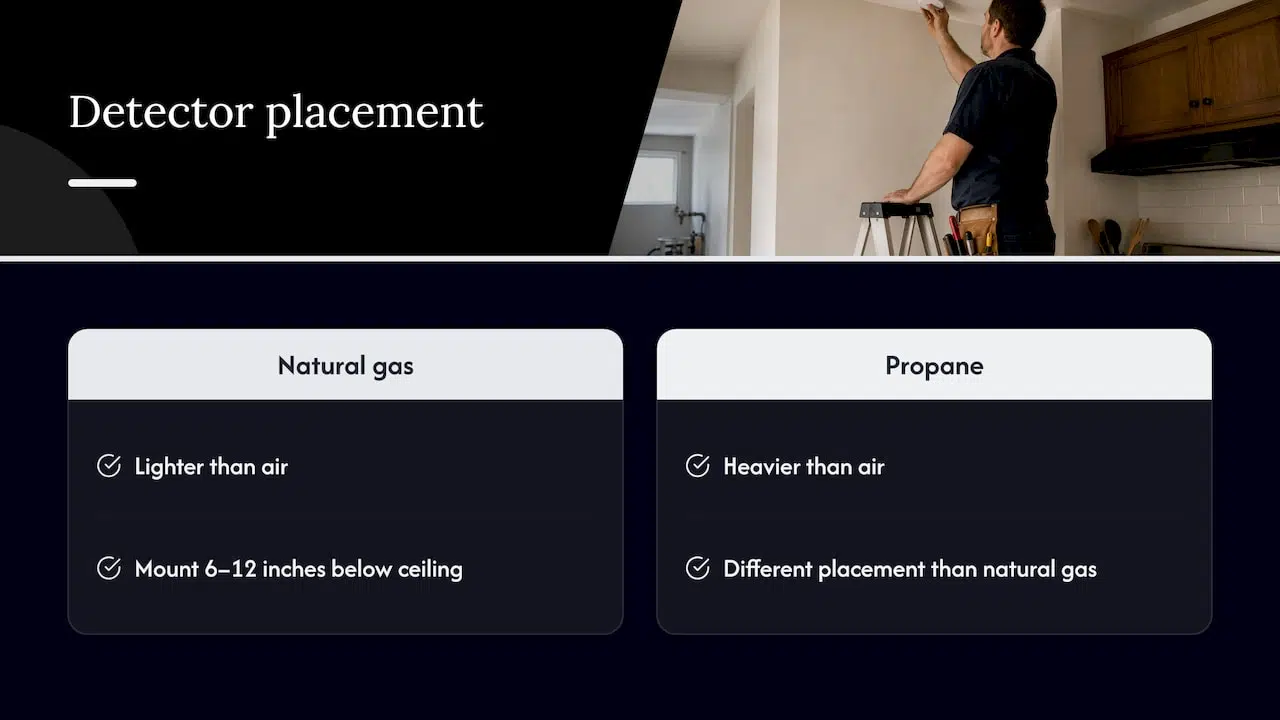
A detector does not replace the steps above. If it sounds, leave and call, the same as if you had smelled gas.
Getting it fixed after the all-clear
Once the utility has cleared the home, the work is to find the cause and fix it. That means a licensed technician checks the appliance, connector, valve and visible line, and repairs or replaces what failed. Our page on professional gas line repair covers what that work involves.
Do not relight pilots, reconnect appliances or restore service yourself until the cause is found. If the utility shut off your gas, it will tell you what is needed before service resumes.
Book a licensed technician in Orange and Los Angeles counties
If a gas appliance has given you a scare, or you want a line or connector checked before a problem starts, we can help. We repair and install residential appliances, including ovens, dryers and kitchen appliances, and we handle gas conversions, HVAC and plumbing across Orange County and Los Angeles County. You can book online, and our licensed technicians will explain what they find before any work begins.

See our appliance repair services or our appliance installation services to book a visit. If you smell gas right now, do not call us first. Leave the home and call your utility and 911.
FAQ
How can you tell if there is a gas leak?
Look for a rotten-egg or sulfur smell, a hissing or roaring sound, bubbling water, blowing dirt or dead vegetation outdoors, and unexplained headache or dizziness indoors. Because odor can fade, treat any one of these as a reason to act even if you cannot smell anything. Leave the home and call the utility and 911 from outside.
What should I do if I smell gas in my house?
Get everyone, pets included, out right away without flipping switches or using appliances. Move at least 300 feet away, then call your gas utility and 911. Stay out until the utility or emergency crews say it is safe.
Can a gas leak make you sick?
Yes. Natural gas displaces oxygen, and Poison Control lists nausea, headache, dizziness, confusion, vision changes and drowsiness as symptoms. Severe exposure can cause unconsciousness. If anyone is confused, very sleepy or has passed out, call 911 and move them into fresh air if you can do so safely.
Are there warning signs before a gas explosion?
Yes, the same signs as a leak: the odor, hissing, bubbling water, vapor clouds and dead plants. Gas is explosive at only 5 to 15 percent in the air, and ordinary sparks can ignite it. That is why the guidance is to leave immediately and avoid anything that could cause a spark.
Is it safe to look for the leak myself?
No. Searching for the source keeps you in a space that may already contain an explosive mix. Leave, call the utility, and let trained responders find it. After the all-clear, have a licensed technician repair the cause.
Sources
- American Public Gas Association: Natural Gas Safety
- DCPSC: Natural Gas Leaks
- PHMSA: Pipeline Leak Recognition and What to Do
- Con Edison: Gas Safety Tips
- Illinois Commerce Commission: Gas leak
- Puget Sound Energy: What to Do About Natural Gas Leaks
- National Grid: Report a Gas Emergency
- IURC: Learn to recognize the signs of a gas leak
- Nicor Gas: Emergency Information
- Poison Control: Natural gas
- People’s Gas: Safety guide
- FPU: Gas Safety Handbook for First Responders
- New Hampshire Department of Energy: What To Do If I Smell Gas
- San Diego Gas & Electric: Gas leaks
- SoCalGas: Natural Gas Leaks