
Most ovens reach 350°F in roughly 12 to 20 minutes. If yours takes noticeably longer than that, or longer than it used to, something is usually off: a worn heating element or igniter, a drifting temperature sensor, a leaky door seal, or low voltage at the outlet. Some of these you can rule out in ten minutes with no tools. Others need a technician. This guide shows you which is which.
TL;DR
- A normal preheat to 350°F takes about 12 to 20 minutes, depending on oven type. Higher temperatures add time.
- Run a simple timing test first: empty oven, one rack, 350°F, door closed. Over 20 minutes means the oven needs service.
- The usual culprits are a weak bake element or gas igniter, a faulty temperature sensor, a worn door gasket, extra racks, and low voltage.
- Gas smells, tripping breakers, control board faults and hidden wiring are jobs for a licensed technician, not for a home fix.
Table of Contents
- How long should an oven take to preheat?
- Run a simple preheat test first
- Quick checks that cost nothing
- What usually causes an oven to heat slowly
- Gas versus electric: what to expect
- Get the most from a healthy oven
- When to call a technician
- Book an oven repair in Orange County or Los Angeles County
- FAQ
- Sources
How long should an oven take to preheat?
The honest answer is that it depends on the oven and the temperature you set. Manufacturers publish their own ranges, and they overlap more than they disagree.
Whirlpool says reaching 350°F generally takes about 12 to 15 minutes, with about five more minutes for every 100 degrees above that. It puts 350 to 400°F at about 15 to 20 minutes and 400 to 450°F at about 20 to 25 minutes. KitchenAid’s product help page gives the same 12 to 15 minutes for 350°F with all racks in.
GE Appliances breaks it down by oven design:
| Oven type | Typical preheat time (GE) |
|---|---|
| Electric, hidden bake element | 15 to 20 minutes |
| Gas oven | 15 to 20 minutes |
| Electric, hidden bake element with Fast Preheat | 7 to 10 minutes |
| Electric, visible bake element | 5 to 10 minutes |
So “is 20 minutes normal?” Often yes, especially for a gas oven, a hidden-element electric oven, or a setting of 400°F or higher. Thirty minutes to reach 350°F is not normal on any of them.
A few details explain why your neighbor’s oven seems faster than yours. According to GE, every 25 degrees above a 350°F setting adds roughly 45 to 60 seconds, and each extra rack adds about 30 seconds. A 208-volt installation instead of 240-volt can lengthen preheat by 25%. Newer ovens also tend to have larger cavities, which take longer to fill with heat, KitchenAid notes.
Run a simple preheat test first
Before you decide the oven is failing, put a number on the problem. Samsung’s US support guidance offers a clean method:
- Empty the oven and leave one rack inside.
- Set it to bake at 350°F.
- Start a timer and keep the door closed the whole time.
- Stop the timer when the oven signals that it has preheated.
The oven should signal within 20 minutes. Samsung also advises against using a thermometer for this check. If it takes longer, the oven needs service. Write down your time. A technician can use it to narrow the cause quickly, and it gives you a baseline if the problem gets worse.
Note what you have: gas or electric, a visible element on the oven floor or a hidden one under the surface, and whether the oven has a Fast Preheat or rapid preheat mode. Those three facts change what “normal” means.
Quick checks that cost nothing
Several slow-preheat problems are not repairs at all. Work through these before you book anything.
Reset the power to the oven
GE suggests that for an oven taking much longer than normal, you turn off the circuit breaker for the range or wall oven, wait 30 seconds, then switch it back on. This confirms the breaker is seated properly and the oven is getting full power. Only operate the breaker at the panel. Never open the oven’s wiring compartment yourself.
Pull out unused racks
Racks soak up heat. Leaving extra ones in is one of the factors KitchenAid lists for longer preheats, and GE puts the cost at about 30 seconds per rack. Keep the one you plan to use and take out the rest.
Keep the door shut
Opening the door to peek lets the heat out, and KitchenAid lists a door left open for an extended time among the causes of long preheats. Trust the timer and the preheat signal.
Check the door seal
Look along the gasket around the door. Is it flattened, frayed, torn or missing in places? Close the door and look for gaps at the corners or the hinge side. Martha Stewart’s reporting quotes appliance technician Andrei Suprunov explaining that a damaged gasket or bent hinges can keep the door from closing completely, letting heat escape and stretching out preheat time.
Clear the vents and skip the foil
The same Martha Stewart piece recommends keeping oven vents clear and avoiding aluminum foil lining inside the oven, both of which can interfere with airflow and heat distribution. Food debris and spills near vents are worth wiping up once the oven is cool.
Think about the room and the setting
A cold kitchen slows things down, and a high setting takes longer than a moderate one. Neither is a defect. If the oven only seems slow when you set it to 450°F in January, compare it against the time ranges above before assuming something is broken.
What usually causes an oven to heat slowly
If the test runs long and the quick checks change nothing, one of these parts is the likely cause.
A weak or failing bake element (electric ovens)
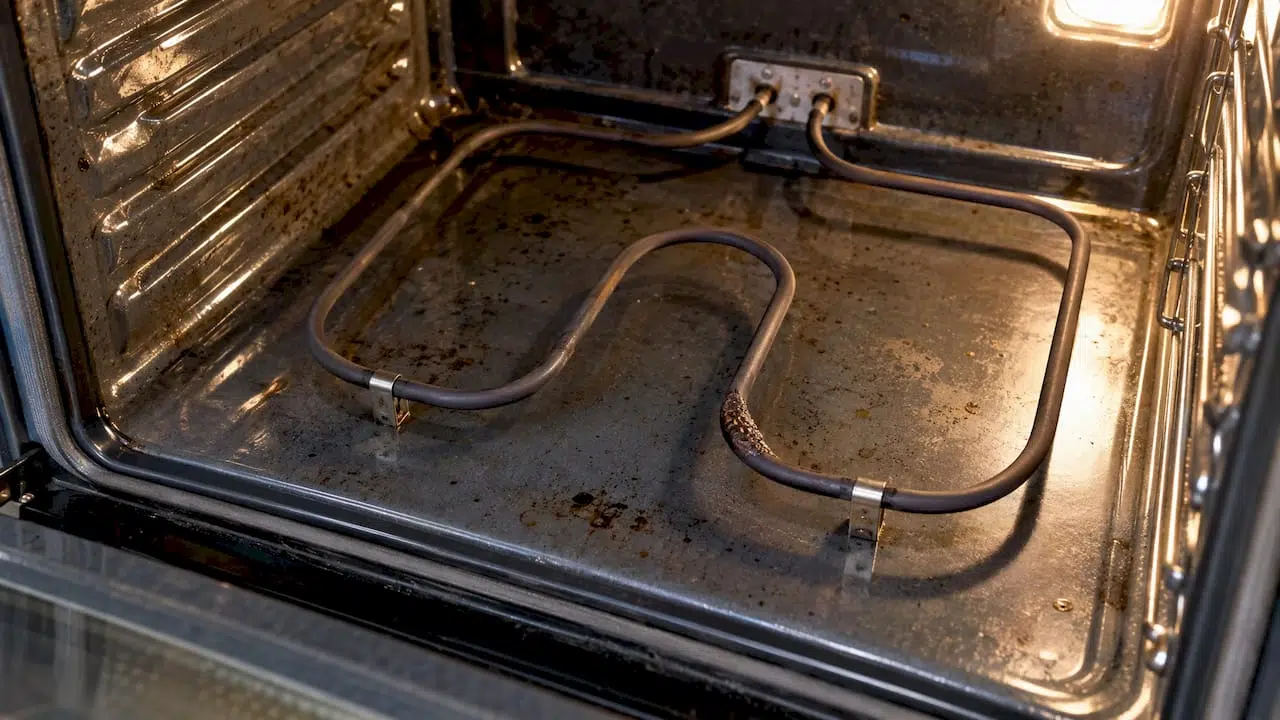
The bake element is the main heat source in an electric oven. When it ages, it can lose output, so the oven climbs toward temperature slowly or never gets all the way there. Martha Stewart’s reporting lists a faulty heating element among the main reasons for slow preheating. Some are visible on the oven floor, and some are hidden under the surface. A visible element that is blistered, cracked or has dark spots is a clear sign. A hidden element is harder to judge, and replacing it involves internal wiring, which is a technician’s job.
A weak igniter (gas ovens)
In most modern gas ovens, a hot surface igniter does two jobs. The U.S. Consumer Product Safety Commission’s research on gas range ignition explains that it acts as the ignition source and also as a timing switch for the gas valve, because the valve will not open until the igniter has drawn enough current. That safety design is why a tired igniter causes delay: it may glow, but if it cannot pass enough current, the gas valve opens late or not at all.
Technical guides written for the trade describe the weak igniter as the most frequent igniter fault. As it ages its resistance rises and it draws less current, so it can still glow brightly but open the valve slowly, and the oven reaches its set temperature late. If your gas oven used to preheat quickly and now crawls, the igniter is a prime suspect.
One more gas note. Martha Stewart’s source mentions ignition problems among the causes, and Samsung’s and others’ guidance is consistent that gas work is not a DIY matter. If you smell gas at any point, stop, leave the area and treat it as an emergency. More on that below.
A drifting temperature sensor
The oven sensor tells the control board how hot the cavity is. If it reads wrong, the oven may keep heating longer than needed, shut off early, or behave oddly during preheat. Martha Stewart’s reporting includes a malfunctioning temperature sensor among the reasons for slow preheating. Sensor trouble often shows up as food that cooks unevenly or comes out under- or over-done. If that sounds familiar, our guide to an oven not heating evenly walks through the tests.
Heat escaping around the door
A worn gasket or loose hinge turns the oven into a leaky bucket. The heating parts work, but the heat has somewhere to go. You may also feel warm air along the door edges or notice heat rising around the control panel. Gasket replacement is usually straightforward for a technician, and it is a common reason an oven that “works fine” still takes forever.
Airflow or electrical connection problems
KitchenAid says a preheat much longer than 12 to 15 minutes can point to an airflow or electrical connection issue. On convection models, a failing convection fan can be part of that picture. If you are weighing the two oven styles, see our comparison of convection and conventional ovens.
Low voltage at the outlet
Electric ranges are designed for 240 volts. Samsung notes that if the voltage is below 240V, preheat time increases, and that this by itself is not something the appliance repair addresses. KitchenAid’s Katie Rush, quoted by Martha Stewart, points out that in buildings with elevators, ovens are often fed with 208V service, which can make preheating take longer than expected. If you live in an apartment or condo and the oven has always been a bit slow, this may be the explanation. Building electricians and property managers are the people to ask about it.
Gas versus electric: what to expect
Katie Rush of KitchenAid says in the Martha Stewart piece that gas ovens typically preheat faster than electric ones because gas heats quickly, and that some electric ovens offer a rapid preheat mode that uses multiple heating elements at once. Manufacturer tables still list gas at 15 to 20 minutes, so do not be surprised if your gas oven sits in that range. What matters is change over time: the same oven that now takes noticeably longer than it did last year is telling you something.
A few patterns help you read the symptoms:
- Electric, slow from the start, with visible damage to the element: likely the bake element.
- Gas, igniter glows but the flame takes a long time to appear: likely a weak igniter.
- Either type, food cooks unevenly and the preheat signal comes too early or too late: possibly the sensor.
- Either type, warm air leaking at the door: gasket or hinges.
- Either type, slow since the day it was installed or since a move: check the voltage and the setup.
For a wider look at ovens that struggle to heat, our article on why ovens won’t heat up covers the full range of faults, and the oven troubleshooting guide for homeowners lists safe checks in order.
Get the most from a healthy oven
Once the oven is performing normally, you do not need to over-preheat. Bon Appétit reports that about 20 minutes covers most preheating needs, and that going beyond 30 minutes does no extra good while it raises your utility bill. Use the preheat signal as your guide, give heavier dishes a few extra minutes only if the recipe calls for it, and cook with the fewest racks you need.
What we see in the field
At MDTECH we hear the same story from homeowners across Orange County and Los Angeles County: “It still heats, it just takes forever.” That sentence usually describes a part that is on its way out, not one that has already failed. A weak igniter, a tired bake element or a worn door gasket costs far less to fix early than after the oven stops working in the middle of a family dinner.
Our approach is to treat the preheat time as a measurement. We ask how long the oven takes to reach 350°F, whether it is gas or electric, and whether the oven has changed over time. With those answers our licensed technicians arrive knowing what to look at first, which keeps the visit focused.
We also believe in being straightforward about safety. Gas ignition parts, control boards and the wiring behind hidden elements are not weekend projects. They are exactly the repairs a trained technician should handle, so the oven works as designed and the kitchen stays safe.
MDTECH
When to call a technician
Home checks have a ceiling. Stop and book service if any of these apply:
- The timing test runs past 20 minutes with one rack, door closed, at 350°F. Samsung’s guidance says to request service at that point.
- You smell gas or suspect a problem in the gas line. Do not use the oven or any switch or flame. Leave the home and contact your gas utility or emergency services from outside.
- The breaker keeps tripping when the oven runs.
- The control board or gas safety valve may be failing, for example, the oven shuts off unpredictably or the display acts strangely.
- The fix involves a hidden heating element or internal wiring.
That list follows the guidance in AHS’s oven troubleshooting article, and it matches the safety logic above. Power off at the breaker before anyone opens an access panel, and let the oven cool completely first.
If you are deciding whether a repair makes sense on an older range, our page on repair versus replacement covers how to think it through. Our step-by-step oven repair guide also explains what a technician does during a visit.
Book an oven repair in Orange County or Los Angeles County
If your oven is taking too long to preheat, we can diagnose it and fix it. MDTECH sends licensed technicians to homes across Orange County and Los Angeles County for kitchen appliance repair, including ovens, ranges, refrigerators, dishwashers, washers and dryers. You can book online, and it helps to tell us the oven’s brand, whether it is gas or electric, and how long it takes to reach 350°F.
See our kitchen appliance repair page for what we cover, or go to our appliance repair services page to book your appointment.
FAQ
Is it normal for an oven to take 20 minutes to preheat?
Yes, in many cases. Manufacturers such as GE list 15 to 20 minutes for gas ovens and hidden-element electric ovens, and Whirlpool puts 350 to 400°F at about 15 to 20 minutes. If it takes much longer than 20 minutes to reach 350°F with one rack in, the oven should be serviced.
How long should it take to preheat an oven to 400 degrees?
Whirlpool’s range for 350 to 400°F is about 15 to 20 minutes, and 400 to 450°F takes roughly 20 to 25 minutes. Your exact time depends on the oven type, the number of racks, the kitchen temperature and the voltage supplied to the oven.
How do I get my oven to preheat faster?
Remove unused racks, keep the door closed, keep the vents clear and skip aluminum foil in the oven. Check that the door gasket seals all the way around. If your oven has a rapid or Fast Preheat mode, use it. If none of that helps, a worn element, igniter or sensor is the likely cause.
Why is my gas oven slow to heat up?
The most common reason is a weakening igniter. It may glow, yet not pass enough current to open the gas valve quickly, so the burner lights late. A damaged door seal can also let heat escape. Because this involves gas, have a licensed technician inspect it, and leave the home if you ever smell gas.
Can low voltage make an oven slow to preheat?
Yes. Electric ranges are built for 240 volts, and Samsung says lower voltage increases preheat time. GE says a 208V installation can lengthen preheat by about 25%. This is common in apartment buildings, so ask your property manager or an electrician about the service to your unit.
Sources
- How Long Does it Take to Preheat an Oven? | Whirlpool
- Long Pre-Heat Times for Oven | KitchenAid
- Range & Wall Oven – Preheat Time Too Long | GE Appliances
- Samsung oven temperature issues
- Your Oven Shouldn’t Take Forever to Preheat | Martha Stewart
- Gas Range Delayed Ignitions | U.S. Consumer Product Safety Commission
- Oven Igniters: Gas Ovens That Won’t Heat | InspectandTest
- Oven Not Heating Up: Possible Causes and Fixes | KitchenAid
- How Long Does It Take to Preheat An Oven? | Bon Appétit
- Oven Not Working? 7 Common Oven Fixes | AHS