
A counter-depth refrigerator is shallower, so it sits close to flush with your cabinets and gives the kitchen a built-in look. A standard-depth refrigerator is deeper, so it holds more food and usually costs less. If your kitchen is tight or you care about a clean line of cabinetry, counter-depth is usually the better fit. If you cook for a big household or buy in bulk, standard depth usually serves you better. Below you will find the real numbers, the catches in the labels, and a measuring routine that prevents a delivery-day surprise.
TL;DR
- Standard-depth fridges typically run about 30 to 36 inches deep and stick out past your cabinets. Counter-depth models are usually 24 to 30 inches deep without handles.
- You give up interior space. A typical comparison is roughly 4 to 8 cubic feet, and shelves get shallower.
- Counter-depth models often cost more than comparable standard-depth ones, despite holding less.
- The label is loose. Many “counter-depth” freestanding models still stick out, so check the full spec sheet, including handles and door swing.
- Measure the opening, the walls and the delivery path before you order.
Table of Contents
- Counter-depth vs. standard-depth at a glance
- What “counter-depth” actually means
- How much storage you give up
- Why counter-depth models often cost more
- Disadvantages of each depth, so you can choose well
- How to measure before you buy
- Which one fits your household
- Perspective: what we see in real kitchens
- Get the fridge installed correctly
- FAQ
- Sources
Counter-depth vs. standard-depth at a glance
The published ranges vary a little by source, because brands do not use one fixed definition. The table below pulls together the figures from the guides we reviewed.
| Feature | Standard-depth | Counter-depth |
|---|---|---|
| Typical depth | 30 to 36 inches | 24 to 30 inches, excluding handles |
| Position vs. cabinets | Extends past the cabinet fronts | Sits flush or nearly flush |
| Typical capacity in one US comparison | About 25 to 28 cu. ft. | About 20 to 23.8 cu. ft. |
| Shelf depth | Often 17 to 20 inches | Often 13 to 14 inches |
| Price | Usually lower | Usually higher |
| Best for | Large households, bulk shopping | Tight kitchens, a built-in look |
The capacity and shelf figures come from the Wirecutter counter-depth guide, which compared typical US models. Treat them as a typical range, not a promise for any one model. Capacity also depends on width, height, layout and fridge style.
What “counter-depth” actually means
Kitchen base cabinets and countertops are commonly 24 to 25 inches deep. A counter-depth refrigerator is built to line up with that edge, so the fridge body does not push out into the walkway. A standard-depth unit, by contrast, hangs out past the cabinetry. If you want to see how those cabinet depths work, how deep base kitchen cabinets are is a good place to confirm your own run before you compare fridges.
Why the label can mislead
There is no single rule for the term. Wirecutter notes that manufacturers use “counter-depth” inconsistently, and many freestanding models still jut out past the counter. Wirecutter describes true counter-depth units as no deeper than about 24 to 25 inches, while standard freestanding units usually measure 31 to 36 inches from the back wall to the door front. Handles can add more.
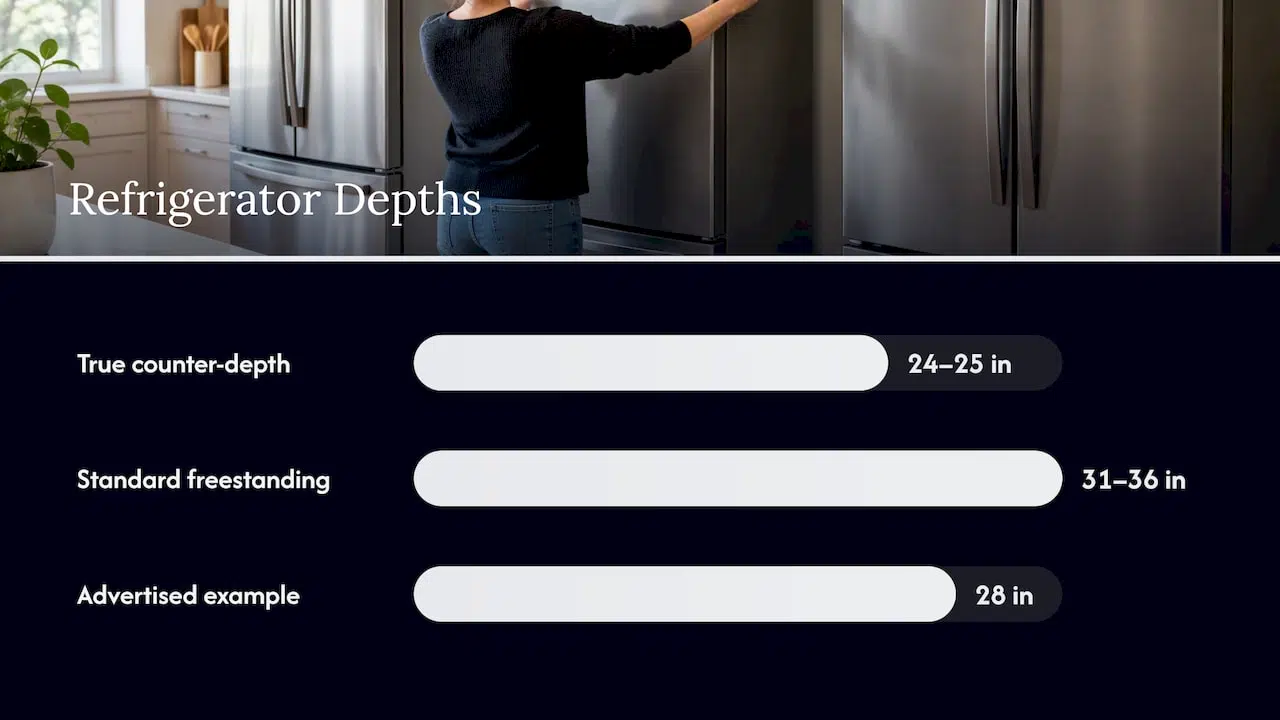
So a fridge advertised as counter-depth at 28 inches without handles may still protrude a few inches. That is not necessarily bad. It simply means you should read the spec sheet for total depth, not the headline.
Doors always stick out a bit
Even a true counter-depth refrigerator has doors that typically extend beyond the front edge of the countertop, because they need room to swing open. Expect a slim ridge of door and handle, not a perfectly flat wall.
Built-in is a different category
Counter-depth freestanding fridges give a built-in look, but they are not the same as true built-in or panel-ready units. Those are designed to be enclosed by cabinetry. If you are choosing between the two, ask what finish and trim your kitchen design needs before settling on a model.
How much storage you give up
There is no fixed percentage. Shallower means less space, but manufacturers often compensate. Counter-depth fridges are often slightly wider or taller than standard-depth units to recover some capacity.
In the US comparison above, regular-depth models run about 25 to 28 cubic feet and counter-depth models about 20 to 23.8 cubic feet. That is roughly 4 to 8 cubic feet less. Wirecutter also notes shelves commonly shrink from about 17 to 20 inches deep to 13 to 14 inches.
What that looks like day to day
- Large platters and sheet pans. Party trays, pizza boxes and big casserole dishes are the first things that stop fitting.
- Bulk buying. Warehouse-club packs and gallon jugs need more room than a shallow shelf offers.
- Visibility. The upside of shallow shelves is that nothing hides in the back. KitchenAid points out that an easy-to-view interior can be an advantage, and its guide puts counter-depth capacities at often 15 to 25 cubic feet.
- Less waste. Food you can see is food you use before it spoils, which many households find offsets a smaller interior.
A quick way to judge your needs
Open your current fridge and note what you actually keep in it for a typical week. If the back third is mostly condiments and forgotten containers, shallow shelves will cost you little. If you routinely stack items two deep and the door is full, price in the capacity loss before you choose.
A well-run fridge also uses space better. Our guide to refrigerator energy saving tips covers loading habits that keep air moving and costs down, whatever depth you choose.
Why counter-depth models often cost more
Counter-depth refrigerators usually cost more than comparable standard-depth models, in part because of their custom look, even though they offer less interior storage. You are paying for the design and the engineering that squeezes capacity into a slimmer body.
Two published manufacturer listings show the range for counter-depth models:
- GE lists a 21.8 cu. ft. counter-depth side-by-side model at a regular price of $2,299, with sale pricing at times.
- LG lists a 24 cu. ft. smart counter-depth French door model at $3,899.
Prices change often, so use these as examples of the spread, not a quote. When you compare, match the fridge style (side-by-side, French door, top freezer), the finish and the features, or the depth premium will be buried under other differences.
If you already own a fridge that works and you are only wondering whether to swap it for the look, our page on repair vs. replacement can help you weigh the cost of a repair against a new purchase.
Disadvantages of each depth, so you can choose well
Counter-depth: what to plan around
The main trade-offs are less total and shelf storage, less room for oversized pans or platters, and often a higher price than a comparable standard model. Wirecutter also flags the loose labeling, so buyers need the complete manufacturer dimensions, including clearance and handles. Plan for these and counter-depth is an easy choice in the right kitchen.
Standard-depth: what to plan around
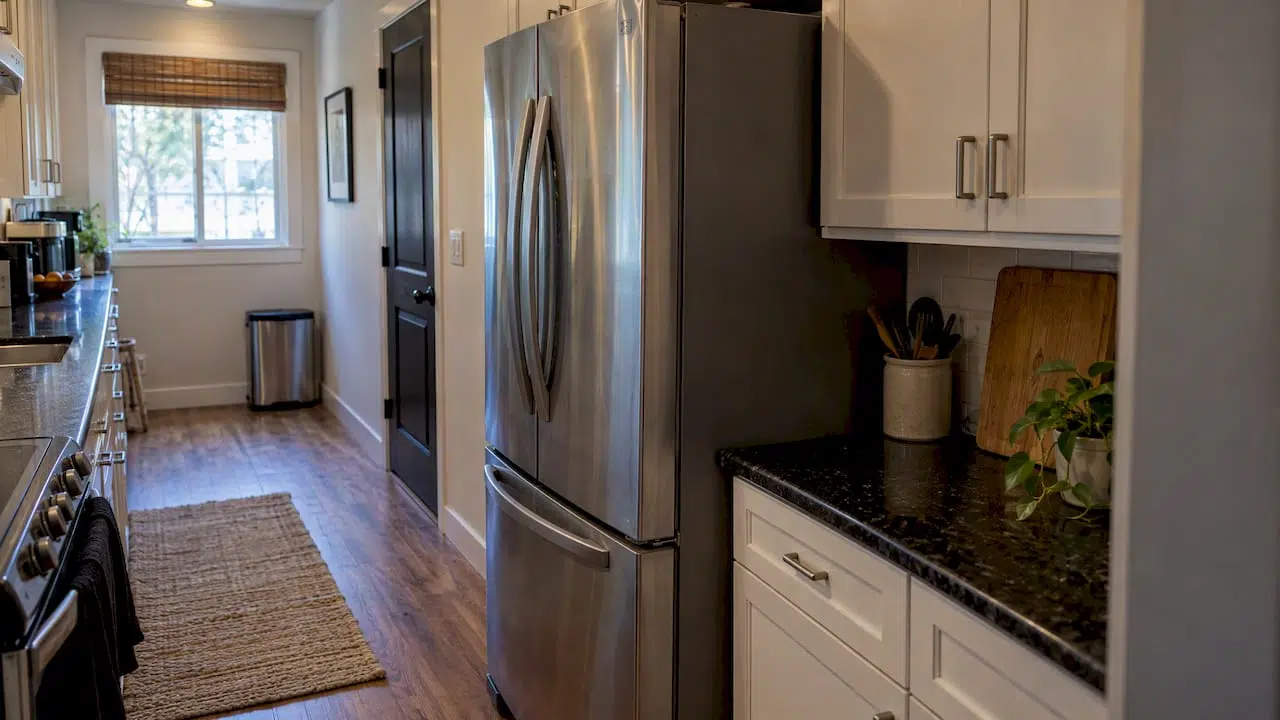
A standard-depth fridge protrudes into the room. In a galley kitchen or a narrow walkway, that matters every time you open the door or pass by. It also makes cabinet runs look interrupted. If you love the capacity, you can soften the effect with surrounding cabinetry or a shallow cabinet above, which is a common way to get a more integrated look from a deeper unit.
How to measure before you buy
Most return headaches come from measuring only the cavity. Use this routine.
- Measure width, height and depth of the space. Home Depot advises allowing minimum clearances of 2 inches at the back, 1 inch above and 1/8 inch on either side, and checking the manufacturer’s own recommendations, which can differ.
- Check the countertop edge. Account for overhang and decorative trim. Backsplashes can push countertops forward or reduce their depth, which changes what flush really means in your kitchen.
- Add handles and door swing. Look at total depth with the doors closed, and at the space the doors need to open fully. Make sure a door can clear a nearby wall or island, and that drawers can pull out.
- Map the delivery path. Measure doorways, hallways and turns from where the fridge is unloaded to its final spot, as the same Home Depot guide recommends. Include stairs and tight corners.
- Check water and power. Note where the water line and outlet sit. A fridge that fits but pinches a line is a repair call waiting to happen.
- Compare to the spec sheet. Use the manufacturer’s installation dimensions, not a retailer’s summary.
Quick fit checklist
- Is there at least 2 inches of space behind the unit, or whatever the manual specifies?
- Does the total depth, handles included, leave a comfortable walkway?
- Can both doors open without hitting anything?
- Will the fridge physically get through every doorway on the way in?
Which one fits your household
Bob Vila’s roundup puts it plainly: counter-depth models give you more room to move around the kitchen and a built-in look, while standard-depth models give more interior storage. Lowe’s frames the decision around priorities in a similar way: counter-depth suits smaller or tight kitchens and a streamlined look, while standard-depth suits larger households or people who value storage over appearance.
| Your situation | Likely better fit |
|---|---|
| Small or galley kitchen with tight walkways | Counter-depth |
| Open kitchen with an island you want to keep clear | Counter-depth |
| Family of four or more, lots of fresh and bulk food | Standard-depth |
| Frequent hosting with large platters | Standard-depth |
| Cabinetry is a design feature you want to show off | Counter-depth |
| Budget is the top priority | Standard-depth |
If you land between the two, a larger counter-depth model, perhaps wider or taller, can recover some of the lost capacity. Just re-measure the width and height before you commit.
Perspective: what we see in real kitchens
We install and repair refrigerators across Orange County and Los Angeles County, and fit problems are one of the most common reasons a delivery goes sideways. A fridge that looked right on a showroom floor does not always suit the kitchen it lands in.
Our advice is to treat depth as one of four numbers: the depth, the width, the door swing and the path in. Get all four on paper before you order. A counter-depth fridge is a smart choice when you want a clean cabinet line and have thought through your storage habits. A standard-depth fridge is just as sensible when capacity and budget come first.
Either way, a proper installation protects the investment. Our technicians are licensed, and our aim is clear communication, safe setup and a fridge that is level, connected and cooling correctly before we leave. Getting the clearances right at the start also helps the unit run as designed.
MDTECH
Get the fridge installed correctly
Choosing the right depth is half the job. The other half is getting the unit into the kitchen, leveled, connected and running without damaging floors, water lines or cabinets. We handle appliance installation and refrigerator service across Orange County and Los Angeles County, including kitchen appliances of many brands.
See how our refrigerator installation works, or go straight to appliance installation services to book an appointment online. If your current fridge is acting up before you shop, our kitchen appliance repair page explains what we can look at. For help with a fridge that is warm, see refrigerator not cooling: fast checks.
FAQ
Do you lose a lot of space with a counter-depth refrigerator?
You lose some, but it depends on the model. In a typical US comparison, counter-depth units hold roughly 4 to 8 cubic feet less than regular-depth ones, and shelves are shallower. Many counter-depth models are slightly wider or taller to make up part of the difference.
Is a counter-depth refrigerator worth it?
It is worth it if you value a built-in look and a clearer walkway, and your household does not need maximum storage. If you routinely store large platters or shop in bulk, a standard-depth model may serve you better. Compare total capacity, not just the depth label.
Why is counter-depth more expensive than standard?
Counter-depth models typically cost more in part because of their custom, built-in look, even though they offer less interior storage. Engineering a shallower body that still holds a useful amount of food also adds cost. Compare same-style models with similar features to see the real gap.
Will a counter-depth fridge sit perfectly flush with my counters?
Not always. Doors and handles usually extend beyond the counter edge, and some freestanding models labeled counter-depth still stick out several inches. Check the manufacturer’s full dimensions, including handles, and measure your counter depth with any overhang or backsplash.
Can I use a standard-depth fridge and still get a built-in look?
Yes, to a degree. Surrounding cabinetry, such as side panels and a cabinet above, can make a deeper unit look more integrated. You will still see the front of the fridge protrude, so measure the walkway before you decide.
Sources
- Here’s the Standard Refrigerator Size and When to Go Bigger
- The 6 Best Counter-Depth Refrigerators, Wirecutter
- What To Look For In A Counter Depth Refrigerator, KitchenAid
- How Deep Is a Counter-Depth Refrigerator?
- What Is a Counter-Depth Refrigerator? Whirlpool
- How to Measure a Refrigerator, The Home Depot
- Comparing Counter-Depth vs. Standard-Depth Fridges, Lowe’s
- GE 21.8 Cu. Ft. Counter-Depth Side-By-Side Refrigerator
- LG 24 cu. ft. Smart Counter-Depth Refrigerator