
An agitator washer has a tall, finned post in the middle of the tub that twists back and forth to scrub clothes. An impeller washer has a low cone or disc at the bottom that spins the laundry against itself. If your laundry is muddy, greasy or heavily soiled and you want a simple, budget-friendly machine, an agitator is the safer pick. If you wash bulky bedding, care about water use and want more room in the drum, an impeller is usually the better fit. Both are top-loaders, so the real question is which one matches what you wash every week.
TL;DR
- Agitator: a central post twists to rub clothes. It tends to be better on heavy soil and odors, usually costs less, and has simpler, familiar parts.
- Impeller: a low-profile disc or cone moves clothes through the water so they rub against each other. It leaves more drum space and generally uses less water, but can tangle loads.
- Water and capacity: a conventional agitator washer uses about 20 gallons per load, while high-efficiency top-loaders use about 13.
- Care: wash similar items together, avoid overloading and keep the tub clean. Persistent shaking, error codes or a washer that will not spin is a repair call, not a settings problem.
Table of Contents
- How the two washers actually clean
- Agitator vs. impeller at a glance
- Cleaning performance: do impeller washers clean well?
- Water and energy use
- Capacity and fit
- Fabric care and tangling
- Cycle time
- Cost, upkeep and reliability
- Which one fits your household?
- Our perspective
- When a washer needs a technician
- Need a washer repaired or installed in Orange or LA County?
- FAQ
- Sources
How the two washers actually clean
The difference comes down to what moves inside the tub.
An agitator is a tall post, usually with fins or vanes, that sits in the center of the basket. It twists back and forth and rubs against the clothes to help break apart stains. That is the design most of us grew up with, and it works in a tub filled with water.
An impeller is a low-profile cone, disc or wheel at the bottom of the basket. It spins or rotates, creating currents that move clothes from the outer rim toward the center so they rub against each other. Cleaning comes mostly from fabric on fabric rather than from a post pushing the load around.
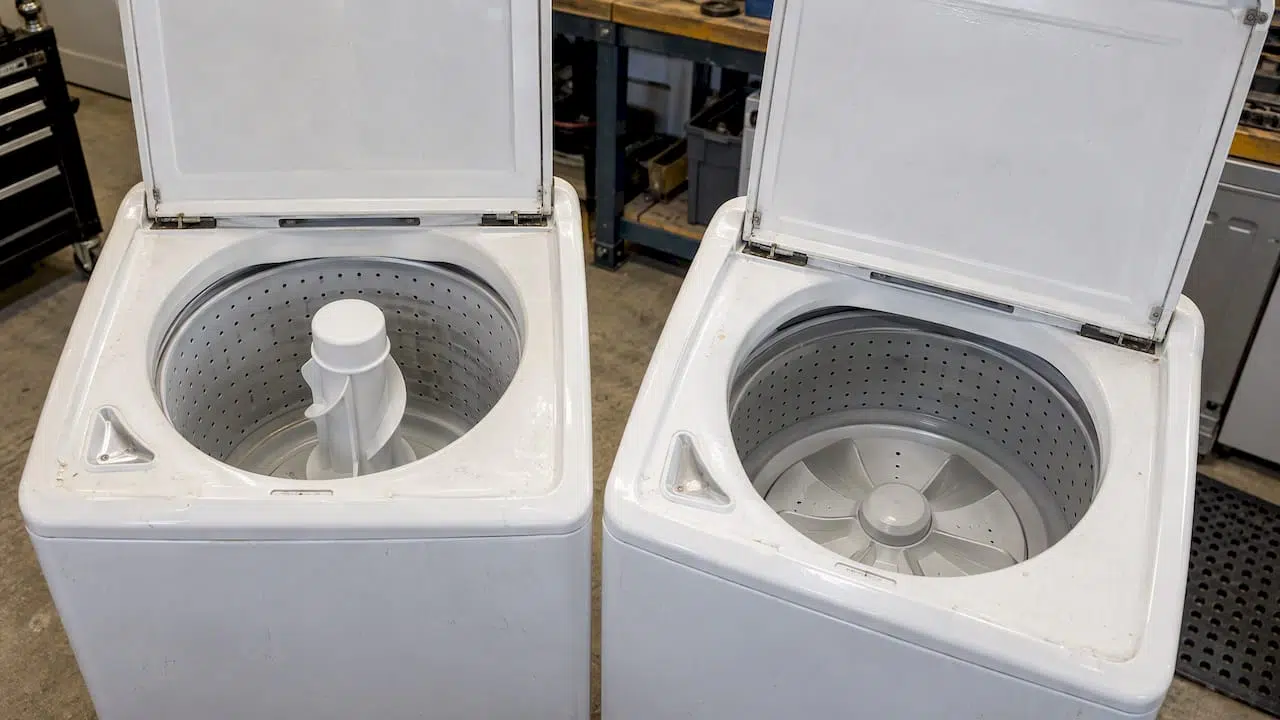
The U.S. Environmental Protection Agency’s ENERGY STAR program describes the split the same way: agitator models use a central post in a full tub of water, while impeller models use low-profile discs and clean with less water and energy.
Neither is a front-loader. If you are still deciding between top-load and front-load, our guide to top-load vs. front-load washers covers that choice first.
Agitator vs. impeller at a glance
| Factor | Agitator washer | Impeller washer |
|---|---|---|
| Moving part | Tall central post that twists | Low disc or cone at the bottom |
| Cleaning style | Post rubs clothes, aggressive action | Clothes rub together, gentler action |
| Water per load | About 20 gallons (conventional) | About 13 gallons (HE top-load) |
| Drum space | Post takes up room | More open space for bulky items |
| Heavy soil and odors | Generally the stronger performer | Fine for everyday loads |
| Fabric wear | Can be hard on clothes, may twist items around the post | Gentler in principle, but can tangle |
| Upfront cost | Typically lower | Typically higher |
| Maintenance | Simple, but the post can collect residue | Fewer crevices, but sensitive to unbalanced loads |
The water and cost figures come from consumer testing organizations, covered below. Treat them as typical, not guaranteed for any single model.
Cleaning performance: do impeller washers clean well?
Yes, for everyday laundry. Whirlpool describes impeller cleaning as a gentle, thorough clean that relies on clothes rubbing together. T-shirts, jeans, towels and work shirts with normal soil come out fine in either design.
The gap shows up on the hard stuff. Agitator washers are generally considered best for heavy-duty stains and odors, which is why they remain popular with households that deal with sports uniforms, gardening clothes, mechanic’s coveralls or kids’ muddy play clothes.
Two practical habits help an impeller washer clean better:
- Pretreat stains. Because the action is gentler, a stain stick or soak before the cycle does more work than extra rinse time.
- Mix sizes in the load. Clothes need to rub against each other, so a load of only small items or only one heavy item moves poorly.
Water and energy use
Water is where the two designs separate most clearly, and it matters in Southern California, where many households watch both the water bill and drought restrictions.
Consumer Reports says agitator washers use about 20 gallons per load, while HE top-loaders use about 13. Good Housekeeping adds that older top-loaders used nearly 40 gallons per cycle, and newer models use closer to 12 or 13. If your current washer is more than 15 years old, either new design will cut water use noticeably.
Impeller washers also tend to spin fast at the end of the cycle. Maytag notes that high spin speeds wick moisture out of the load, which often shortens dry time. That saves dryer energy, which is easy to forget when comparing washers on water use alone.
Capacity and fit
The post in an agitator washer takes up tub space. Consumer Reports points out that agitators take up room in the tub, so large items are harder to fit. The same guide lists top-load agitator washers at up to 5.4 cubic feet.
An impeller leaves the center open. Whirlpool says impeller washers provide more room in the basket for bulky articles. In practice, that means a comforter, a pair of king-size sheets or a big pile of towels sits more freely instead of wrapping around a post.
If you wash a lot of bedding, or your household is large enough that you are always working to fit one more load, the impeller layout is a real advantage.
Fabric care and tangling
Agitator washers have a reputation for being tough on clothes. Items can twist around the post, which stresses seams and delicate fabrics over time.
Impeller washers avoid that post, but they come with their own quirk. With less water, clothes rub against each other more, and Consumer Reports found that two-thirds of HE top-loaders earned satisfactory or lower gentleness scores, citing low water, longer washes and clothes rubbing together. It also notes that tangling can happen and that washing similar items together and lowering the spin speed can help.
A few easy rules reduce tangling in any top-loader:
- Wash sheets with sheets and towels with towels.
- Keep long straps, ties and bra hooks fastened or in a mesh bag.
- Do not stuff the drum. Clothes need room to circulate.
- Use a lower spin setting for delicates.
Cycle time
High-efficiency machines trade water for time. Consumer Reports lists cycle times of 35 to 105 minutes for both agitator and HE top-loaders, and separately says HE top-loaders generally run 55 to 80 minutes on the heavy-soil setting.
The result: if you need a quick wash before work, check the cycle chart for the specific model. Agitator machines are often favored by people who want faster, simpler cycles, while impeller models can run longer because they rely on less water.
Cost, upkeep and reliability
Agitator washers are the budget option. Consumer Reports puts top-load agitator models at $450 to $1,500. Home Depot describes agitator washers as budget-friendly and low-maintenance, with impeller washers carrying a higher upfront investment.
Maintenance differs in small ways:
- Agitator: the post has nooks and crannies where mold can build up. Wipe around it and run a tub-clean cycle regularly.
- Impeller: the smooth floor is easier to wipe, but HE top-loaders are sensitive to lopsided loads. When a load is unbalanced, the machine may add water to rebalance it, and if that fails it shows an error asking you to redistribute the clothes.
For a routine you can follow, see our essential washing machine care tips.
Which one fits your household?
Choose an agitator if:
- Your loads are often heavily soiled, greasy or muddy.
- You want the lowest upfront price.
- You prefer a familiar design with fast, simple cycles.
- You rarely wash oversized bedding.
Choose an impeller if:
- You wash comforters, blankets and large towels regularly.
- You want lower water use per load.
- You prefer a gentler cleaning action for everyday clothes.
- You are fine with sorting loads to limit tangling.
Maytag frames the decision the same way: it depends on laundry type and volume, water and energy concerns, cycle duration, capacity and personal preference. There is no universal winner, only a better match for your laundry.
Our perspective
Most of the washers we see in Orange County and Los Angeles County homes are top-loaders, and the design matters less to us than how the machine is installed, loaded and maintained. A well-set agitator machine will outlast a neglected impeller machine, and the reverse is just as true.
What we see on service calls is mostly the same few problems: loads piled to one side, machines sitting off level, worn belts and couplings, and drain restrictions. Those show up in both designs. If you are choosing a new washer, ask where it will sit, how it will be leveled and how you will load it, not only which wash plate it has.
Our licensed technicians work on a broad range of household brands, including luxury ones, and we explain what we find in plain language before any work starts. If a new washer shakes, will not spin or throws balance errors, book a visit rather than running it through repeated cycles.
MDTECH
When a washer needs a technician
Some problems are not about agitator versus impeller. They belong to either machine, and they need hands-on diagnosis:
- Violent shaking or walking across the floor. Level the machine and redistribute the load first. If it continues, read our guide to washing machine shaking and when to call.
- The drum will not spin. Start with why a washer won’t spin. Belts, couplings, lid switches and motors can all be the cause.
- Repeated balance errors. One bad load is normal. A pattern points to a suspension or sensor fault.
- Leaks, burning smells or tripped breakers. Unplug the machine and call for service. Do not keep running it.
Our washer repair warning signs list helps you spot trouble before it turns into a flooded laundry room. And if you are weighing a fix against a new machine, our guide on repair vs. replacement walks through the decision.
Need a washer repaired or installed in Orange or LA County?
Whether you own an agitator or an impeller washer, we repair and install residential appliances across Orange County and Los Angeles County, including washers, dryers, refrigerators, ovens and dishwashers. You can book online and tell us what the machine is doing, so the technician arrives prepared.
See our appliance repair services to book a visit, or our appliance installation services if you just bought a new washer and want it set up level, connected and tested.
FAQ
Which is better, an agitator or an impeller washer?
Neither is better for everyone. An agitator suits heavily soiled laundry and tighter budgets, while an impeller suits bulky items, lower water use and a gentler wash. Pick based on what you wash most often.
Do impeller washers clean as well as agitator washers?
For everyday laundry, yes. For heavy stains and odors, agitator washers are generally the stronger performer. With an impeller, pretreating stains and mixing item sizes in a load makes a visible difference.
Do impeller washers tangle clothes?
They can. Low water means clothes rub against each other more, which can twist items together. Consumer Reports suggests washing similar items together and lowering the spin speed to reduce it.
Is an agitator or impeller washer more reliable?
The research does not show one design as clearly more reliable. Agitator washers are described as low-maintenance, and either type lasts longer when level, not overloaded and kept clean. If either starts shaking or stops spinning, have a technician look at it.
Sources
- Agitator vs. Impeller Washer: Which Is Better? (Whirlpool)
- Which Clothes Washer Should I Choose: Front Load or Top Load? (ENERGY STAR)
- Choose the Right Washing Machine for Your Laundry Needs (Consumer Reports)
- 5 Things to Know About High-Efficiency Top-Loaders (Consumer Reports)
- 6 Best Top-Loading Washing Machines (Good Housekeeping)
- Impeller Washer vs. Agitator Washer: What’s the Difference? (The Spruce)
- Agitator vs. Impeller Washing Machine: Which is Best? (Maytag)
- Impeller vs. Agitator Washing Machines (The Home Depot)