
An inverter AC has a variable-speed compressor that slows down and speeds up to hold your set temperature. A non-inverter (fixed-speed) AC runs its compressor at full power until the room is cool, shuts off, then starts again. For most homeowners who run air conditioning often, the inverter is the better long-term buy. It is quieter and steadier, and it uses less electricity. The non-inverter still makes sense when you cool a room only now and then and the purchase price matters most.
Below, we explain how each works, what the savings look like, where the extra cost goes, and what changes when something breaks.
TL;DR
- A non-inverter AC is either fully on or off. An inverter AC adjusts compressor speed continuously to match the heat in the room.
- ENERGY STAR says certified room AC models use 20 to 35% less energy than standard models. Your actual savings depend on sizing, climate and how many hours you run the unit.
- Inverters usually cost more upfront, but Consumer Reports says the gap has narrowed. Fixed-speed units are noisier and swing more in temperature.
- Inverter systems are more complex to service, so choose a unit that a qualified local technician can work on.
- Heavy daily use and hot weather favor an inverter. Occasional use on a tight budget favors a fixed-speed unit.
Table of Contents
- How the two types actually work
- Side-by-side comparison
- Energy use: how big are the savings?
- Upfront cost versus lifetime cost
- Comfort: noise, temperature swings and humidity
- Repairs, maintenance and lifespan
- Which one fits your home?
- Our perspective
- Need help choosing, installing or repairing an AC?
- FAQ
- Sources
How the two types actually work
The fixed-speed (non-inverter) AC
A conventional compressor has one speed. When the thermostat calls for cooling, it starts and runs flat out. When the room reaches the set temperature, it stops. As the room warms, it starts again. Carrier describes this as a fixed-speed compressor that is either fully on or off, cycling to hold the temperature.
Two things follow from that design. First, the temperature is never perfectly steady: it drifts a little above and below your setting. Second, each restart is a hard push on the electrical system and the compressor.
The inverter AC
The inverter is the electronics that control the compressor motor. Carrier explains that it converts incoming AC power to DC and back again so the motor speed can be modulated. Consumer Reports puts it plainly: the more sophisticated compressor ramps down as the room cools instead of simply turning on and off.
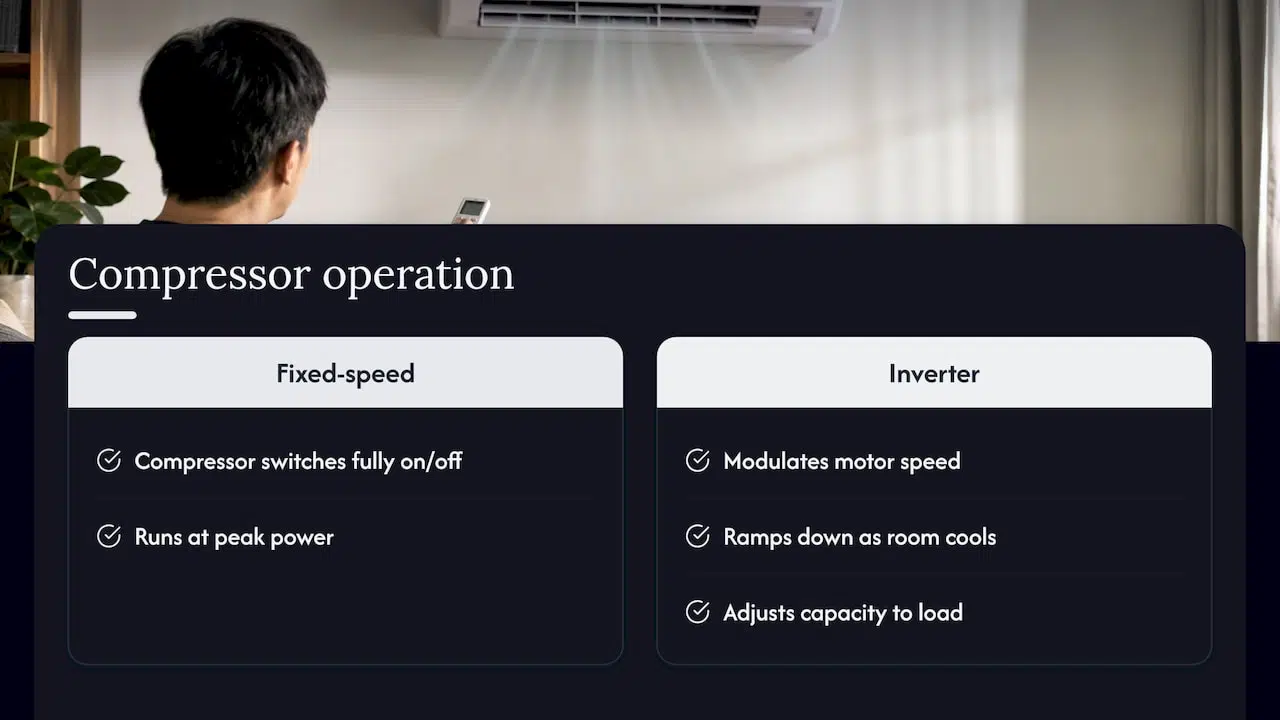
In practice, an inverter unit works hard at first to pull the room down. Then it settles into a low, steady output that offsets the heat coming in through windows, walls and doors. Mitsubishi Electric notes that fixed-speed systems run at peak power regardless of room size, while inverter units adjust capacity to the load.
A note on terms
You will see “inverter,” “variable speed” and “variable capacity” used for the same idea. “Non-inverter,” “fixed speed,” “standard” and “single speed” describe the other side. In the U.S., inverter technology is most familiar in ductless mini splits and newer window units. Central systems come in single-stage, two-stage and variable-speed versions. Check the spec sheet for the compressor type rather than trusting a marketing label.
Side-by-side comparison
| Factor | Inverter (variable speed) | Non-inverter (fixed speed) |
|---|---|---|
| Compressor | Adjusts speed continuously | Full power or off |
| Upfront price | Usually higher, gap narrowing | Usually lower |
| Running cost | Lower, especially with frequent use | Higher |
| Temperature stability | Steady, tight to the setpoint | Noticeable swings |
| Noise | Quieter, no loud restarts | Louder on each cycle |
| Humidity control | Better, longer gentle run times | Weaker |
| Start-up power draw | Soft start | Surge on each start |
| Repair complexity | More electronics, specialized parts | Simpler design |
The qualitative points come from Consumer Reports and Carrier. The sections below go through each row.
Energy use: how big are the savings?
This is the question most readers care about, and the honest answer is a range, not a single number.
- ENERGY STAR: certified room air conditioners use 20 to 35% less energy than standard models. That figure covers certified models in general. Variable-speed units are one way to reach it.
- Start-up surge: Mitsubishi Electric states that standard fixed-speed systems may draw three to four times as much power at start-up as inverter-driven systems.
- Lab-style testing: a 2020 study of 18,000 BTU units in Saudi Arabia found inverter models saved about 44% of daily energy. The same study reported that the gap grew as outdoor temperature rose. That is a hot-climate result from one country, so treat 44% as an upper marker, not a promise for your house.
- Dollars: Consumer Reports cites a Department of Energy analysis suggesting a more efficient unit could trim $18 to $21 a year from a power bill, or $167 to $189 over a nine-year lifespan.
Those dollar figures are modest. They apply to a room unit, and the savings on a larger system running many hours would scale up. If you are weighing a higher price against a slow payback, run the numbers with your own hours of use and your utility rates. Our friends in the electrical trade explain how solar and household energy bills interact with usage, which is a useful lens if you are thinking about cutting cooling costs overall.
Why part-load matters
An inverter earns its keep when the house does not need full cooling, which is most of the time. CLASP notes that recognizing these benefits requires testing at part-load conditions, because the advantage lies in non-peak demand. A fixed-speed unit has only one gear, so it overshoots and cycles. If you run AC a few hot afternoons a year, there is little part-load time to exploit.
Sizing can erase the benefit
ENERGY STAR warns that an undersized unit may run continuously at full speed, while an oversized unit costs more to operate. A well-sized fixed-speed system can beat a badly sized inverter. Have the load calculated for your room or home before you buy anything.
Leave it on or turn it off?
ENERGY STAR also advises that keeping a variable-speed room AC running can often be more efficient than switching it off and on, since it avoids big jumps in cooling demand when the room has warmed up. That habit works against fixed-speed units, where there is no gentle low gear. If you leave the house for the day, an off or setback strategy can still make sense. Use your judgment and your thermostat settings.
Upfront cost versus lifetime cost
Inverter units have traditionally carried a higher sticker price because of the added electronics. Carrier says non-inverter systems have a lower upfront cost, which keeps them a common pick for budget-focused cooling. Consumer Reports adds that the price gap has narrowed, and some high-scoring inverter models now sell for the same or less than comparable conventional models.
A simple way to compare:
- Get the installed price for both options, not just the unit price.
- Estimate the hours you will run cooling in a typical year.
- Ask for the efficiency rating and compare the rated difference.
- Check utility rebates for your address, since programs change.
- Divide the extra upfront cost by the yearly savings to see the payback period.
If the payback is shorter than the time you plan to stay in the home, the inverter wins. If you rent out a unit or plan to move soon, a fixed-speed model may be the practical call.
Comfort: noise, temperature swings and humidity
This is where many owners feel the difference before they see it on a bill.
- Temperature: Carrier says inverter ACs deliver more precise temperature control and humidity management, while fixed-speed units are prone to noticeable swings.
- Noise: Consumer Reports describes inverter units as quieter because they avoid the frequent start-stop cycling. That matters in a bedroom or a home office.
- Wear and cost of cycling: Mitsubishi Electric says the all-or-nothing operation of fixed-speed compressors can cause unpleasant temperature swings, and that constant cycling can be costly.
If you sleep with the AC on, work from home, or have someone sensitive to temperature changes, these comfort gains often count for more than the dollar savings.
Repairs, maintenance and lifespan
This is the part sales pages skip. Inverter systems are not unreliable, but they are more complex. Danfoss, a compressor manufacturer, says inverter systems have more complex oil management and need a compressor and drive qualified to work together. It also notes that soft starting can reduce mechanical stress and wear. Inverter compressors need strong lubrication systems to protect their lifetime when running at variable speeds.
What that means for you:
- Fixed-speed units have fewer electronic parts, so more technicians can diagnose them quickly.
- Inverter units have control boards and drives. A fault can be an electronics problem, not a mechanical one, and parts may be specific to the brand.
- Both types need upkeep. Consumer Reports says all central AC systems, including advanced ones, need regular professional maintenance such as flushing coils, cleaning drain systems and checking refrigerant levels.
When a compressor does fail, the repair-or-replace decision depends on the unit’s age and type. Our guides on compressor failure causes and signs and AC compressor replacement costs walk through what to expect. For a broader view, see repair vs replacement.
Which one fits your home?
Carrier says an inverter is likely the superior choice if you live in a hot climate, use AC frequently, or prioritize humidity control and silence. Non-inverter models win on purchase price.
An inverter usually fits if:
- You cool the home for many hours across a long season.
- You want quiet bedrooms and steady temperatures.
- You are staying in the home for years, so the payback has time to arrive.
- You are adding a ductless mini split for a room addition, garage conversion or ADU.
A fixed-speed unit usually fits if:
- You run cooling only on the hottest days.
- The room is a rarely used guest room or storage space.
- The budget is tight and the installed price decides the purchase.
- You are replacing a failed unit in a rental and want simple, familiar parts.
For Orange County and Los Angeles County homes, the length of your own cooling season and your utility rate tier will matter more than any general rule. Coastal homes and inland valley homes can differ a lot, so judge by the hours your unit actually runs.
Our perspective
We repair and install air conditioning across Orange County and Los Angeles County, and the pattern we see in the field is simple: the best system is the one that is sized correctly, installed carefully and maintained on schedule. Inverter technology is a real improvement in comfort and efficiency. It rewards good installation and punishes poor sizing, loose electrical connections and neglected coils just as much as a conventional unit.
Our advice before you buy:
- Have the cooling load of the space calculated rather than guessing by square footage.
- Choose a brand and model that licensed technicians in your area can service, and ask how parts are sourced.
- Keep the maintenance record. Dirty coils and low refrigerant drain efficiency on any type of unit.
- If your current unit is failing, compare the repair against replacement honestly, including the electrical side.
If your current AC is running poorly, many problems are not about inverter or fixed speed at all. Our guides on common HVAC problems and HVAC troubleshooting tips cover what to check first.
— MDTECH
Need help choosing, installing or repairing an AC?
We handle air conditioning repair and HVAC service as well as air conditioning installation for homeowners in Orange County and Los Angeles County. Our licensed technicians can look at your current system, tell you whether it is worth repairing, and install a new unit of either type. You can book online through our site. For work in Irvine, see our AC repair page. We do not publish set prices, so ask for a quote for your specific job.
FAQ
Is an inverter AC worth the extra money?
Usually, if you run cooling often and plan to stay in the home. Savings come from the compressor slowing down instead of cycling, and Consumer Reports notes the price gap has narrowed. If you only use AC a few days a year, the payback may never arrive.
What are the disadvantages of a non-inverter AC?
Fixed-speed units are louder and swing more in temperature because they cycle fully on and off. They also draw a surge of power at each start and use more energy over time. Their advantage is a lower purchase price and simpler design.
Can an inverter AC be repaired as easily as a standard one?
It depends on the fault and the brand. Inverter systems add control electronics and need a compressor and drive that work together, so diagnosis can take more specialized knowledge. Routine maintenance such as coil cleaning and refrigerant checks is similar for both types.
Does an inverter AC use less power when the room is already cool?
Yes. Once the room reaches the set temperature, the compressor slows to a low output instead of stopping and restarting. ENERGY STAR notes that leaving a variable-speed unit on can often be more efficient than frequent off-and-on use.
Does the right size matter more than the type?
Often it does. ENERGY STAR says an undersized unit may run continuously at full speed, and an oversized one costs more to operate. Get the room or home sized properly before you pick inverter or fixed speed.
Sources
- Inverter Air Conditioner Guide, Carrier
- Inverter Air Conditioner Can Keep You Cool, Save You Money, Consumer Reports
- Variable Speed Means More Savings with Room Air Conditioners, ENERGY STAR
- Fixed-Speed vs. Inverter Compressor Technology, Mitsubishi Electric
- Comparison of energy consumption between non-inverter and inverter air conditioners, Springer
- Recognizing and rewarding higher efficiency, CLASP
- Inverter technology for AC and HVAC, Danfoss
- Best Central Air Conditioning Buying Guide, Consumer Reports