
When a refrigerator stops cooling on a Saturday night or an oven fails just before a big family gathering, the stress of a sudden appliance breakdown can feel overwhelming. Every household in Orange and Los Angeles Counties eventually faces the critical choice between fixing a trusted machine or shopping for a whole new one. By clarifying the difference between repair and replacement—and understanding the key factors behind each—homeowners can make financially smart decisions that keep daily life running smoothly.
Table of Contents
- Core Definitions: Repair Vs Replacement
- Types Of Appliance Failures And Fixes
- Evaluating Lifespan And Reliability
- Cost, Energy, And Warranty Impacts
- Risks, Safety Hazards, And Common Mistakes
Key Takeaways
| Point | Details |
|---|---|
| Repair vs. Replacement | Evaluate whether to repair or replace based on costs, reliability, and lifespan. The ‘50 percent rule’ is essential: if repair costs exceed half the replacement price, opt for a new unit. |
| Types of Failures | Be aware of mechanical, electrical, and environmental failures in appliances, as each requires a distinct approach for diagnosis and repair. |
| Cost and Energy Impacts | Consider long-term energy efficiency and warranty coverage when making decisions, as older appliances may lead to higher utility bills and repair costs. |
| Safety Precautions | Always prioritize safety during repairs; consult a professional if uncertain about potential hazards. Proper procedures and protective equipment are crucial. |
Core Definitions: Repair vs Replacement
Homeowners facing equipment breakdowns often encounter a critical decision: should they repair an existing appliance or invest in a complete replacement? Understanding the fundamental definitions and strategic considerations can help make this choice more straightforward and financially prudent.
At its core, repair involves restoring a malfunctioning appliance to working condition by fixing specific components or addressing mechanical issues. This process typically requires professional intervention, diagnostic testing, and targeted part replacement. Maintenance and reliability theories suggest that repair becomes most viable when:
- The damage is localized and does not compromise overall system functionality
- Replacement parts are readily available and reasonably priced
- The appliance has significant remaining operational life expectancy
- Total repair costs remain substantially lower than replacement expenses
Conversely, replacement means completely substituting the existing appliance with a new unit. This approach becomes strategically preferable when:
- Repair costs exceed 50% of the new equipment’s price
- The current appliance demonstrates consistent reliability problems
- Technological advancements offer substantially improved efficiency
- Existing equipment has reached or exceeded its expected service lifespan
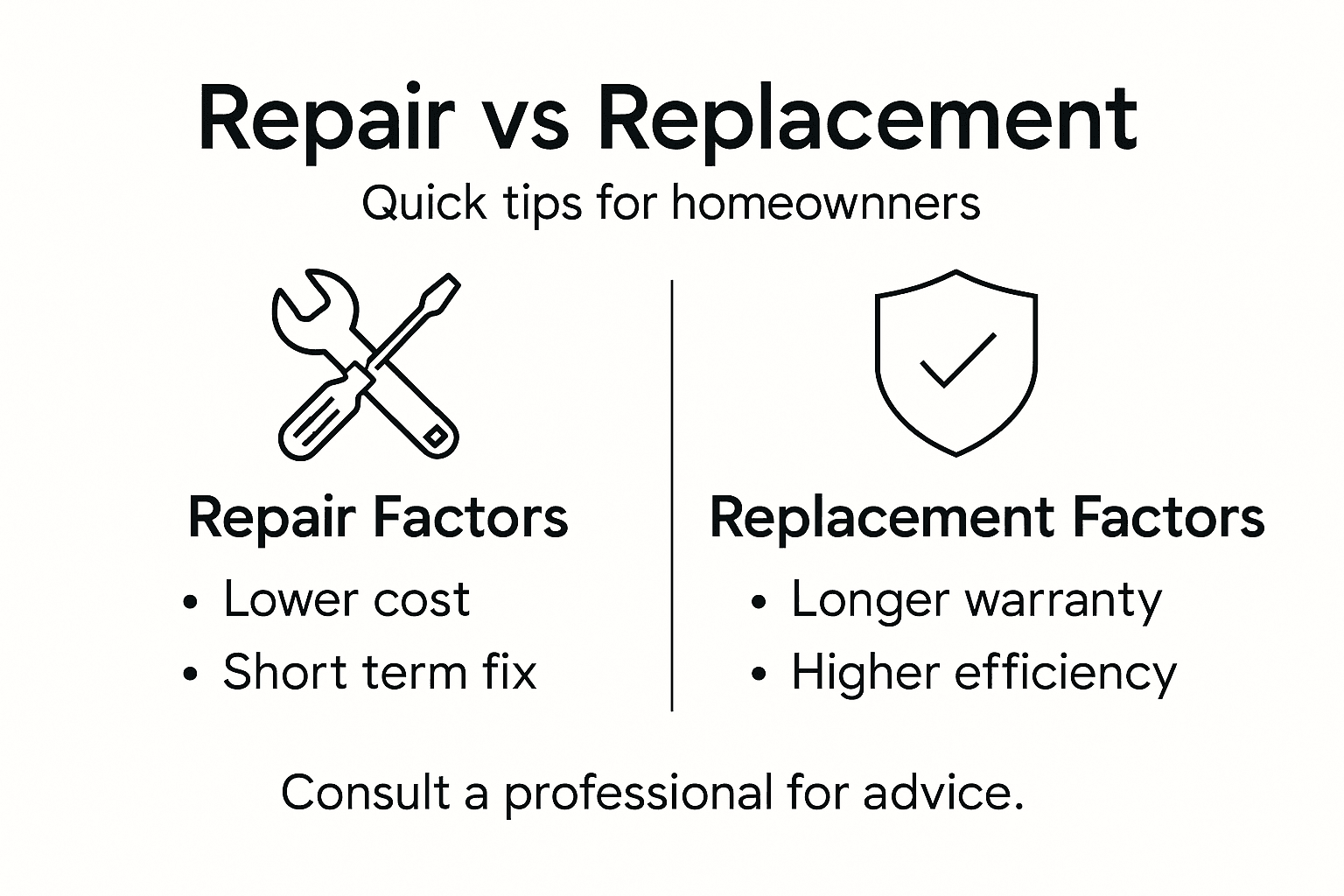
The “50 percent rule” provides a fundamental guideline: if repair costs surpass half the replacement price, investing in a new appliance often makes more economic sense.
Repair vs replacement decisions are not purely financial—they also involve assessing operational reliability, potential downtime, and long-term performance expectations. Cost factors remain primary drivers in determining the most strategic approach for homeowners.
Here’s a comparison of key factors to consider when choosing between repairing or replacing an appliance:
| Decision Factor | Repair Approach | Replacement Approach |
|---|---|---|
| Upfront Cost | Usually lower, may vary by part | High initial expense |
| Long-Term Savings | May be limited if repeated failures | Improved efficiency, lower bills |
| Warranty Coverage | Often limited to recent repairs | Full coverage for new product |
| Expected Lifespan | Extends current unit’s life temporarily | New unit with maximum lifespan |
Pro tip: Before making a final decision, always obtain professional diagnostic assessments and written repair cost estimates to make an informed comparison between repair and replacement options.
Types of Appliance Failures and Fixes
Appliances are complex systems that can experience multiple types of failures, each requiring specific diagnostic approaches and repair strategies. Understanding these failure modes helps homeowners and technicians effectively address equipment malfunctions and determine the most appropriate intervention.
Mechanical failures represent a significant category of appliance issues. Failure classification systems indicate these typically involve:
- Moving parts wearing down or breaking
- Misalignment of internal components
- Bearing or shaft deterioration
- Mechanical stress from regular usage
- Lubrication system failures
Electrical failures constitute another critical category of appliance malfunctions. These complex issues often require professional diagnosis and can pose significant safety risks. Common electrical hazards include:
- Short circuits in internal wiring
- Damaged electrical control boards
- Faulty power supply connections
- Overloaded electrical components
- Degraded insulation materials
Electrical failures can rapidly transition from minor issues to potentially dangerous situations, making professional assessment crucial.
Environmental and material-related failures represent a third significant failure mode, where external factors contribute to appliance deterioration. These failures often develop gradually and might include:
- Moisture intrusion causing corrosion
- Temperature-induced material stress
- Chemical degradation of internal components
- Dust and debris accumulation
- Thermal expansion and contraction effects
Pro tip: Conduct regular visual inspections and maintenance to catch potential failure indicators early, preventing more extensive and costly repairs.
Below is a summary of common appliance failure types and their potential impacts on household operations:
| Failure Type | Impact on Appliance | Safety Risk Level |
|---|---|---|
| Mechanical | Reduced performance | Usually moderate |
| Electrical | Complete system outage | High, potential fire hazard |
| Environmental | Gradual malfunction | Low to moderate |
Evaluating Lifespan and Reliability
Understanding an appliance’s expected lifespan and reliability is crucial for making informed repair or replacement decisions. Homeowners need sophisticated strategies to assess their equipment’s long-term performance and potential maintenance requirements beyond surface-level observations.
Reliability analysis techniques provide systematic approaches to evaluating equipment longevity. These statistical methods help predict appliance performance through key metrics such as:
- Mean time between failures (MTBF)
- Survival probability calculations
- Failure time distribution modeling
- Probability of continued operational performance
- Estimated service life under specific conditions
Maintenance strategies play a critical role in extending appliance reliability. Reliability engineering principles emphasize proactive approaches that include:
- Preventative maintenance scheduling
- Regular diagnostic inspections
- Component performance tracking
- Early warning system implementation
- Predictive maintenance techniques
Reliability is not just about preventing failures, but understanding the probability of consistent performance under defined operational conditions.
Homeowners can leverage several practical techniques to assess their appliances’ reliability, including tracking repair frequency, monitoring performance consistency, and understanding manufacturer-provided reliability data. Professional diagnostic assessments can provide deeper insights into an appliance’s remaining operational potential.

Pro tip: Maintain a detailed maintenance log documenting all repairs, performance issues, and service interventions to build a comprehensive reliability profile for each appliance.
Cost, Energy, and Warranty Impacts
Homeowners face complex financial considerations when deciding between repairing and replacing household appliances. Multiple interconnected factors beyond immediate repair costs influence this critical decision, including long-term energy expenses, warranty coverage, and potential future performance.
Cost analysis techniques reveal several key financial decision-making principles. Typical cost evaluation strategies include:
- Comparing repair expenses against replacement price
- Calculating cumulative repair history
- Assessing potential downtime expenses
- Evaluating long-term operational costs
- Analyzing potential performance degradation
Energy efficiency represents a crucial economic factor in appliance decisions. Energy consumption analysis demonstrates that older appliances can significantly increase utility expenses through:
- Higher electricity consumption
- Reduced mechanical performance
- Inefficient operational cycles
- Increased maintenance requirements
- Outdated technological specifications
The true cost of an appliance extends far beyond its initial purchase or repair price, encompassing ongoing energy consumption and potential future maintenance expenses.
Warranty considerations add another layer of complexity to repair versus replacement decisions. Remaining warranty coverage, potential extended warranty options, and manufacturer support can dramatically influence the most economically sensible approach to addressing appliance issues.
Pro tip: Request a comprehensive cost-benefit analysis from professional technicians that includes projected energy savings, repair costs, and remaining warranty coverage before making your final decision.
Risks, Safety Hazards, and Common Mistakes
Appliance repair involves significant safety risks that can transform a routine maintenance task into a potentially dangerous undertaking. Homeowners must understand the complex landscape of potential hazards to protect themselves and their property during repair or replacement processes.
Safety hazard prevention requires a comprehensive approach that addresses multiple risk categories. Critical safety considerations include:
- Electrical shock potential
- Mechanical component risks
- Toxic material exposures
- Thermal burn dangers
- Equipment instability risks
Electrical safety represents the most prevalent concern in appliance repair. Common repair safety protocols emphasize avoiding critical mistakes such as:
- Working on energized electrical circuits
- Neglecting proper lockout/tagout procedures
- Using non-insulated tools
- Ignoring environmental hazard conditions
- Attempting repairs without appropriate protective equipment
Safety in appliance repair is not an option—it’s an absolute necessity that requires constant vigilance and professional-level precautions.
Many homeowners unknowingly compromise their safety by attempting complex repairs without proper training, tools, or understanding of underlying system complexities. Professional technicians are trained to navigate these risks systematically, identifying potential hazards before they become dangerous situations.
Pro tip: When in doubt about an appliance repair’s safety, always consult a licensed professional technician who can assess risks and perform repairs with proper protective measures.
Make the Right Choice Between Repair and Replacement Today
Deciding whether to repair or replace a faulty appliance is a challenge every homeowner faces. This article highlights key concerns like repair costs versus replacement expenses, appliance reliability, and safety risks. If you want to avoid costly mistakes and ensure your home appliances perform efficiently and safely, expert guidance is essential. Understanding terms like the “50 percent rule” and assessing mechanical or electrical failures can save you time and money.
Take control now by connecting with professional technicians who specialize in evaluating, repairing, or replacing your household appliances across Orange County and Los Angeles County. At Appliances Repair MD Tech, we provide fast, trustworthy service for refrigerators, washers, dryers, ovens, and more. Visit our main website to book an appointment online or learn why homeowners rely on us for expert repairs and smart replacement advice. Don’t wait until a minor issue turns into a costly emergency. Contact us today and get your appliances back to optimal performance with confidence.
Frequently Asked Questions
What factors should I consider when deciding to repair or replace an appliance?
Consider factors such as the upfront cost of repairs compared to the replacement price, the appliance’s reliability and performance history, its expected lifespan, and energy efficiency.
When is it more cost-effective to replace an appliance rather than repair it?
It is generally more cost-effective to replace an appliance when repair costs exceed 50% of the new equipment’s price, or if the appliance consistently exhibits reliability problems and has reached or exceeded its expected service lifespan.
What are the common types of appliance failures that may require repair?
Common appliance failures include mechanical failures (like moving parts wearing down), electrical failures (such as short circuits), and environmental failures (like corrosion from moisture exposure).
How can I determine the expected lifespan of my appliance?
You can determine your appliance’s expected lifespan by reviewing manufacturer data, tracking repair frequency, monitoring performance consistency, and considering reliability analysis techniques such as looking at mean time between failures (MTBF).