
Burst pipes and faulty air conditioners can turn a peaceful day at home into a stressful situation for families across Orange and Los Angeles Counties. When appliances break down, trusting licensed technicians means homeowners receive service from experts with proven training, certification, and legal qualifications. This overview shows how skilled professionals protect your home, meet strict California standards, and help avoid costly risks linked to repairs handled by unqualified workers.
Table of Contents
- Licensed Technicians Defined For Home Repairs
- Types Of Technician Licenses In California
- Qualifications And Certification Requirements
- Legal And Safety Standards In Appliance Repair
- Risks Of Hiring Unlicensed Technicians
- Comparing Licensed, Certified, And Diy Approaches
Key Takeaways
| Point | Details |
|---|---|
| Licensed Technicians Ensure Safety | Hiring licensed technicians guarantees compliance with safety protocols and legal standards, reducing risks associated with home repairs. |
| Verification is Crucial | Always verify a technician’s licensing and certification status before hiring to safeguard against unqualified service. |
| Understand Repair Specializations | Different types of licenses exist for various home repair fields; understanding these can help homeowners choose the right professional for their needs. |
| DIY Can Lead to Risks | While DIY repairs may seem cost-effective, they carry a higher long-term risk of costly mistakes compared to hiring licensed professionals. |
Licensed Technicians Defined for Home Repairs
Licensed technicians are specialized professionals trained to perform complex home repair services with precision, safety, and legal compliance. These skilled workers possess advanced technical knowledge and formal certifications that enable them to handle intricate systems requiring expert intervention. Unlike general handymen, licensed technicians undergo rigorous training and must meet strict state and local regulatory requirements.
According to the Bureau of Labor Statistics, licensed technicians typically specialize in critical home systems such as heating, ventilation, air conditioning, and refrigeration. Their professional qualifications often include:
- Postsecondary nondegree technical awards
- State-mandated licensing credentials
- Specialized certification in specific repair domains
- Comprehensive understanding of safety protocols
- Expertise in multiple repair crafts
The certification process ensures that these professionals can safely and effectively manage complex home repair challenges. Occupational Information Network data confirms that licensed technicians must demonstrate proficiency across multiple skill areas, including plumbing, electrical work, carpentry, and HVAC maintenance. This multidisciplinary approach protects homeowners by guaranteeing that repairs meet professional standards and local regulatory requirements.
Technical expertise distinguishes licensed technicians from unlicensed workers. They possess in-depth knowledge about system interactions, diagnostic techniques, and repair methodologies that go far beyond basic maintenance skills. Their training enables them to identify potential issues before they become major problems, potentially saving homeowners significant time and money.
Pro tip: Always verify a technician’s current licensing status and ask to see their certification credentials before allowing them to perform complex home repairs.
Types of Technician Licenses in California
California maintains a comprehensive and structured approach to professional licensing across various home repair and technical service industries. The Contractors State License Board regulates an extensive range of technical licenses that ensure professionals meet rigorous standards for competence and reliability in their respective fields.
The primary technician license categories in California include:
- Electrical Technician License: Covers electrical system installations and repairs
- HVAC Technician License: Specialized in heating, ventilation, and air conditioning systems
- Plumbing Technician License: Focused on water and drainage system expertise
- General Building Contractor License: Allows comprehensive home repair and renovation services
- Home Improvement Salesperson License: Regulates professional home service consultations
Each license category requires unique qualifications. Aspiring technicians must typically demonstrate:
- Minimum work experience in the specific trade
- Passing comprehensive state-administered examinations
- Providing proof of liability insurance
- Submitting to background checks
- Paying required licensing fees
The licensing process ensures that California homeowners receive services from verified professionals who have proven their technical skills and commitment to safety standards. These rigorous requirements protect consumers from potentially unqualified or unethical service providers.
Specialty certifications further distinguish technicians within their fields. Advanced credentials allow professionals to specialize in complex system repairs, cutting-edge technologies, and specific manufacturer-authorized maintenance procedures.
Pro tip: Always verify a technician’s current license status online through the California Contractors State License Board before hiring.
Qualifications and Certification Requirements
Licensed technicians must navigate a complex landscape of professional qualifications that demonstrate their expertise and commitment to high-performance service delivery. The National Institute for Certification in Engineering Technologies establishes rigorous standards that ensure technicians possess the necessary skills and knowledge to perform critical home repair services safely and effectively.
The comprehensive qualification process typically involves several key components:
- Educational Requirements
- Technical degree or diploma
- Specialized vocational training
- Accredited professional certification programs
- Professional Experience
- Documented work history
- Supervised apprenticeship programs
- Verifiable on-the-job training
- Examination Criteria
- Standardized technical competency tests
- Specialized skill assessment
- Written and practical evaluation components
Professional certifications serve multiple critical functions in protecting consumers and maintaining industry standards. Certification programs validate a technician’s ability to:
- Demonstrate advanced technical knowledge
- Understand complex system interactions
- Apply safety protocols effectively
- Maintain high-quality service standards
- Continuously update professional skills
The certification landscape demands ongoing professional development. Technicians must frequently participate in continuing education programs, renew their credentials, and stay current with emerging technologies and industry best practices. This dynamic approach ensures that licensed professionals remain competent and adaptable in a rapidly evolving technical environment.
Verification processes play a crucial role in maintaining professional integrity. Employers, regulatory bodies, and consumers can now easily validate a technician’s credentials through online databases and professional certification tracking systems.
Pro tip: Request and independently verify a technician’s current certification status before engaging their services, as credentials can change or expire.
Legal and Safety Standards in Appliance Repair
Appliance repair technicians operate within a complex regulatory framework designed to protect consumer safety and ensure high-performance equipment functionality. Department of Energy standards establish critical guidelines that govern energy efficiency, safety protocols, and performance requirements for household appliances across the United States.
The primary legal and safety standards encompass several critical domains:
- Electrical Safety Protocols
- Compliance with national electrical codes
- Proper grounding techniques
- Circuit load management
- Energy Efficiency Requirements
- Minimum performance standards
- Power consumption limits
- Environmental impact considerations
- Equipment Inspection Standards
- Comprehensive diagnostic procedures
- Manufacturer-recommended maintenance
- Systematic safety evaluation processes
National Fire Protection Association regulations provide comprehensive guidelines for technicians, ensuring that every repair and installation meets rigorous safety benchmarks. These standards mandate specific protocols to prevent potential hazards such as electrical fires, gas leaks, and equipment malfunctions.
Technicians must demonstrate intricate knowledge of:
- Federal and state safety regulations
- Manufacturer-specific repair guidelines
- Current electrical and mechanical safety codes
- Proper diagnostic and repair methodologies
- Documentation and reporting requirements
The legal landscape surrounding appliance repair continues to evolve, with increasing emphasis on consumer protection, energy efficiency, and technological safety. Modern technicians must remain continuously updated on regulatory changes, emerging technologies, and advanced safety protocols.
Compliance verification represents a critical component of professional appliance repair. Technicians must maintain detailed records, use approved diagnostic tools, and follow strict procedural guidelines to ensure every repair meets or exceeds established safety standards.
Here’s how key legal and safety standards influence appliance repair outcomes:
| Standard Domain | Impact on Repairs | What Homeowners Gain |
|---|---|---|
| Electrical Protocols | Reduces fire and shock incidents | Increased household safety |
| Energy Efficiency | Lowers utility costs, eco-friendly | Savings and sustainability |
| Inspection Procedures | Catches faults before breakdowns | Reduced repair emergencies |
| Regulatory Compliance | Meets state and federal laws | Peace of mind, legal safety |
| Documentation | Tracks all repairs, ensures proof | Future problem prevention |
Pro tip: Always request documentation of safety compliance and ask your technician about their current certification and training status.
Risks of Hiring Unlicensed Technicians
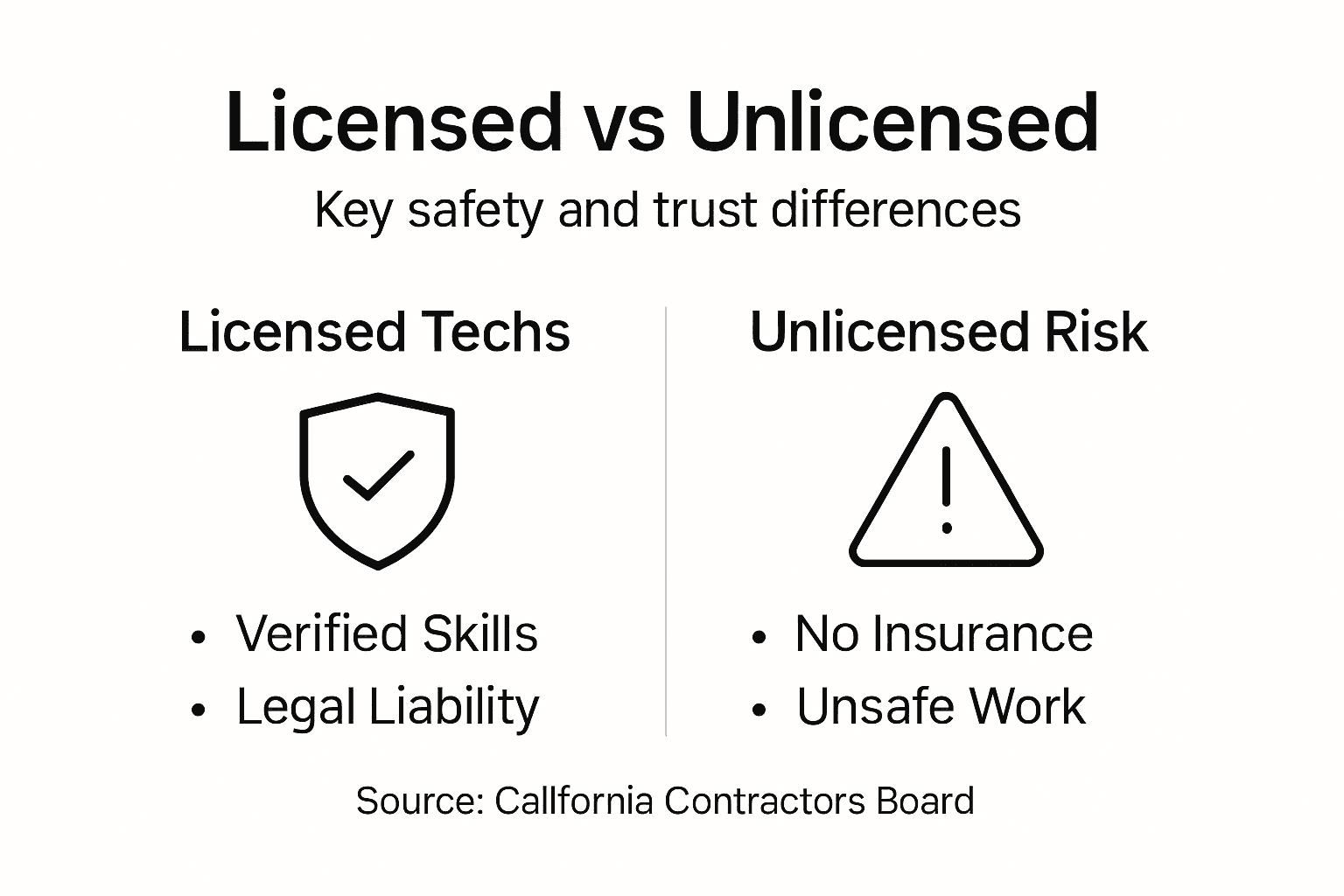
Hiring unlicensed technicians represents a significant financial and safety gamble that can expose homeowners to substantial risks and unexpected complications. Legal research indicates that unverified and unregulated repair work can create profound legal and financial vulnerabilities for unsuspecting property owners.
The potential risks associated with unlicensed technicians include:
- Financial Vulnerabilities
- No guaranteed workmanship warranties
- Limited legal recourse for poor repairs
- Potential expensive future corrections
- Safety Hazards
- Lack of proper technical training
- Potential code violation risks
- Increased likelihood of dangerous installations
- Insurance Complications
- Possible claim denials
- Reduced property protection
- Potential liability issues
Contractor oversight organizations consistently highlight that unlicensed technicians frequently circumvent essential safety regulations. These professionals typically lack critical protections such as:
- Mandatory insurance coverage
- Professional liability protection
- Verified technical competency
- Background security checks
- Accountability mechanisms
The financial implications of hiring unlicensed technicians extend far beyond immediate repair costs. Homeowners may face significant expenses related to potential damage repair, code violation corrections, and unexpected system failures resulting from improper maintenance.
Regulatory noncompliance creates substantial risks that many homeowners fail to recognize. Unlicensed technicians operate outside established professional standards, potentially voiding equipment warranties, compromising home insurance coverage, and exposing residents to potential safety threats.
Pro tip: Always request and independently verify a technician’s professional license and insurance documentation before authorizing any home repair work.
Comparing Licensed, Certified, and DIY Approaches
Homeowners face critical decisions when addressing appliance repairs, with three primary approaches offering distinct advantages and potential risks. Harvard research reveals significant differences between professional and do-it-yourself repair strategies that can dramatically impact long-term home maintenance outcomes.
The comparative landscape of repair approaches includes:
- Licensed Professional Approach
- Comprehensive technical expertise
- Guaranteed quality workmanship
- Full legal and insurance compliance
- Certified Technician Method
- Advanced specialized training
- Continuous professional education
- Rigorous skill validation
- DIY Repair Strategy
- Lowest upfront cost
- Personal learning opportunity
- Limited professional oversight
Home repair professionals emphasize that certification represents a critical distinction beyond basic licensing. Certified technicians demonstrate:
- Verified technical competencies
- Ongoing skills assessment
- Adherence to current industry standards
- Commitment to professional development
- Ethical service delivery
The cost comparison extends far beyond immediate expenses. DIY approaches might seem financially attractive initially, but potential mistakes can lead to expensive system failures, safety risks, and voided equipment warranties. Licensed and certified professionals provide structured protection against such long-term financial vulnerabilities.
Technical complexity increasingly favors professional intervention. Modern appliances incorporate sophisticated electronic systems and intricate technological components that require specialized diagnostic tools and advanced technical knowledge beyond typical homeowner expertise.
Compare the licensed, certified, and DIY repair approaches at a glance:
| Approach | Strength | Limitation | Best For |
|---|---|---|---|
| Licensed | Full legal protection | Higher initial costs | Complex system repairs |
| Certified | Specialized expertise | May lack broad coverage | Unique appliances or technologies |
| DIY | Low up-front expense | Heightened long-term risk | Simple, non-technical projects |
Pro tip: Consider your technical skill level, available time, and potential risk before choosing between DIY, licensed, or certified repair approaches.
Trusted Licensed Technicians Deliver Safety and Peace of Mind
When it comes to appliance repair and home system services, trusting unverified help can put your safety and finances at risk. This article highlights why hiring licensed technicians ensures compliance with legal and safety standards, protects your home from costly mistakes, and guarantees professional quality. If you are in Orange County or Los Angeles County and want the assurance that every repair is done with expert precision and full licensing, then relying on proven professionals is not just a choice but a necessity.
At AppliancesRepairMDTech, we connect you with licensed technicians specializing in appliance repair, HVAC, and plumbing services. Our team meets all certification and licensing requirements discussed in the article and is committed to delivering reliable, safe, and efficient repairs for refrigerators, washers, dryers, and more. Experience quick appointment booking and service available across multiple local cities, backed by a trusted community reputation.
Don’t compromise your home’s safety with unlicensed repairs. Visit AppliancesRepairMDTech today to schedule service with verified licensed technicians who stand behind their work. Secure your home and enjoy worry-free appliances now.
Frequently Asked Questions
What is the role of licensed technicians in home repairs?
Licensed technicians are specialized professionals trained to perform complex home repair services safely and effectively. They possess advanced technical knowledge and must meet strict state and local licensing requirements.
How do I verify if a technician is licensed?
You can verify a technician’s current licensing status by checking online through your local licensing authority or regulatory body, such as the Contractors State License Board.
What are the risks of hiring unlicensed technicians?
Hiring unlicensed technicians can expose homeowners to financial vulnerabilities, safety hazards, and legal complications, as unlicensed workers may not comply with safety regulations or industry standards.
What certifications should I look for in a technician?
Look for certifications that validate a technician’s abilities, such as specialized training in fields like HVAC, plumbing, or electrical work, which demonstrate their proficiency and commitment to ongoing education.