
TL;DR:
- For most U.S. homes in 2026, electric appliances offer better indoor air quality and higher efficiency despite gas’s cost advantages. The best choice depends on local utility rates, existing infrastructure, and how long homeowners plan to stay. Professional assessments and careful cost calculations are essential before converting or installing appliances, especially with changing regulations.
For most U.S. homes in 2026, modern electric options win on efficiency and indoor air quality — but gas still makes sense if you have existing infrastructure, live in a cold climate, or want cooking performance without a panel upgrade. The real decision comes down to three things: your local utility rates, what’s already in your walls, and how long you plan to stay in the home.
Before reading further, do two things right now:
- Pull your last two utility bills and note your cost per kWh (electricity) and per therm (gas).
- Check whether your home has an active gas hookup and whether your electrical panel has capacity for a 240V circuit.
Those two data points will settle most of the debate for your specific home. Everything below helps you interpret them.
Table of Contents
- What are the real pros and cons of gas vs electric appliances?
- How do gas and electric appliances compare by type?
- How do you calculate whether gas or electric costs less for your home?
- What safety risks do gas and electric appliances carry?
- How does fuel choice affect your home’s carbon footprint?
- What does a gas-to-electric conversion or new installation actually involve?
- How do you decide? A checklist and questions to ask your contractor
- When should you hire a licensed technician?
- Key Takeaways
- Why modern electric usually wins, but gas isn’t going away
- Appliancesrepairmdtech handles gas, electric, and everything in between
- Useful sources for homeowners
What are the real pros and cons of gas vs electric appliances?
| Dimension | Gas | Electric |
|---|---|---|
| Upfront cost | Comparable to electric at baseline; gas lines add cost in retrofits | Comparable at baseline; panel upgrades can add $1,500–$5,000 |
| Operating cost/efficiency | Often cheaper per unit of heat in many regions; efficiency varies by appliance | Higher per-kWh cost, but heat pumps and induction offset this significantly |
| Responsiveness/performance | Instant flame, precise heat control for cooking | Induction boils water ~20% faster than gas; ovens heat evenly |
| Safety and mitigation | CO risk, combustion byproducts, leak risk; requires detectors and ventilation | Overload and fire risk from faulty wiring; requires proper circuits and grounding |
| Installation/retrofit complexity | Gas-line work varies widely; exterior trenching possible in retrofits | 240V circuit or panel upgrade often required for high-draw appliances |
| Lifespan and maintenance | Gas furnaces and water heaters are durable; annual inspections recommended | Heat pumps and electric appliances generally need less combustion-related maintenance |
| Environmental impact | On-site combustion emits CO₂, NO₂, and methane; indoor air quality concerns | Zero on-site combustion; emissions depend on local grid mix |

Pro Tip: Induction cooktops and heat-pump water heaters are the two appliances where electric efficiency has most clearly surpassed gas. If you’re replacing either of those, run the numbers on electric before defaulting to gas.
The short version: gas wins on per-unit fuel cost in many regions and on existing-infrastructure convenience. Electric wins on indoor air quality, long-run efficiency with the right equipment, and zero on-site combustion.
How do gas and electric appliances compare by type?
Cooktops and ranges
Gas stovetop pros:
- Instant heat response; works during power outages
- Compatible with all cookware types
- Preferred by many cooks for visual flame control
Gas stovetop cons:
- Emits NO₂, CO, and fine particulates indoors; linked to childhood asthma rates
- Requires ventilation; open burners are a burn and fire hazard
- Harder to clean around grates
Induction electric pros:
- Boils water roughly 20% faster than gas
- Surface stays cool; dramatically lower burn risk
- No combustion byproducts
Induction electric cons:
- Requires magnetic cookware (cast iron, stainless steel)
- Needs a 240V circuit; older homes may need panel work
When to choose gas: You cook frequently, already have a gas line, and prioritize flame control or power-outage resilience.
When to choose induction: You’re upgrading from scratch, have young children, or have indoor air quality concerns.
Ovens
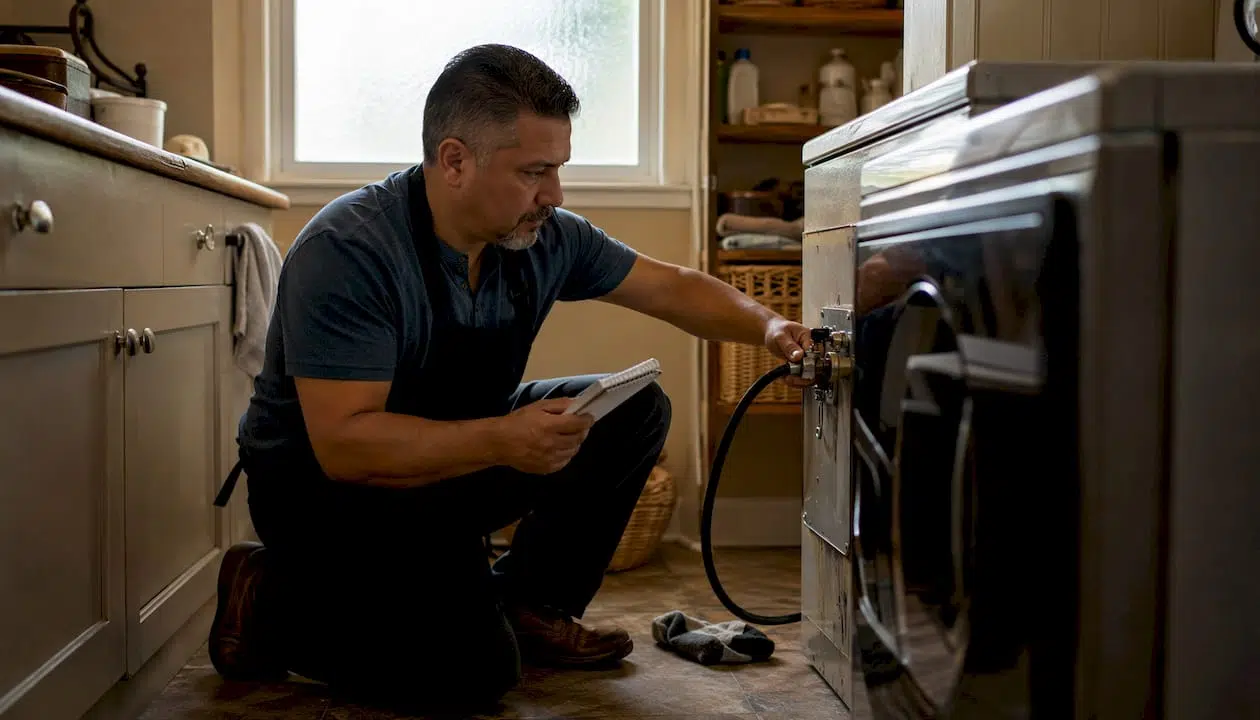
Gas ovens tend to run slightly moister (better for bread), while electric ovens heat more evenly and hold temperature more consistently. For most baking, electric wins. For roasting, the difference is minor.
When to choose gas: Existing gas range with a combined oven; no panel capacity for a 240V circuit.
When to choose electric: New installation, convection baking priority, or no gas line available.
Water heaters
- Gas tank water heater: Lower operating cost in most regions; faster recovery time. Requires venting.
- Electric tank water heater: Higher operating cost but simpler installation; no venting needed.
- Heat pump water heater: Efficiency above 300% (COP > 3) compared to standard electric models. Requires a space with adequate ambient temperature and at least 700–1,000 cubic feet of air volume. Dehumidifies the surrounding space, which helps in humid climates but can be a drawback in tight utility rooms.
- Tankless gas: High efficiency, endless hot water, but requires proper gas-line sizing and venting.
When to choose gas: Cold climate, high hot-water demand, existing gas infrastructure.
When to choose heat-pump electric: Mild to moderate climate, utility room with adequate space, access to rebates.
Dryers
- Gas dryers heat faster and cost less per cycle in most markets, but require a gas line and proper venting.
- Electric vented dryers are the most common and easiest to install; higher per-cycle cost.
- Heat-pump dryers (ventless electric) are the most efficient option and don’t require exterior venting, but cost more upfront and have longer cycle times.
When to choose gas: Existing gas hookup, high laundry volume, cost-per-cycle priority.
When to choose electric heat-pump dryer: No exterior vent option, efficiency priority, or new construction.
Space heating
A high-efficiency gas furnace (95% AFUE condensing model) remains the lower-cost heating option in cold climates, where average gas heating bills are often significantly lower than electric alternatives. Cold-climate heat pumps have closed the gap considerably, but standard heat pumps lose efficiency below freezing and rely on electric resistance backup, which drives up winter bills. A high-HSPF2 heat pump (rated around 10.5 HSPF2) reduces backup heat use by roughly 80% compared to a standard model.
When to choose gas furnace: Cold climate (USDA zones 5–7), existing gas infrastructure, heating load above 50 MMBtu per year.
When to choose heat pump: Mild to moderate climate, new construction, dual heating/cooling need, or strong local incentives.
How do you calculate whether gas or electric costs less for your home?
Local utility rates matter far more than national averages. A home in California paying $0.30/kWh faces a very different calculation than one in the Midwest paying $0.12/kWh.
Here’s a repeatable method:
- Find your per-unit rates. From your bills: cost per kWh (electricity) and cost per therm (gas). National averages run roughly $0.16/kWh for electricity and $1.10/therm for gas, but regional rates vary widely.
- Estimate annual appliance energy use. Your appliance’s EnergyGuide label lists estimated annual kWh or therm consumption.
- Convert to annual cost. Multiply usage by your local rate. Example: a water heater using 4,500 kWh/year at $0.16/kWh costs $720/year to run. A gas equivalent using 250 therms at $1.10/therm costs $275/year.
- Add hidden retrofit costs. A panel upgrade or new 240V circuit typically runs $1,500–$5,000. Gas-line work for a retrofit can range from a few hundred dollars in simple cases to several thousand when exterior trenching is required. Divide those one-time costs by your projected annual savings to get your payback period.
- Check incentives before finalizing. The Inflation Reduction Act includes federal tax credits for heat-pump water heaters, heat pumps, and other efficient electric appliances. State and utility rebates can further reduce upfront costs. Check the DOE’s Energy Saver page and your utility’s rebate portal.
Pro Tip: Don’t use national-average energy tables to make this decision. Pull your actual bills, plug in your real rates, and run the math for your specific appliance. The answer often surprises people.
What safety risks do gas and electric appliances carry?
Both fuel types carry real risks — they’re just different risks that require different mitigation.
Gas appliance safety risks and mitigation:
- Carbon monoxide (CO): Install UL-listed CO detectors on every level of the home, especially near sleeping areas.
- Combustion byproducts (NO₂, fine particulates): Use a range hood vented to the exterior; never use a gas oven for space heating.
- Gas leaks: Know how to shut off the gas supply; schedule annual inspections by a licensed technician.
- Improper venting: Furnaces and water heaters must vent combustion gases to the exterior; blocked or cracked flues are a serious hazard.
Electric appliance safety risks and mitigation:
- Overloaded circuits: High-draw appliances (electric ranges, dryers, heat pumps) require dedicated 240V circuits.
- Faulty wiring: Older homes with aluminum wiring or undersized panels need evaluation before adding electric appliances.
- Arc faults: AFCI breakers reduce fire risk from damaged wiring; required by code in most new installations.
Safety checklist before any gas or electric appliance installation:
- [ ] CO detectors installed and tested (gas homes)
- [ ] Range hood vented to exterior (gas cooking)
- [ ] Annual gas-line and appliance inspection scheduled
- [ ] Panel capacity confirmed for new electric loads
- [ ] Dedicated circuit installed for high-draw appliances
- [ ] Licensed, insured installer with permit pulled for the job
- [ ] Final inspection by local building department completed
Pro Tip: Before buying any appliance, check with your local building department about permit requirements. Skipping a permit on a gas line or electrical circuit can void your homeowner’s insurance and create liability if something goes wrong. A professional gas appliance installation includes permit coordination as part of the job.
Federal and state codes are shifting. Two federal appellate courts in New York and California upheld restrictions on gas appliances in new construction in 2026, while the DOE has proposed rulemaking to preserve consumer choice at the federal level. Check your local building code before planning any new gas hookup.
How does fuel choice affect your home’s carbon footprint?
Gas appliances burn fuel on-site, producing CO₂, NO₂, and methane directly inside or adjacent to your living space. Electric appliances produce zero on-site combustion, but their emissions depend entirely on how your local grid generates power.
Emissions comparison:
- Gas cooking: Emits NO₂ and CO indoors; peer-reviewed studies link gas stove use to elevated childhood asthma rates.
- Gas heating: A high-efficiency condensing gas furnace (95% AFUE) can match or beat the lifetime emissions of a standard electric heat pump in cold climates, depending on grid carbon intensity.
- Electric with heat pump: COP above 3 means the appliance delivers more than three units of heat per unit of electricity consumed, making it dramatically more efficient than electric resistance heating.
- Electric on a clean grid: In states with high renewable penetration, electric appliances produce substantially lower lifecycle emissions than gas equivalents.
The efficiency reality: Heat pump appliances achieve efficiencies that no gas appliance can match at the point of use. A heat pump water heater running at COP 3.5 is effectively 350% efficient. The question is whether your grid is clean enough to make that efficiency advantage translate to lower emissions.
For climate-minded homeowners: switching cooking to induction and water heating to a heat-pump model delivers the largest indoor air quality and emissions benefit per dollar spent, especially in states with cleaner grids.
What does a gas-to-electric conversion or new installation actually involve?
Conversion projects cannot be accurately costed from a distance. Every site is different. Here’s what the process typically looks like:
- Site visit and assessment. A licensed technician checks panel capacity, existing gas-line routing, venting, and wall access. This visit is what makes accurate pricing possible.
- Permit application. Gas-line work and electrical circuit additions both require permits in most jurisdictions. Expect 1–3 weeks for permit approval.
- Rough work. Running a new gas line may require exterior trenching or interior wall access. Adding a 240V circuit requires running wire from the panel to the appliance location.
- Panel upgrade (if needed). A main panel upgrade runs $1,500–$5,000 and can take a full day. Ask your contractor explicitly about main-lug vs. full-panel replacement and whether a subpanel is an option to reduce cost.
- Appliance installation and venting. New venting or capping of old gas vents adds time and cost.
- Inspection. Local building department inspection closes the permit. Budget 1–4 weeks from permit to final inspection depending on your municipality.
Common surprises that change the ROI:
- Home older than 30 years: likely needs panel evaluation and possibly full replacement.
- Shared electrical load (multi-unit building): panel capacity may be constrained.
- Limited space for heat-pump water heaters: they need adequate air volume and won’t perform well in very cold or very small utility rooms.
- Exterior gas-line trenching: adds significant cost in retrofit scenarios.
For gas conversion options and what each involves, a professional site visit is the only way to get a number you can actually plan around.
How do you decide? A checklist and questions to ask your contractor
Work through this in order before committing to either fuel type:
- Run the local utility math (see the calculation method above). Use your actual bills.
- Assess existing infrastructure. Gas line present? Panel capacity for 240V? Exterior venting available?
- Estimate your service life. If you’re staying 10+ years, efficiency savings compound. If you’re selling in 3 years, upfront retrofit costs may not pay back.
- Check indoor air quality priorities. Households with children or asthma sufferers have a stronger case for induction and electric.
- Verify local code and incentives. Some states and cities restrict new gas hookups in new construction. Federal and state rebates may cover 30% or more of heat-pump appliance costs.
Questions to ask your contractor before signing anything:
- What is my current panel capacity, and will this appliance require an upgrade?
- Does this job require a permit, and will you pull it?
- How will the appliance be vented, and what does that involve structurally?
- What is the full scope of gas-line or electrical work, in writing?
- What warranty covers the installation labor, and who handles service calls?
- If I’m converting from gas to electric (or vice versa), what happens to the existing line or circuit?
Red flags in contractor quotes:
- No mention of permits
- Verbal-only scope with no written estimate
- No license or insurance documentation provided
- Price quoted without a site visit for a conversion project
Trust signals to look for: state contractor’s license number on the estimate, proof of liability insurance, written scope of work, and a clear permit plan. For appliance installation best practices, licensed technicians follow a documented process that protects you if something goes wrong later.
When should you hire a licensed technician?
Three scenarios where a professional isn’t optional:
- New hookup or conversion. Running a gas line or adding a 240V circuit to a panel requires a licensed contractor and a permit. No exceptions.
- Repeated CO or combustion symptoms. Headaches, soot around appliances, or CO detector alerts mean you stop using the appliance and call a pro immediately.
- Pre-purchase or pre-renovation inspection. Before buying a home or planning a major appliance upgrade, a professional inspection tells you exactly what the infrastructure can support.
What a licensed technician checks during a professional inspection:
- Gas-leak test on all accessible lines and fittings
- CO test and combustion analysis on gas appliances
- Panel load test to confirm capacity for new electric loads
- Venting integrity check (flue, exhaust, and intake)
- Operation safety check on all appliances being inspected
- Verification that existing detectors are functional and correctly placed
A single professional visit can settle the conversion question. A panel capacity test, CO test, and vent integrity check together typically take a few hours and give you the data you need to make a confident decision.
Pro Tip: Routine appliance maintenance tips from a qualified technician can catch small issues before they become expensive ones. Annual inspections on gas appliances are the single most cost-effective safety investment a homeowner can make.
For gas-specific safety guidance, the gas appliance safety checklist from Appliancesrepairmdtech covers detector placement, ventilation requirements, and inspection triggers in detail.
Key Takeaways
Modern electric appliances, particularly induction cooktops and heat-pump water heaters, have narrowed or reversed the traditional performance and cost advantages of gas for most U.S. homeowners, but local utility rates and retrofit costs remain the deciding factors.
| Point | Details |
|---|---|
| Run local utility math first | Use your actual per-kWh and per-therm rates, not national averages, to calculate real operating costs. |
| Factor in retrofit costs | Panel upgrades run $1,500–$5,000 and can erase first-year savings from switching a single appliance. |
| Heat pumps and induction lead on efficiency | Heat-pump appliances achieve COP above 3; induction boils water roughly 20% faster than gas. |
| Check local codes before planning | State and local gas restrictions are expanding in 2026; verify what’s permitted before buying. |
| Appliancesrepairmdtech handles the hard part | For installation, gas conversion, or safety inspections in Orange and Los Angeles counties, book a licensed technician to assess your site before committing to either fuel type. |
Why modern electric usually wins, but gas isn’t going away
The conventional wisdom used to be simple: gas is cheaper and more responsive, electric is cleaner but slower. That framing is outdated for cooking and water heating. Induction has genuinely surpassed gas on speed and precision. Heat-pump water heaters running at COP 3+ deliver efficiency no gas tank heater can match at the point of use. The indoor air quality case against gas cooking has grown stronger with each peer-reviewed study.
But here’s what gets lost in the electrification conversation: the grid still matters enormously. In states where electricity is generated primarily from coal or natural gas, switching to an electric appliance doesn’t automatically reduce emissions. And in cold climates, a high-efficiency condensing gas furnace paired with a smart thermostat can still beat a standard heat pump on both cost and emissions, especially in existing homes where panel upgrades would add thousands to the project cost.
The regulatory picture is genuinely complicated right now. Federal appellate courts in New York and California have upheld gas appliance restrictions in new construction, while the DOE has proposed rulemaking designed to preserve consumer choice at the federal level. Builders in multiple states face different rules depending on where they operate. For homeowners, the practical takeaway is this: check your local building code before planning any new gas hookup, because what’s allowed varies by city and county.
Gas retains real advantages for households with existing infrastructure, cold-climate heating needs, and cooking preferences that induction doesn’t satisfy (open-flame wok cooking, for instance). The honest recommendation is to run the local math, get a site visit before committing to a conversion, and prioritize the appliances where the efficiency gap is largest: water heating and cooking first, space heating second.
Appliancesrepairmdtech handles gas, electric, and everything in between
Choosing between gas and electric is one decision. Getting the installation done right is another. Appliancesrepairmdtech serves homeowners and property managers across Orange County and Los Angeles County with licensed technicians who handle gas-line repair, gas-to-electric conversions, appliance installation, safety inspections, and HVAC repair.
A service visit from Appliancesrepairmdtech starts with a site assessment: panel capacity, gas-line routing, venting, and appliance condition. That assessment gives you the actual numbers you need to decide whether a repair vs replacement makes financial sense, and what a conversion would realistically cost for your specific home. For heat pump and gas HVAC systems, the team also handles HVAC repair and maintenance across both counties.
Book a site visit or get a quote at appliancesrepairmdtech.com.
Useful sources for homeowners
- U.S. Department of Energy — Water Heating: Efficiency ratings, heat-pump water heater guidance, and federal incentive information.
- NAHB — Gas Appliance Ban Rulings (2026): Coverage of the New York and California appellate decisions affecting new construction.
- DOE Proposed Appliance Rulemaking — Green Building Law Update: Analysis of the DOE’s July 2026 proposed rule and what it means for consumer choice.
- AGA Building for Efficiency Report: Cost and emissions comparison of gas vs electric homes in new construction.
- Pick Comfort — Gas vs Electric Cost Comparison: Regional rate tables and scenario-based cost comparisons for U.S. households.
- CleanTechnica — The Long U.S. Goodbye to New Gas Connections: Policy and legal developments shaping gas access in new construction.
- Appliancesrepairmdtech — Gas Appliance Safety Checklist: Homeowner checklist for gas detector placement, ventilation, and inspection triggers.
- Appliancesrepairmdtech — Gas Conversion Guide: What gas-to-electric and gas-type conversions involve, with local service details for Orange and Los Angeles counties.