
Choose a bottom freezer if your household reaches into the fridge many times a day and into the freezer only now and then. Choose a top freezer if you want the lowest price, the lowest running cost and the most freezer space for the money. Both layouts are good refrigerators. The better one is the one that matches how you shop, cook and move around your kitchen.
If you are replacing a fridge in Orange County or Los Angeles County, the layout also decides how the unit is delivered, leveled, connected and later serviced. Our technicians handle appliance installation and refrigerator repair for homes across both counties, so the choice below comes with a plan for getting it running properly.
TL;DR
- Top freezer: the lowest price, the best value per cubic foot and the lowest energy use. Frozen food sits at eye level, but you bend for fresh food every day.
- Bottom freezer: fresh food at eye level and a pull-out freezer drawer. It usually costs more and offers a little less freezer space, because drawers and bins take room.
- Count your openings: most households open the fridge several times a day and the freezer once or twice. That favors the bottom freezer for comfort and the top freezer for budget.
- Measure before you buy: door swing, width and a level floor matter as much as the layout.
- Either layout lasts longer with clean coils, sound door seals and a timely service call at the first sign of trouble.
Table of Contents
- The difference in one minute
- Count how often you open each door
- Space: what you really get inside
- Energy use and running cost
- Price and long-term value
- Reliability and repairs
- Fit: your kitchen, your body, your household
- Which one is right for you
- Getting it installed and running right
- Book MDTECH for your fridge
- Our view: pick by habit, then protect the choice
- FAQ
- Sources
The difference in one minute
A top-freezer refrigerator, also called a top-mount, has a freezer compartment above the fresh-food section. A bottom-freezer refrigerator, or bottom-mount, puts the fresh-food section at eye level and the freezer below it, usually as a pull-out drawer, as Whirlpool describes the two layouts.
Consumer Reports’ 2026 buying guide gives the typical ranges:
| Top freezer | Bottom freezer | |
|---|---|---|
| Typical price range | $500 to $1,700 | $600 to $2,900 |
| Width | 22 to 33 inches | 24 to 33 inches |
| Largest capacity | Up to 24 cu. ft. | Up to 26 cu. ft. |
| Where you bend | To reach fresh food | To reach frozen food |
| Storage for its size | Tends to offer the most | May offer less than a top freezer |
The same guide says top freezers tend to cost less and be more reliable than other types. That is the whole trade in a sentence: the top freezer is the practical choice, and the bottom freezer is the comfortable one.
Count how often you open each door
The most useful test is also the simplest. Think about a normal week in your kitchen.
According to Fridge.com’s ergonomic comparison, most households open the fridge four to seven times a day and the freezer only once or twice. With a bottom freezer, you bend one or two times a day for frozen items. With a top freezer, you bend four to seven times a day for milk, produce, leftovers and drinks.
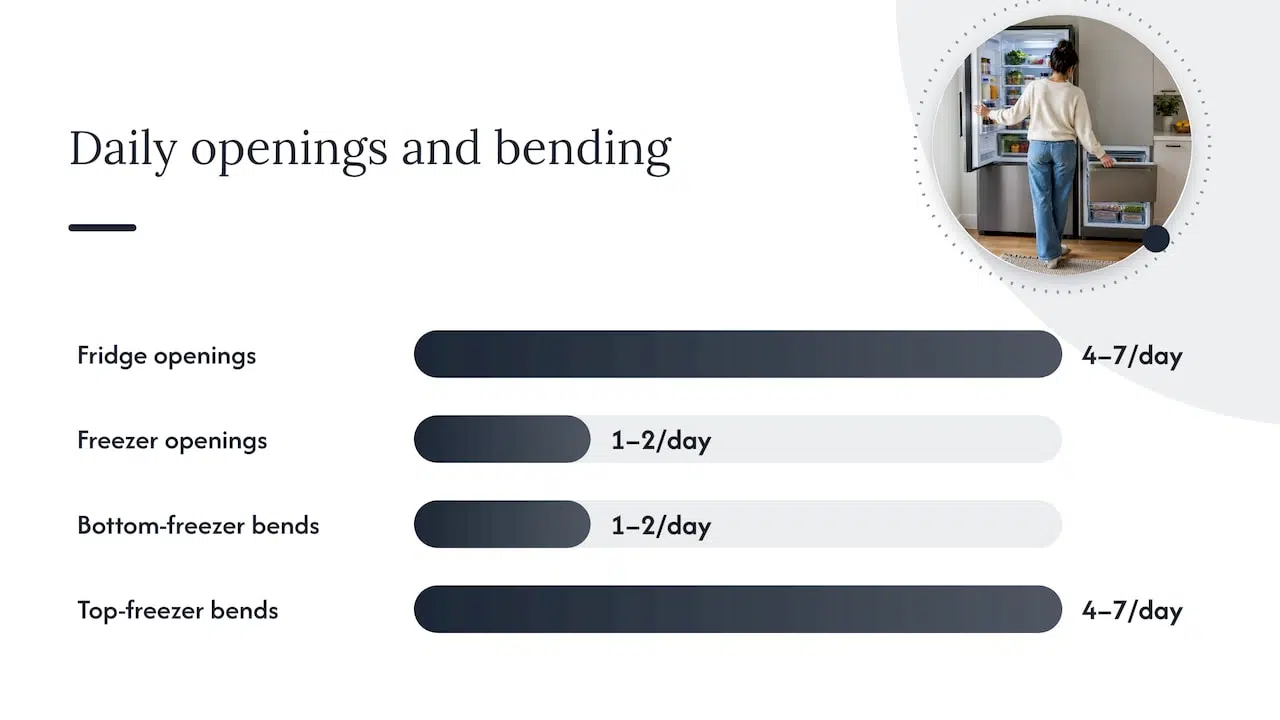
That is why the bottom freezer has become so common. Bray & Scarff notes that the design took off in the 1990s and 2000s as shoppers moved toward fresh produce, dairy and prepared meals, which made eye-level fresh food more valuable.
Your own pattern can point the other way. If you cook from frozen several times a day, keep bulk meat or frozen meals on hand, or run a household that lives on frozen vegetables and pizza, the top freezer puts the busy compartment at a comfortable height. Fridge.com’s usage guidance makes the same point: households that open the freezer three or more times a day are more comfortable with eye-level frozen access.
A quick way to decide
- For one week, tally how many times each person opens the freezer.
- If the total is under about two openings per day, a bottom freezer saves you the most bending.
- If it is three or more per day, a top freezer will likely feel better.
- If someone in the home has back, hip or knee problems, think about who does the reaching. The person who opens the fridge most often should not have to crouch for it.
Space: what you really get inside
Two fridges with the same cubic-foot rating do not always hold the same amount. Consumer Reports’ buying guide notes that lab tests often find usable storage is less than the manufacturer’s claim.
Bottom freezers lose some room to the drawer hardware. In Consumer Reports’ freezer-space comparison, Jim Nanni, head of appliance testing, said bottom-freezers tend to have smaller freezers because of the space taken by organizer bins and sliding hardware. Some top-freezers offered about a cubic foot more freezer space than the largest bottom-freezers tested. That 2019 test is older, but the design logic has not changed: a drawer needs rails and a basket, and a cabinet freezer does not.
The fresh-food side tells a different story. Bottom-mount models usually give you a full-width fresh-food section with wider shelves and deeper door bins, which is handy for party trays and pizza boxes. Reviewed’s guide to refrigerator styles describes the bottom freezer as a basic fridge with a better freezer, and points out that it costs much less on average than French-door models.
Size by household
Consumer Reports says most manufacturers recommend 19 to 22 cubic feet for a family of four, and 30 to 33 cubic feet for households that do big weekly or bulk shopping trips. Bulk shoppers in Southern California, where warehouse-store runs are routine, should therefore look closely at freezer capacity, not only the headline number.
How each freezer organizes food
- Top freezer: shelves and door bins keep items visible at eye level. Heavy items such as a holiday turkey are easy to slide in and out.
- Bottom freezer: a drawer stacks food in layers. It lets you see the top layer at once, but items at the back and bottom can get buried unless you use baskets and a simple labeling habit.
If you pick a drawer model, keep flat, uniform packages on top and use bins for loose items. That keeps the drawer working like a filing cabinet instead of a pile.
Energy use and running cost
Top freezers generally have the edge. Fridge.com’s 2026 comparison reports that top freezers are typically 10 to 15 percent more efficient: roughly 300 to 500 kWh a year, or about $38 to $65, against 400 to 650 kWh, or about $50 to $85, for bottom freezers. It adds that ENERGY STAR top freezers around 18 cubic feet can run under 350 kWh a year.
For an official yardstick, the Federal Trade Commission’s EnergyGuide tables list estimated yearly operating costs for bottom-mounted automatic-defrost models. The 2011 edition of the rules gives about $46 to $63 per year depending on size, and $47 to $61 for 16.5 to 18.4 cubic foot units. Those are historical range tables. Your cost depends on the electricity rate on your utility bill, so use the yellow EnergyGuide label on the exact model as your real comparison.
The gap between layouts is about $10 to $20 a year in Fridge.com’s figures. Over a service life of 12 to 18 years, that adds up to a real but modest sum. It rarely outweighs comfort for a household that opens the fridge all day, and it rarely justifies a bottom freezer’s higher price for one that does not.
A few habits shrink the difference for either layout:
- Keep the condenser coils clean so the compressor does not run longer than it needs to.
- Replace a worn door gasket. A leaky seal makes any fridge work harder, and our guide to a refrigerator door that won’t seal shows how to spot one.
- Leave a little breathing room behind and beside the unit.
- Do not overpack the fresh-food section, so air can circulate.
Price and long-term value
Top freezers are the cheapest full-size option. Fridge.com also calls them the best value per cubic foot, and puts the start of bottom-freezer pricing at around $800. Consumer Reports’ ranges ($500 to $1,700 for top freezers, $600 to $2,900 for bottom freezers) show the same pattern, with the premium end of the bottom-freezer market reaching higher.
What you pay extra for with a bottom freezer is mostly design and convenience: eye-level fresh food, a drawer, and on many models an exterior water and ice dispenser. Abt’s comparison lists the lack of an exterior dispenser as a typical top-freezer drawback and lists dispensers among bottom-freezer advantages. If a door dispenser matters to you, that narrows the field fast.
A simple value check
Ask what you would pay per year of comfort. If a bottom freezer costs $300 more and you keep it 12 years, that is $25 a year for not crouching several times a day. For many people that is easy to justify. For a rental, a garage, a guest unit or a first apartment, the top freezer’s lower price usually wins.
Reliability and repairs
Consumer Reports says top freezers tend to be more reliable than other types. The reason is mostly simplicity. A top freezer has fewer moving parts to wear: no drawer slides, no rails, and often fewer features overall.
Bottom freezers are dependable too, and a few parts deserve attention over the years:
- The freezer drawer and its slides. Keep the track clean and avoid overloading the basket so the drawer glides without catching.
- Door and drawer gaskets. A gasket that no longer seals can lead to frost, extra energy use and warm spots.
- Defrost components. Frost-free models use a defrost cycle to keep the evaporator clear. If you notice frost build-up or a warm fridge, see our explainer on the refrigerator defrost cycle.
- Water and ice lines on models with dispensers, which are a common source of drips. Our guide to why a refrigerator leaks covers the usual causes.
Whichever layout you buy, a stable routine helps. Our step-by-step refrigerator maintenance guide covers cleaning, temperature checks and the small jobs that protect the compressor. If the fridge stops cooling properly, our page on a refrigerator not cooling lists fast checks and tells you when it is time to call a technician.
Fit: your kitchen, your body, your household
Tight spaces and door swing
Top freezers come in the narrowest sizes, from about 22 inches wide, which is why they are popular for apartments, back houses and garages. Fridge.com notes that a single wide bottom-freezer door can need up to 33 inches of swing clearance. French-door bottom-freezer models solve that with two narrow upper doors. Measure the opening, the path from your front door to the kitchen, and the swing before you order. Better Homes & Gardens quotes appliance expert Spanyer that bottom freezers come in 30- and 33-inch widths, so confirm the cabinet cutout.
Mobility, age and children
For older adults, a bottom freezer is usually kinder to the back because the compartment used most sits at chest height. It is not the best fit for everyone, though. Bray & Scarff points out that regular leaning in a top-freezer is inconvenient for people with mobility concerns, and Better Homes & Gardens notes that young children may struggle to reach a bottom freezer drawer. If both compartments need to be reachable by everyone, a side-by-side layout is worth a look, but it is wider, typically 36 inches.
Garages and secondary spaces
A top freezer is the common pick for a garage or an ADU. Southern California garages can run hot in summer, and a fridge working in a hot space has to work harder, so give it ventilation, a level floor and a dedicated outlet. This is a good moment to have the unit installed properly instead of just rolled into place.
Which one is right for you
| Your situation | Better layout |
|---|---|
| Tight budget, simple needs | Top freezer |
| Lowest energy bill | Top freezer |
| Heavy frozen-food use | Top freezer |
| Garage, ADU or rental | Top freezer |
| Fresh produce, dairy and leftovers daily | Bottom freezer |
| Back or knee problems | Bottom freezer |
| You want a door water and ice dispenser | Bottom freezer |
| Frozen food used once a day or less | Bottom freezer |
There is no universal winner. Pick the layout that matches the compartment you use most.
Getting it installed and running right
A new fridge needs a level base, a clear water line if it makes ice, a grounded outlet and enough clearance for the door and for airflow. Small mistakes at the start, such as a tilted cabinet that stops a drawer from closing flush or a kinked water line, can cause trouble later. Our appliance installation checklist walks through the basics.
If your fridge is a Samsung, LG, Whirlpool or another major name, our brand list shows what we repair and install.
Book MDTECH for your fridge
Whether you have just bought a top-freezer or a bottom-freezer refrigerator, or the one you own has started to act up, our licensed technicians serve homeowners across Orange County and Los Angeles County. You can book online, and we handle both repair and installation of residential refrigerators. See our refrigerator repair in Orange County page or go to our appliance repair services page to schedule a visit.
For new units, our appliance installation services page explains what a professional setup covers.
Our view: pick by habit, then protect the choice
Most people choose a fridge by looking at a showroom floor and the price tag. We think the better question is what happens in your kitchen on an ordinary Tuesday. How many times does someone open the fridge, and how many times the freezer? Who does the reaching, and how far do they have to bend?
A top freezer is a sensible, economical machine with a simple layout, and a bottom freezer is a comfortable one for households that live in the fresh-food section. Both work well when they are set up properly. A level base, enough clearance and a clean gasket do more for the life of a refrigerator than most buyers expect.
Our licensed technicians install and repair refrigerators across Orange County and Los Angeles County, so we see the choice through to the day the unit is humming in your kitchen. If you are weighing the two layouts, decide by openings and space, then have it installed correctly and keep up the simple maintenance. If something goes wrong later, early attention is the cheapest repair.
MDTECH
FAQ
Is a bottom freezer or a top freezer better?
Neither wins on every count. A top freezer costs less, uses less energy and tends to be more reliable, according to Consumer Reports. A bottom freezer puts fresh food at eye level, which suits households that open the fridge far more often than the freezer.
Do bottom freezers use more electricity?
Generally a little more. Fridge.com’s 2026 comparison puts top freezers at about 300 to 500 kWh a year and bottom freezers at about 400 to 650 kWh. Actual cost depends on your local electricity rate and the model’s EnergyGuide label.
Why are freezers at the bottom now?
Shopping habits changed. As households bought more fresh produce, dairy and prepared meals, designers moved the freezer down so the most-used compartment sits at eye level. Frost-free designs with fans and ducts also made the freezer’s position less critical to how the fridge cools.
Which layout is easier on the back?
A bottom freezer, for most households, because you bend only for the freezer, which you open least. If you rely heavily on frozen food, a top freezer may be easier. Think about who reaches into the fridge most often.
Can you service and install both types in Orange County and Los Angeles?
Yes. We install and repair residential refrigerators, including top-freezer and bottom-freezer models, in Orange County and Los Angeles County. You can book through our site.
Sources
- Choose the Right Refrigerator for Your Kitchen, Consumer Reports
- More Freezer Space: Top- or Bottom-Freezer Fridge?, Consumer Reports
- Top Freezer vs. Bottom Freezer Refrigerators, Whirlpool
- Bottom Freezer vs. Top Freezer Refrigerator, Fridge.com
- Federal Trade Commission, 16 CFR Part 305 EnergyGuide tables (2011)
- Our guide to refrigerator styles, Reviewed
- Top Freezer vs Bottom Freezer, Bray & Scarff
- Bottom freezer vs side-by-side, Better Homes & Gardens