
A Whirlpool oven that won’t heat is almost always down to one failed part: the igniter on a gas oven, the bake element on an electric one, or, less often, the temperature sensor or control board. A few checks take five minutes and need no tools: the breaker, the settings, the gas shut-off valve and an oven thermometer. If those don’t fix it, the repair involves live power or gas, and it belongs with a licensed technician. If you live in Orange County or Los Angeles County, our appliance repair team handles Whirlpool oven heating problems on site.
TL;DR
- Start with power and settings: a tripped or half-switched breaker, the wrong cooking mode, or Control Lockout can all look like a dead oven.
- On a gas oven, the usual culprit is a weak igniter. On an electric oven, it is a burned-out bake element.
- Whirlpool says to preheat with an oven thermometer on the center rack. A gap of 15°F or more calls for calibration, and a gap of 100°F or more calls for a professional.
- Replacing an igniter, element, sensor or gas valve means working with electricity or gas, so stop at the checks below and book a technician.
- A slow preheat is an early warning: the part is usually weakened, not dead yet.
Table of Contents
- What “not heating” can actually mean
- Five-minute checks before you call anyone
- Gas Whirlpool oven: the igniter is the usual suspect
- Electric Whirlpool oven: bake element, broil element, and thermal fuse
- Temperature sensor and control board
- Heats, but not hot enough: test with a thermometer
- What a repair typically costs
- When to stop and call a technician
- Book your Whirlpool oven repair in Orange County or Los Angeles County
- Our view: diagnose first, then replace the right part
- FAQ
- Sources
What “not heating” can actually mean
People use the same words for four different problems, and each points to a different cause.
| What you see | Most likely area |
|---|---|
| Oven is completely dead, no display | Power: breaker, outlet, control board |
| Display and fan work, but no heat | Heating element (electric) or igniter (gas), thermal fuse |
| Heats, but stalls well below the set temperature | Weak element or igniter, sensor, door seal, calibration |
| Cooktop burners light, oven does not (gas) | Gas shut-off valve for the oven, igniter |
Whirlpool’s own guidance names a faulty igniter in a gas oven or a broken heating element in an electric oven as possible reasons an oven will not heat, because those parts are what give the oven its ability to produce heat. The same page lists the breaker, the outlet, the door seal and the position of the temperature sensor as other things to check.
Five-minute checks before you call anyone
These are the checks the manufacturer itself suggests, and none of them involve opening the oven.
- Check the breaker. Whirlpool says to look for a circuit breaker stuck between “On” and “Off” and to make sure the outlet works. Flip the breaker fully off, then on. If you aren’t sure the outlet is live, a licensed electrician should check it, not you.
- Check the controls. Make sure the oven is set to Bake (not a timed or delayed mode), the temperature is set, and Control Lockout is not on. A Whirlpool owner’s manual lists these same basics for an oven that is not heating.
- Look at the temperature unit. An oven set to Celsius will look far too cool when you expect Fahrenheit.
- Reset after a power outage. Whirlpool’s help page says an F9 or F9 E0 code can appear after an outage if the control senses line noise or buttons were pressed during the 10-second power-up delay. The fix is to switch the household breaker off for one minute, switch it back on, and watch the oven for one minute.
- Gas ovens only: check the gas valve. Whirlpool says to confirm the gas connection valve is in the “On” position, and that if the oven still won’t heat, a licensed professional should inspect it.
If your cooktop burners light but the oven won’t, there is one more spot. Whirlpool’s product help explains that a dedicated gas pressure regulator shut-off valve on the back of the range may be closed. The lever should sit parallel to the gas line for “On”, and the anti-tip bracket must be re-engaged afterward. A 350°F Bake test then confirms ignition. If you smell gas at any point, leave the kitchen, don’t touch switches, and call your gas utility or 911 from outside.
Gas Whirlpool oven: the igniter is the usual suspect
A gas oven doesn’t have a pilot flame waiting to light. A hot-surface igniter glows, and as it heats it draws current through the oven safety valve, which opens the gas. If the igniter is weak, it can glow orange and still not pull enough current to open the valve. That is why the oven can look like it’s trying and still stay cold.
Two independent descriptions agree on how common this is. A troubleshooting guide from iFixit calls a weakened igniter the most common gas-oven failure and says an igniter that glows but fails to light the gas after 90 seconds is weakened and should be replaced. The same guide describes how Whirlpool ovens with direct spark ignition work: a 40-second delay, a short burst of sparks, several tries, then lockout after three failed attempts.
A 2026 diagnostic guide from ServiceMag adds that when a known-good igniter produces no flame, the safety valve itself may have failed, because the valve only opens when the igniter’s current shows it is hot enough. That is why a technician measures current draw rather than just replacing the part that looks worst. It also explains why replacing an igniter without checking the valve can leave you with the same cold oven.
What this means for you: a gas oven that glows but won’t light, or that heats only to a low temperature, needs a technician who can test the igniter and the valve together. Gas ovens are not a place for trial-and-error part swaps.
Electric Whirlpool oven: bake element, broil element, and thermal fuse
Electric ovens heat with two elements: the bake element on the floor of the oven and the broil element at the top. A useful clue costs nothing: if the broil function heats and bake does not, the bake element is the likely cause. A bake element that has visible blisters, cracks or a break, or that never glows red, has probably failed.
If the fan and the light work but nothing heats, the cause may be elsewhere, such as a thermal fuse or the control. Those parts sit inside the oven’s wiring, behind panels, on circuits that carry household voltage. Whirlpool advises contacting a professional for electrical issues and for replacing a heating element, and that is the right call. Unplugging isn’t always enough on a wall oven, which is typically wired to a breaker.
For a broader look at causes, our guide to why ovens won’t heat up walks through the common problems across brands.
Temperature sensor and control board
When both element and igniter are fine, the next suspects are the oven’s brain and its thermometer. The sensor is a thin probe inside the oven cavity. The control board reads the sensor’s resistance to know how hot the oven is, so a damaged or corroded sensor can make the oven shut off early or refuse to start. Whirlpool’s guidance lists the temperature sensor position among the checks. A sensor that has been bumped while cleaning can touch the oven wall and give bad readings.
Error codes such as F3 E0 or F3 E1 point to sensor trouble, and repeated codes after a breaker reset mean the problem is real, not a glitch. Whether the fault is the sensor, the wiring harness or the control board is something a technician determines by measuring, since replacing a control board is the most expensive guess you can make.
Heats, but not hot enough: test with a thermometer
If your oven preheats slowly or stalls, for example a digital display that sits in “preheating” while the real temperature stays low, test before you assume anything. Whirlpool’s instruction is to preheat with an oven thermometer on the center rack. When preheating finishes:
- Within 15°F of the setting: the oven is behaving normally.
- 15°F or more off: calibrate the oven using the owner’s manual, and confirm the temperature unit is right.
- 100°F or more off: don’t calibrate it yourself. Contact a professional.
A July 2026 guide from ServiceWorks Academy notes that slow heating usually means a part that still works but is degraded: a weak element, a weak igniter or a leaking door seal. Rack placement, opening the door often and a failing convection fan can also stretch preheat times. In other words, a slow oven is a warning, not a mystery. Fixing it while the part still works usually costs less than waiting for a total failure, and avoids a dinner for guests with an oven that dies halfway.
For more on this exact symptom, see our pages on an oven that preheats slowly and an oven not heating evenly.
What a repair typically costs
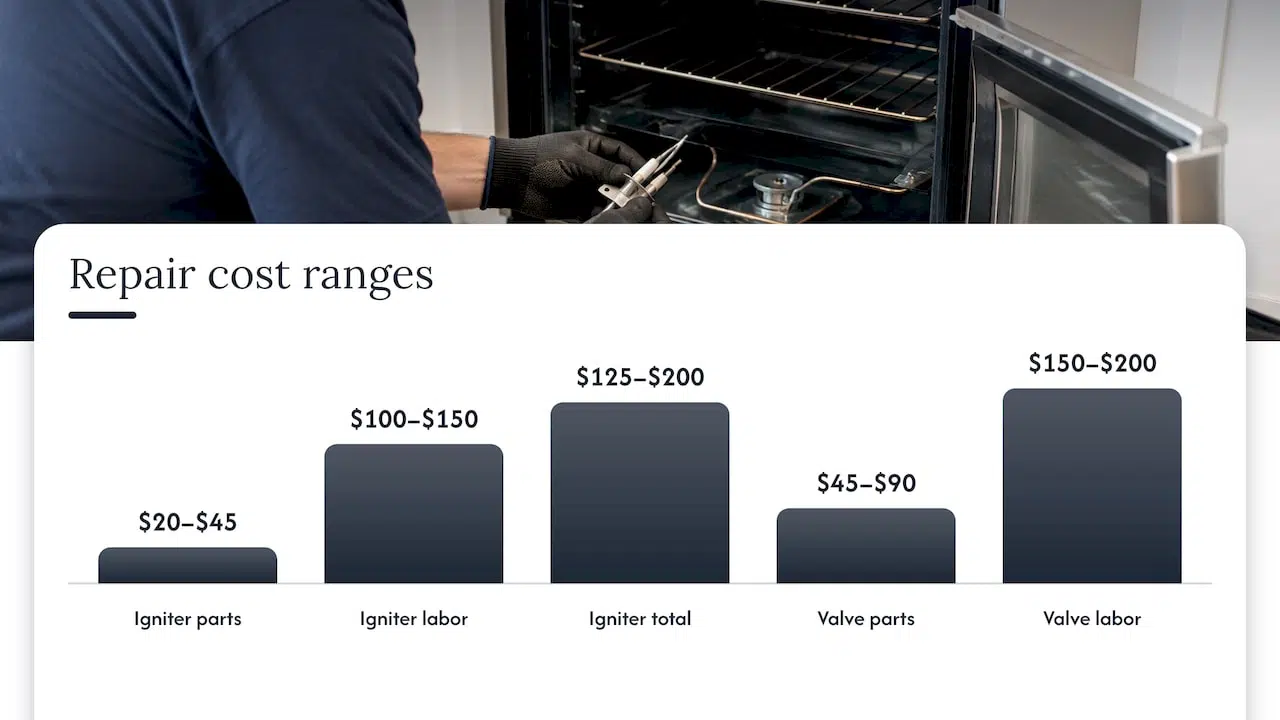
We don’t publish fixed prices on this page, and every oven is different, but published industry ranges help you judge a quote. ServiceMag’s 2026 guide puts an igniter replacement at $20 to $45 in parts plus $100 to $150 in labor, roughly $125 to $200 in total. It lists a Whirlpool oven safety valve at $45 to $90 in parts plus $150 to $200 in labor. Those are national figures. Prices in Southern California can run differently, and parts availability depends on your model.
The broader question is whether a repair makes sense at all. A heating element or igniter is usually a modest repair compared with the cost of a new oven, especially on a built-in or wall oven where replacement also means cabinet work and wiring or gas hookup. A control board is the part where the numbers get closer to a new oven. The model’s age and how the rest of the oven looks matter more than any rule of thumb, which is why the sensible first step is a diagnosis on site.
When to stop and call a technician
Stop and book a repair if any of the following applies:
- The breaker and settings are fine and the oven is still cold.
- A gas oven glows but does not light, or you smell gas.
- The oven is 100°F or more off the setting on a thermometer.
- The bake element is blistered, cracked or never glows.
- An F3 or F9 code returns after a breaker reset.
- The breaker trips every time the oven heats.
The common thread is that each fix involves 240-volt wiring or gas lines. Whirlpool itself directs people to a professional for electrical issues and igniter replacement. Our homeowner pages on oven troubleshooting and best oven repair solutions show what a visit usually covers.
Book your Whirlpool oven repair in Orange County or Los Angeles County
MDTECH Appliance Repair works on residential ovens, refrigerators, washers, dryers and dishwashers across Orange County and Los Angeles County, with licensed technicians and online appointment booking. Our kitchen appliance repair service covers ovens and ranges, and you can see the makes we work on on our brands page. Tell us the model, what the oven does and whether it’s gas or electric, and book a visit online.
If you’d rather start with the full service list, here is what we repair and install.
Our view: diagnose first, then replace the right part
An oven that won’t heat is one of the most frustrating kitchen failures, because it happens right when you need it. Our technicians are licensed, and our approach is built around a fast response, clear communication and safety.
The reason we favor an on-site diagnosis is that the same symptom has several causes. A cold gas oven can be a weak igniter, a failed safety valve or a closed shut-off. A cold electric oven can be an element, a fuse, a sensor or a board. Replacing parts by guesswork costs more and leaves the oven unreliable. Checking the part and what it connects to saves a second visit.
We also think gas and 240-volt wiring are jobs for trained people. Do the simple checks above, write down what the oven does and any error code, and let us handle the rest. We’d rather fix an oven while it still half-works than after it fails the night before a holiday.
MDTECH
FAQ
Why is my Whirlpool oven not heating but the fan and light work?
Power is reaching the oven, so the problem is in the heating circuit. On an electric model, that means a failed bake element, a thermal fuse or the control. On a gas model, it points to the igniter or safety valve. Because these sit behind live wiring or gas, a technician should test them.
Why does my Whirlpool oven not reach the set temperature?
The usual causes are a weak element or igniter, a worn door seal, a sensor reading wrong or calibration that has drifted. Use an oven thermometer on the center rack. Whirlpool says a difference of 15°F or more calls for calibration, and 100°F or more calls for a professional.
Is it worth replacing a heating element or igniter?
In most cases, yes, because these are among the lower-cost oven repairs compared with buying a new oven, particularly a built-in model. Published 2026 figures put an igniter job at about $125 to $200 including labor. A technician can tell you whether the rest of the oven justifies the repair.
Can I reset my Whirlpool oven to fix it?
Sometimes. After a power outage, an F9 error can be cleared by switching the household breaker off for one minute and back on, then waiting a minute. If the oven still won’t heat or the code comes back, the fault is a component and needs a technician.
Is a Whirlpool gas oven that won’t light dangerous?
If you smell gas, leave the home and call your gas utility or 911 from outside. If there is no smell, turn the oven off and have it checked before using it again, since the fault could be in the igniter or the safety valve.
Sources
- Why is My Oven Not Heating Up? | Whirlpool
- What to Do If Your Gas Oven Is Not Heating | Whirlpool
- How to Check the Gas Regulator Shut-Off Valve on an Oven | Whirlpool Product Help
- Nothing is Working – Electric | Whirlpool Product Help
- Whirlpool WOS51EC7AB user manual
- Oven Not Turning On – iFixit Troubleshooting
- Oven Not Heating: Complete Diagnostic Guide for Gas and Electric Ovens | ServiceMag
- Whirlpool Oven Not Heating: Complete Guide | ServiceWorks Academy