
A condensing tankless water heater has a second heat exchanger that pulls extra heat out of the exhaust, so it runs more efficiently and vents through inexpensive PVC pipe, but it needs a condensate drain. A non-condensing unit has one heat exchanger, costs less up front, needs no drain, and vents hot exhaust through metal pipe. Which one fits depends mostly on your venting path, where a drain can go, and how much hot water your household uses. In Orange and Los Angeles counties, where homes often have limited wall and roof routes for venting, the installation details can matter as much as the efficiency number.
If you want a licensed technician to look at your venting, gas line and drain options before you buy, our plumbing installation service covers Orange and Los Angeles counties.
TL;DR
- Condensing: two heat exchangers, efficiency above 90%, cool exhaust that uses PVC, and a drain for acidic condensate.
- Non-condensing: one heat exchanger, efficiency around 80%, exhaust near 300°F that needs metal venting, and no condensate drain.
- Cost: non-condensing units usually cost less to buy, and condensing units usually cost less to run. Tankless in general can cost 1.5 to 2 times as much to install as a tank.
- Choose condensing when you have a drain nearby and want the lowest gas use. Choose non-condensing when you are reusing metal vent pipe or have no practical drain location.
- Installation matters: gas line size, venting and drain placement often decide the final price more than the unit itself.
Table of Contents
- How each type works
- Efficiency and what it means on your gas bill
- Venting: the difference that changes your installation
- The condensate drain
- Cost: purchase price, installation and running costs
- Maintenance and durability
- Emissions and local rules
- Which type fits your home
- Perspective
- Plan your tankless installation
- FAQ
- Sources
How each type works
Both types burn gas to heat water only when you open a tap. Inside, a burner fires into a heat exchanger, a metal coil or chamber that passes the flame’s heat to the water flowing through it.
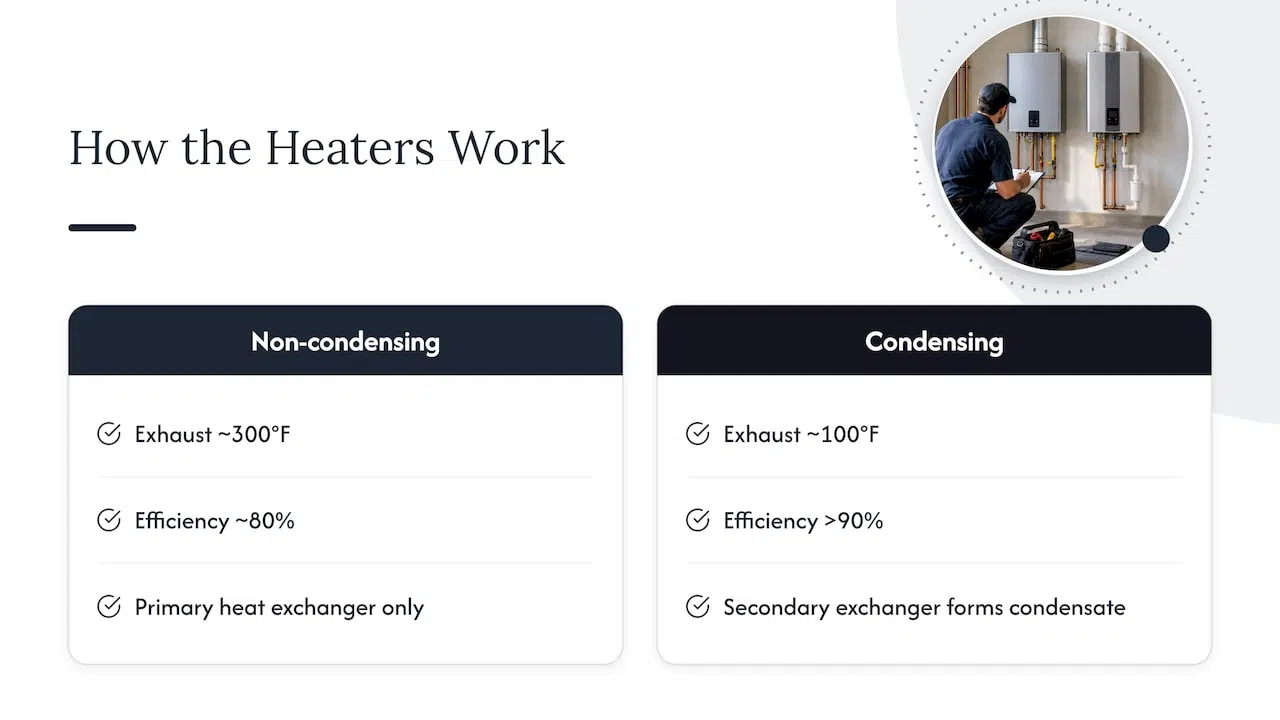
A non-condensing unit stops there. According to the U.S. Department of Energy’s Building America program, noncondensing gas tankless units vent exhaust at roughly 300°F and reach efficiencies around 80%. That heat leaves the house through the vent.
A condensing unit adds a secondary heat exchanger in the exhaust path. The same source says condensing tankless units use that second exchanger to reach efficiencies greater than 90%. Pulling heat from the exhaust cools it enough that water vapor turns to liquid, which is where the word “condensing” comes from. That liquid has to go somewhere.
Efficiency and what it means on your gas bill
Efficiency is the headline difference. The same federal guidance puts gas tankless water heaters at an energy factor of 0.82 to 0.94 depending on whether the unit is standard or condensing. Newer labels use a similar rating called UEF (uniform energy factor), where a higher number means less gas per gallon of hot water.
The same page notes that tankless units can cut energy costs by 5% to 40% compared with a tank-type heater using the same fuel. The spread is wide because savings depend on how much hot water you draw.
A worked example
Imagine a household where the gas used to heat water costs $250 a year with a unit at 0.82 efficiency. Moving to a unit at 0.94 means the same hot water needs roughly 13% less gas, which is about $32 a year. Your numbers will differ, but the arithmetic shows the pattern: the saving is a percentage of your own water-heating gas bill. A small household with a low bill saves little in dollars. A family of five running showers, a dishwasher and laundry daily saves more.
To see your own baseline, check your gas statement from SoCalGas or your local gas utility against the heater’s rating label. For a broader look at how water heating affects household energy use, see our guide on how water heaters impact energy efficiency.
Venting: the difference that changes your installation
Venting is where most homeowners are surprised. The two types need different exhaust pipe because their exhaust is very different.
Non-condensing exhaust is hot. At around 300°F it needs corrosion-resistant metal vent pipe, typically stainless steel, and the pipe must be sealed gas-tight. The pipe is more expensive, and it limits where the unit can sit and how the pipe can run near walls, framing and openings. Building America guidance also notes that the exhaust condensate from noncondensing units is corrosive, with a pH of 3 to 5, which is why vent materials must be chosen for it.
Condensing exhaust is cool. The federal guidance puts it at around 100°F, so condensing units can use less expensive PVC. PVC is lighter, easier to route through tight spaces, and can usually exit through a sidewall without a roof penetration. In a townhome, condo or garage closet, that flexibility can be the deciding factor.
Swapping a tank for a tankless
If your existing tank heater uses a metal flue, a non-condensing tankless may be able to reuse parts of it, but only if the pipe is the right type and size for a tankless and is in good condition. Tankless gas units are generally sealed or powered-vent appliances, and a technician has to confirm the existing run is suitable. Do not assume an old flue is reusable just because it fits the opening.
The condensate drain
A condensing unit produces acidic water, and it must be drained. In practice that means:
- A small drain line, often plastic tubing, running to a floor drain, laundry sink, or a condensate pump.
- A neutralizer, a small cartridge that raises the pH of the condensate before it goes to the drain. It needs periodic media replacement.
- A route for that line that does not freeze, clog or leak.
In mild Southern California climates, freezing is rarely a concern, which removes one headache that homeowners in colder states deal with. The remaining question is whether there is a drain or sink within reach. Garages, side-yard closets and exterior walls with no plumbing nearby can make a drain run harder, which is when a non-condensing unit starts to look attractive.
A non-condensing unit has no condensate drain at all, which also removes one thing that can clog.
Cost: purchase price, installation and running costs
The federal guidance says the initial installed cost of a tankless heater can be 1.5 to 2 times that of a tank-type heater, balanced by lower annual operating costs. Within the tankless category, the pattern is consistent:
| Condensing | Non-condensing | |
|---|---|---|
| Heat exchangers | Two | One |
| Typical efficiency | Above 90% | Around 80% |
| Exhaust temperature | About 100°F | About 300°F |
| Vent material | PVC and similar plastics | Stainless steel or other metal |
| Condensate drain | Required, usually with a neutralizer | Not needed |
| Purchase price | Higher | Lower |
| Gas use | Lower | Higher |
Installation cost often decides the real total. A new gas line sized for the unit’s higher burner rating, electrical access for the fan and controls, a vent run, and a drain can each add to the job. Our guide to water heater installation cost for homeowners in 2026 breaks these items down, and our comparison of tankless and tank water heaters helps if you are still deciding on the type.
Maintenance and durability
Both types are affected by hard water. Southern California tap water is often high in minerals, and scale builds up inside heat exchangers in either design, reducing flow and efficiency. A yearly descaling flush is the standard remedy for both, and our guide to the 45 to 60 minute tankless flush explains what the job involves and when to hand it to a professional.
The differences are small and specific:
- Condensing units add a neutralizer cartridge and a drain line to check. Media is replaced periodically, and the drain trap should stay clear.
- Non-condensing units have no condensate parts, but the metal vent needs its joints and seals inspected, since a hot-exhaust vent must stay gas-tight.
Because the condensate is acidic, condensing exchangers are built from materials made to resist it. That is a design requirement of the category, not a reason for concern when the unit is installed and maintained correctly. If a unit throws error codes, loses heat or runs cold, our overview of water heater problems homeowners should know covers the common causes.
Emissions and local rules
Gas water heaters in much of Southern California fall under the South Coast Air Quality Management District, which covers Orange County and the urban parts of Los Angeles County. Its Rule 1121 regulates nitrogen oxide emissions from residential natural gas water heaters, and the district published proposed amendments in April 2025. Rules like this change over time, so the unit you buy needs to be one that is currently approved for sale and installation in your area. A licensed installer will know what is allowed on your property today.
On carbon, a condensing unit burns less gas for the same hot water, so it produces less carbon dioxide per gallon heated. Both types burn gas and both need correct venting to carry combustion gases outdoors safely.
Which type fits your home
The federal comparison of water heating technologies stresses that results depend on draw patterns, climate and where the unit is installed. So the choice comes down to your house, not a universal winner.
Condensing usually fits when
- You use a lot of hot water and want the lowest gas use.
- A floor drain, laundry sink or condensate pump location is within reach.
- You are running new vent pipe and want inexpensive, flexible PVC.
- The vent has to travel a long way or through a tight space.
Non-condensing usually fits when
- You want the lower purchase price.
- No drain is nearby and adding one would be costly.
- You are replacing an older unit and a suitable metal vent is already in place.
- Hot water use is modest, so the efficiency gap saves only a small amount each year.
Questions to answer before you decide
- How far is the nearest drain from the heater location?
- What vent material is there now, and where can the new vent exit?
- Is the gas line sized for a tankless burner?
- How many people use hot water at the same time?
- How long do you plan to stay in the home?
The fifth question matters because the extra cost of a condensing unit is recovered through lower gas bills over years.
Perspective
Most of the tankless questions we get are not really about the unit. They are about the pipe, the drain and the gas line around it. Homeowners compare efficiency ratings, and then the venting path or the drain location changes the plan.
Our approach is to look at the installation first. Where can the exhaust exit? Is there a drain within reach? Does the gas supply suit a tankless burner? Once those answers are clear, choosing between condensing and non-condensing is straightforward, and you avoid buying a unit your house cannot easily accommodate.
As licensed technicians working across Orange and Los Angeles counties, we think the best time to bring in a professional is before the purchase, not after the box arrives.
MDTECH
Plan your tankless installation
We offer plumbing installation, plumbing repair and appliance installation for homes in Orange and Los Angeles counties, with online booking. Our licensed technicians can look at your venting route, drain options and gas supply, so the unit you choose fits the house.
See our plumbing installation and repair services or book online to schedule a visit.
FAQ
Is a condensing tankless water heater worth the extra cost?
It can be when you use a lot of hot water and have a drain nearby. The savings come from burning less gas for the same output, and they are a percentage of your own water-heating gas bill. A household with low hot water use takes longer to recover the higher purchase price.
Can I use PVC with a non-condensing tankless water heater?
No. Non-condensing units produce exhaust around 300°F, which requires corrosion-resistant metal vent pipe such as stainless steel. PVC is for the cooler exhaust of condensing models. Always follow the vent material listed in the manufacturer’s installation instructions and local code.
Does a condensing tankless need a drain?
Yes. The acidic condensate must flow to a suitable drain, usually through a neutralizer first. If no drain is close, a condensate pump can carry it to one. A non-condensing unit needs no condensate drain.
Can I replace my tank heater with either type?
Often yes, but the gas line, electrical supply and vent all need to suit the new unit. Tankless burners draw more gas than most tank heaters, so the line size is checked first. A technician can confirm this on site.
Sources
- Gas-Fired Tankless Water Heaters, Building America Solution Center
- Comparison of Advanced Residential Water Heating Technologies, U.S. Department of Energy
- Draft Staff Report for Proposed Amended Rules 1111 and 1121, South Coast AQMD