
A conventional oven heats food with elements at the top and bottom of the cavity and still air. A convection oven adds a fan that moves the hot air around the food. That fan is the whole difference, and it changes speed, browning and how you use your racks. Neither oven is better for everything. Convection wins for roasting, sheet-pan meals and baking on several racks. Conventional (regular) bake is gentler for cakes, custards and casseroles.
TL;DR
- A convection oven is a conventional oven plus a fan. The moving air cooks food faster and browns it more evenly.
- A common starting point is to lower the recipe temperature by 25°F in convection mode, or keep the temperature and start checking when 20 to 25 percent of the time remains.
- Use convection for roasts, vegetables, pizza, cookies on multiple racks and pies. Use regular bake for delicate cakes, custards, soufflés and casseroles.
- Many convection ovens still have a regular bake setting, so you do not have to choose one way of cooking.
- If your oven bakes unevenly in either mode, the cause can be a failed fan, element or sensor. A technician can test it.
Table of Contents
- How each oven actually heats food
- Convection vs. conventional oven at a glance
- Bake vs. convection bake vs. convection roast
- What is the equivalent of 350°F in a convection oven?
- What to cook in convection, and what to leave on regular bake
- The real drawbacks of convection, and how to manage them
- Can you use a convection oven as a regular oven?
- Our perspective
- When uneven results point to a repair
- Need your oven looked at?
- FAQ
- Sources
How each oven actually heats food
The conventional oven
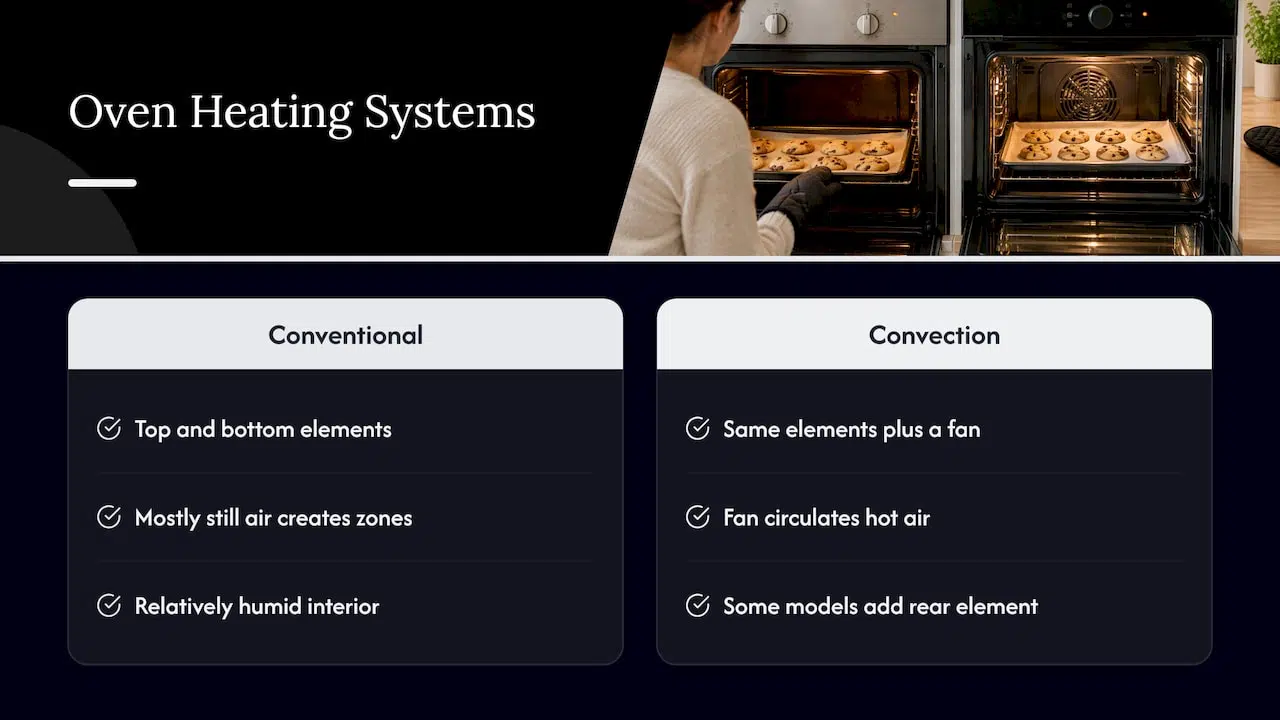
In a conventional oven, heating elements sit at the top and bottom of the oven cavity, and the air inside is mostly still. Lowe’s buying guide describes convection ovens as having those same elements plus a fan that circulates hot air around the food, and notes that some models also add a rear heating element.
Still air creates zones. The area near the element runs hotter, the center of the cavity runs cooler, and the top rack does not behave like the bottom rack. Samsung’s oven guide says conventional cooking produces different heat zones and a relatively humid interior. In practice, that means rotating pans and choosing your rack position on purpose.
The convection oven
The fan pushes air across the food and keeps the temperature more uniform. According to the American Society of Baking, the airflow strips moisture from the surface of the food and improves heat transfer, which is why results are faster and more uniform. Samsung describes the convection environment as drier, which promotes even baking and browning.
Dry surface heat is what gives you crisp chicken skin, browned vegetable edges and a pizza crust that holds up. It is also why delicate batters sometimes misbehave, which we cover below.
Convection vs. conventional oven at a glance
| Factor | Conventional (regular bake) | Convection |
|---|---|---|
| Heat source | Top and bottom elements, still air | Same elements plus a fan (some add a rear element) |
| Heat distribution | Hot and cool zones; rack position matters | More even; fewer hot and cold spots |
| Speed | Standard recipe times | Typically faster, roughly 20 to 25 percent |
| Browning | Gentler | Stronger, drier surface |
| Multiple racks | Often needs pan swapping | Usually works without staggering pans |
| Best for | Cakes, custards, casseroles, standard recipes | Roasts, vegetables, pizza, cookies, pies |
| Recipe adjustments | None for most recipes | Lower temperature or time |
The speed figure is a guide, not a promise. Breville’s US guidance puts convection at about 25 percent faster with more uniform browning, while the American Society of Baking cites about 20 percent less bake time at an unchanged temperature. Your own oven and your own pan will land somewhere in that range.
Bake vs. convection bake vs. convection roast
If your oven has a convection feature, the control panel usually offers several modes. The names differ by brand, but the logic is consistent.
- Bake (regular bake): the elements heat the cavity without forced airflow. KitchenAid says this is often the better choice for cakes, casseroles and delicate desserts.
- Convection bake: the fan circulates air while the elements heat. It usually cooks faster and more evenly, browns better and is especially useful across multiple racks. KitchenAid points to batches of cookies on several racks as a good example, because the circulated air reduces hot and cold spots.
- Convection roast: typically combines the fan with a higher-heat roasting pattern. Samsung’s support guidance recommends Convection Bake for pies, cookies, cakes, bread and large amounts of food, and Convection Roast for larger tender cuts such as roast beef and rotisserie chicken.
Names and behavior vary by manufacturer, so your manual is the final word on what each mode does in your oven.
What is the equivalent of 350°F in a convection oven?
The usual starting point is 325°F. KitchenAid gives 350°F conventional to 325°F convection as a common conversion. Several manufacturers agree on the 25°F rule:
- Samsung gives the example of a 375°F recipe becoming 350°F in convection mode.
- Whirlpool says most foods can cook about 25°F lower or for a shorter time in convection.
- Sub-Zero Wolf advises reducing the temperature by 25°F or the time by 20 to 25 percent.
- The American Society of Baking gives a wider range: 25 to 50°F lower at the same bake time.
Lower the temperature or shorten the time?
Pick one, not both. If you lower the temperature, keep the time but start checking a little early. If you keep the temperature, shorten the time. KitchenAid’s approach is to begin checking with 20 to 25 percent of the time remaining, so for a 60-minute recipe you start checking at about 45 minutes. Sub-Zero Wolf suggests checking doneness 5 to 10 minutes early.
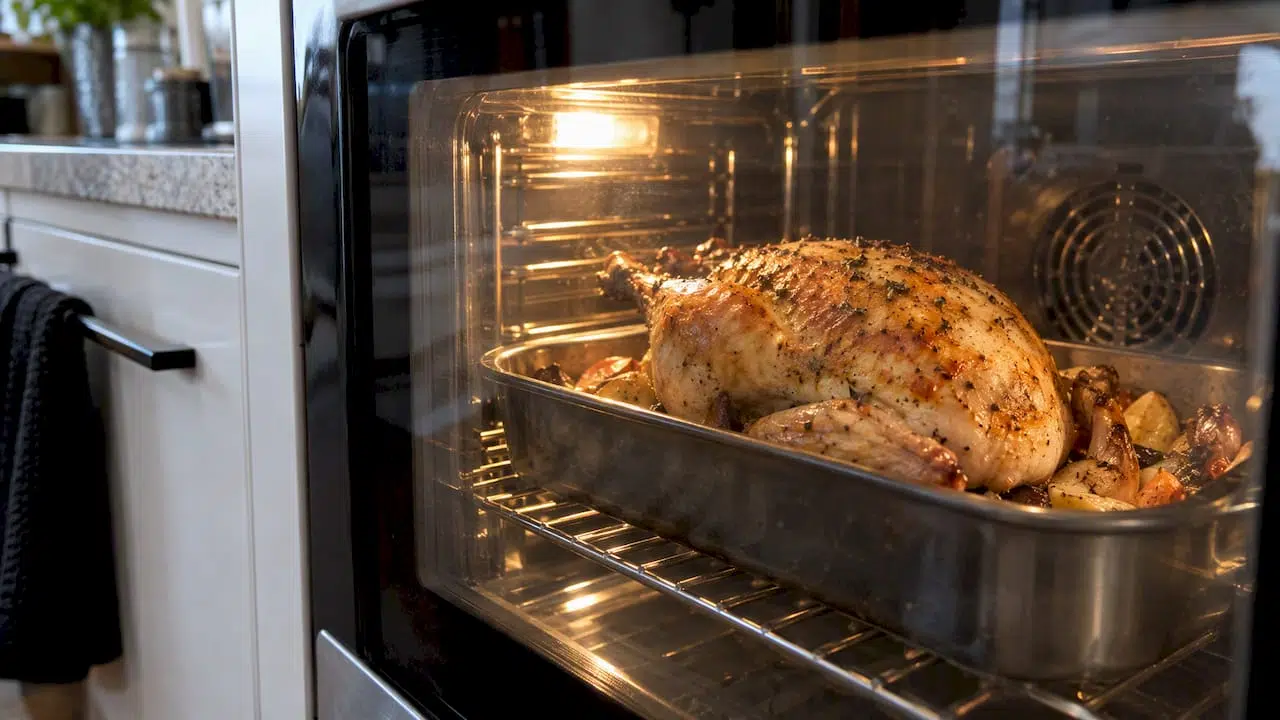
A worked example: a roast chicken recipe calls for 425°F for 60 minutes. In convection you could set 400°F and start checking at about 45 minutes, or hold 425°F and check at the same point. Judge by internal temperature and color, not by the clock.
Check whether your oven already converts for you
Some ovens do the math automatically. Samsung says certain models lower the effective temperature by 25°F in convection mode, so you enter the recipe’s temperature. The feature can be turned off according to the manual. If your oven does this and you also subtract 25°F, your food will take much longer than expected.
The reverse also applies. Lowe’s cautions against lowering the temperature when a recipe was written for convection to begin with. In that case, follow the recipe and your oven’s manual.
Pan and rack tips
- Preheat fully, as Sub-Zero Wolf advises.
- Leave room for air. Sub-Zero Wolf recommends at least 1 inch between a pan or dish and the oven walls.
- Use low-sided pans for roasting and sheet-pan cooking so air reaches the food.
- Cover food with foil when the recipe calls for it, since airflow dries surfaces quickly.
What to cook in convection, and what to leave on regular bake
The question “what should not be cooked in a convection oven?” has a short answer: anything airy or delicate that needs to rise or set undisturbed.
Good candidates for convection
- Roasted vegetables, pizza, pork tenderloin and chicken breast. Mayo Clinic Press lists these among foods that cook better with convection.
- Pies, scones and flaky pastries. KitchenAid says pies, scones and other dense non-yeast mixtures benefit from convection’s stronger heat and browning.
- Cookies on two or three racks. Sub-Zero Wolf notes that multi-rack cooking in convection generally does not need staggered pans.
- Roasts and whole poultry. Dry heat gives you browned skin and a crust.
Better on regular bake
- Delicate cakes, custards and soufflés. Lowe’s says strong airflow can disturb the rise or texture of airy baked goods, so conventional bake is usually the safer choice.
- Lasagna, casseroles, bread, muffins and potatoes. Mayo Clinic Press lists these among foods better suited to regular bake.
The University of Florida IFAS summarizes it the same way: conventional ovens are the standard for most recipes and do not disturb delicate baked goods, while convection shortens cooking time and distributes heat more evenly but can interfere with the rise of cakes and similar items.
The real drawbacks of convection, and how to manage them
Convection asks a little more of the cook. The trade-offs are manageable once you know them:
- Recipe conversion. Most recipes are written for conventional ovens, so you adjust temperature or time, as above.
- Faster drying and browning. Breville notes that standard bake can keep baked goods moister because it does not add the same airflow. Tent with foil, or switch back to regular bake for moist bakes.
- Exterior ahead of interior. Food can brown outside before the center finishes. A slightly lower temperature and a probe thermometer solve this.
- Delicate batters. Switch to regular bake, or turn the fan off if your model allows it.
Regular ovens have their own limits. They can cook unevenly, and with multiple racks you may need to swap pans halfway. Lowe’s says conventional cooking can require attention to rack placement and pan rotation because results vary by rack.
Can you use a convection oven as a regular oven?
Yes. Lowe’s says many convection ranges and wall ovens keep a standard bake setting, and KitchenAid says the convection settings can generally be turned on or off. So a convection-capable oven can do everything a conventional one can. If you are shopping or moving into a new home, a convection model gives you both cooking styles.
Not sure which you have? Look at the control panel for words like Convection Bake, Convection Roast or a fan symbol. Then look in the manual or the model number listing. You can also open the oven while it runs in a convection mode and listen for the fan; some ovens also have a visible fan cover on the back wall.
Our perspective
We see both sides of this question every week. Homeowners buy a convection range expecting faster, more even cooking, and sometimes the oven does not deliver. In many of those cases the cooking style is not the problem. A convection fan that has slowed down or stopped, a worn element, a failing temperature sensor or a door gasket that no longer seals can all make a good oven act like a bad one.
Our advice is to learn the two modes and use both. Use convection for roasting and multi-rack baking. Use regular bake for delicate cakes and casseroles. Then pay attention to the oven itself. If a convection setting is noisy, takes much longer than the conversion rules predict, or leaves one side pale while the other browns, that is a sign to have it tested rather than adjusting every recipe around it.
Our licensed technicians repair ovens, ranges and other kitchen appliances across Orange County and Los Angeles County, and we would rather help you get the oven you already own working properly than have you cook around a fault.
MDTECH
When uneven results point to a repair
Recipe conversion explains most differences between the two modes. It does not explain an oven that bakes unevenly in every mode, heats slowly or does not reach temperature. Signs worth checking:
- One side of the pan browns far more than the other, even after rotating it.
- The convection fan is silent, rattles or squeals when it runs.
- Food takes noticeably longer than the recipe suggests, even after you account for conversion.
- The oven struggles to preheat, or the temperature seems far from the setting.
Our guides cover the common causes. Start with oven not heating evenly for causes and tests, or read why ovens won’t heat up if the problem is temperature. The oven troubleshooting guide walks through checks you can do safely yourself, and our fan repair page explains how fan problems are handled. Gas and electrical components inside an oven are not a place for guesswork, so leave parts that carry power or gas to a licensed technician.
If you are weighing a fix against a new oven, our article on repair vs. replacement lays out the factors. If you have a Samsung oven with an Auto Conversion feature that seems off, see our Samsung appliance page.
Need your oven looked at?
If your convection fan, elements or temperature control are not behaving, we can diagnose and repair the oven at your home in Orange County or Los Angeles County. Our kitchen appliance repair service covers ovens along with refrigerators, dishwashers, washers and dryers, and you can book online through MDTECH Appliance Repair.
If you are installing a new range or wall oven, our appliance installation services cover setup so the oven is level, connected correctly and ready to use.
FAQ
What should not be cooked in a convection oven?
Delicate cakes, custards, soufflés and other airy baked goods are the main exceptions, because strong airflow can disturb their rise or texture. Casseroles, lasagna, muffins and bread often turn out better on regular bake as well. Check your recipe and oven manual first, since they take priority.
Is convection bake better than regular bake?
Not always. Convection bake is usually faster, more even and better for browning and multi-rack cooking. Regular bake is often the better choice for cakes, casseroles and delicate desserts. The right setting depends on the food, and most convection ovens let you use either.
Do I always need to lower the temperature for convection?
No. Many manufacturers suggest lowering a conventional recipe by 25°F, or shortening the time instead. But if the recipe was written for convection, or your oven converts automatically, lowering it again can leave food undercooked. Read the recipe and your oven’s manual.
Can I use a convection oven as a regular oven?
Yes. Many convection ovens keep a standard bake mode, and the convection feature can generally be turned on or off. That means one oven can handle both gentle still-air baking and fan-driven roasting.
Why does my convection oven burn food on the outside?
The fast, dry airflow can brown the exterior before the center is done, especially if you did not lower the temperature or time. Try a 25°F reduction, tent with foil and check early. If food still cooks unevenly in regular bake too, have the oven’s elements and sensor checked.
Sources
- Conventional Oven vs. Convection Oven | Lowe’s
- Convection Oven vs. Conventional Oven | Samsung US
- How to use your Samsung convection oven | Samsung US support
- Convection Oven | American Society of Baking
- Convection Bake vs. Bake: What’s the Difference? | KitchenAid
- What Is a Convection Oven? Benefits, Uses & Cooking Tips | KitchenAid
- Cooking with Convection in Wolf Ovens | Sub-Zero Wolf
- Conventional Oven vs. Convection: What’s the Difference? | Whirlpool
- Bake vs convection bake: Know the difference! | Mayo Clinic Press
- Convection bake vs. bake: What’s the difference? | Breville