
If your stove is clicking but not lighting, check for a gas smell first. If you smell gas, stop and get everyone outside, then call the utility. If there’s no odor, the culprit is almost always moisture, clogged burner ports, or a misaligned cap, and drying and cleaning fixes it in minutes. If all burners click at once or the clicking won’t stop even with the knobs off, cut power and call a licensed technician.
TL;DR:
- Moisture from cleaning or spills is the most common cause of clicking without ignition and typically resolves within 30 minutes of air-drying.
- Cleaning and properly reseating burner caps with aligned notches usually fix 80 to 85 percent of ignition issues before replacing parts.
- If all burners click at once or clicking persists with knobs off, the problem likely lies with the spark module or the power supply, not moisture or debris.
- Gas smells or odors require immediate evacuation, ventilation, and contacting the utility rather than troubleshooting the stove further.
- Continuous clicking despite thorough cleaning and drying indicates a possible faulty spark module, cracked igniter, or wiring issue, warranting professional repair.
Table of Contents
- Why Is My Stove Clicking but Not Lighting? Quick Triage
- Step-by-Step Fixes: Dry, Clean, and Reseat
- Is It the Power, the Circuit, or a Control Setting?
- How Do You Check the Gas Supply Itself?
- Could the Igniter or Spark Module Be Failing?
- What to Do If You Smell Gas
- When Should You Call a Licensed Technician?
- Why We Check Drying and Alignment First
- Book a Diagnosis if the Clicking Won’t Quit
- Sources
- FAQ
Why Is My Stove Clicking but Not Lighting? Quick Triage
Before you touch anything, run through a 60 second check to figure out whether this is a two-minute fix or a job for a professional.
- Smell first. If there’s any hint of rotten eggs or gas, stop immediately and follow the evacuation steps in the safety section below.
- Think about recent history. Did you just clean the stove, spill soup, or wipe down the burners? Trapped water is the most common cause of clicking without a flame, and it usually clears up on its own once things dry.
- Count the burners affected. One burner clicking points to a local issue, like a wet or dirty igniter tip. All burners clicking together points to a shared cause, like the spark module or the power supply.
- Check for a control lockout. Some ranges lock the ignition system after a power blip. Look for a lock icon on the display or try holding the lockout button for a few seconds.
Once you’ve sorted through those four questions, you’ll know whether to grab a hair dryer or grab your phone.
Step-by-Step Fixes: Dry, Clean, and Reseat
This is the sequence technicians run first, in this order, because it solves the vast majority of ignition complaints without opening the stove up or ordering a part. A stepwise approach like this one, working from the easiest fix to the hardest, resolves roughly 80 to 85% of ignition failures before anyone reaches for a replacement part.
- Kill the power and let it cool. Unplug the range or flip the breaker, and give the burners a few minutes to cool if you were just cooking.
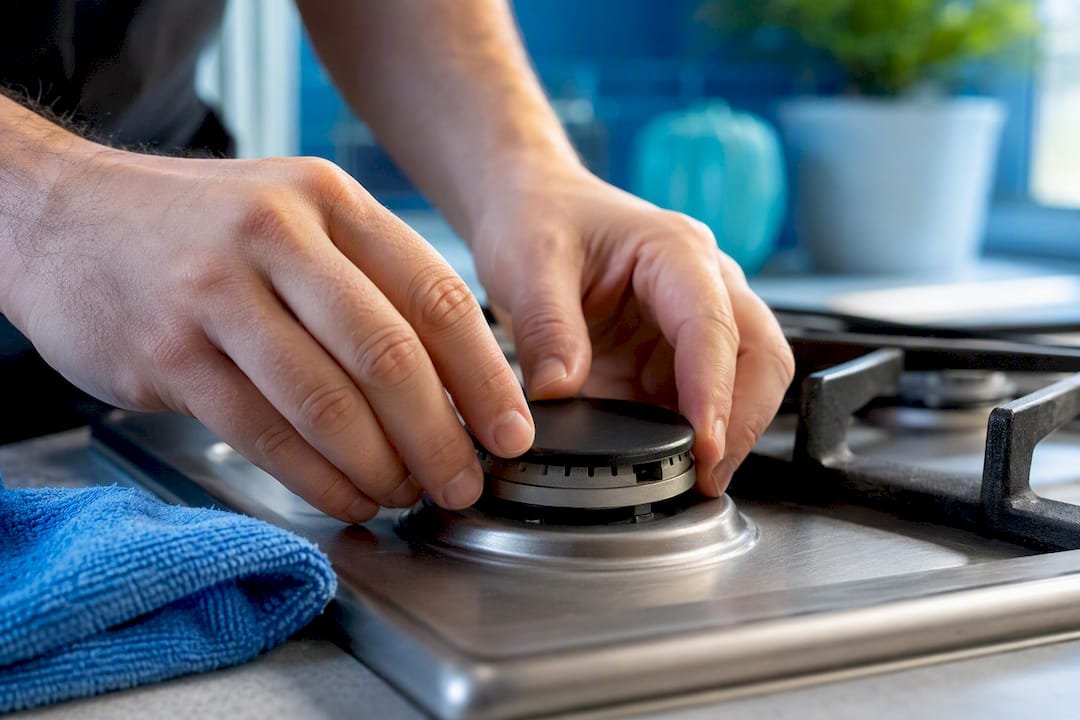
- Pull the grates and caps. Lift the grates off, then lift the burner caps straight up off the burner heads. Set them somewhere you won’t lose track of which cap belongs where.
- Dry everything. Moisture around the igniter or inside the burner head is the number one reason for clicking with no flame. Air-dry the parts for 10 to 30 minutes, or speed things up with a hair dryer on the cool setting. Water on the ceramic tip grounds the spark before it ever reaches the gas.
- Clear the ports. Gas escapes through tiny holes around the burner head. If they’re clogged with food residue or rust, gas can’t flow to the igniter. Clear each port gently with a straight pin, working at the same angle as the hole. Do not widen the holes with a toothpick or a wire, since that changes the burner’s flame pattern permanently.
- Wash the caps. Hot water and dish soap, then dry completely before reinstalling. A damp cap left back on the burner undoes everything you just did.
- Clean the igniter tip. That small ceramic post near the burner is what actually creates the spark. Dab a cotton swab in isopropyl alcohol and wipe it gently, or use a soft brush for stubborn grime. Never bend or press hard on the electrode. It’s brittle, and a cracked tip means no spark at all.
- Reseat the cap correctly. Every burner cap has a notch or peg that has to align with a matching mark on the burner head. Line it up and set the cap down flat. If it’s rocking or sitting crooked, the igniter won’t be positioned in the correct spark gap, and you’ll get clicking with nothing to show for it.
- Test it. With the room lights dimmed, turn the knob and watch for a visible blue spark jumping from the tip to the burner. If you smell no gas and see a spark, a quick test with a long utility lighter confirms ignition is working. Skip this step entirely if there’s any gas odor.
Pro Tip: Dry the caps and burner heads face-down on a paper towel instead of standing them upright. Water trapped underneath the cap is the part people miss, and it’s exactly where the spark needs a clear path.
Is It the Power, the Circuit, or a Control Setting?
When drying and cleaning don’t budge the problem, or when every burner clicks at once, the issue often sits upstream of the burner itself.
- Check the breaker or outlet. A tripped breaker or a loose plug can cause weak, erratic clicking across the whole range. Reset the breaker and confirm the cord is fully seated.
- Look for a control lockout. Manufacturer guidance notes that a power interruption, like a brief outage, can trigger a lockout mode that blocks ignition until it’s manually reset, usually by holding a lock button for a few seconds.
- Read the pattern. One burner staying silent while others click normally usually means a local igniter or switch problem. All burners staying silent, or clicking that won’t quit even after you turn the knobs off, points to the shared spark module or the power supply feeding it.
- Cut power before going further. If you’re hearing continuous clicking with the knobs off, that’s your cue to unplug the range and stop troubleshooting live. A stuck switch behind a dead-off knob is not something to poke at while it’s powered.
How Do You Check the Gas Supply Itself?
Clicking with no flame sometimes has nothing to do with the igniter and everything to do with what’s, or isn’t, reaching the burner.
- Find the shutoff valve, usually behind the range or on the gas line beneath it, and confirm the handle sits parallel to the pipe. Perpendicular means it’s closed.
- Listen for a faint hiss when you turn a knob, a sign gas is actually flowing. If there’s no odor at all, a brief test with a long lighter held near the port confirms flow safely.
- Consider low pressure if multiple gas appliances in the home seem sluggish, not just the stove. That’s a job for the gas utility, not a home fix.
- Never leave gas flowing to an unlit burner. If you turn the knob and don’t get ignition within a couple of seconds, shut it off before trying again.
Could the Igniter or Spark Module Be Failing?
Some clicking problems aren’t about moisture or grime at all. They’re electrical, and they call for a different kind of test.
- One weak or silent burner while the rest spark fine usually points to a local electrode, a cracked ceramic tip, or a failing switch behind that specific knob.
- All burners clicking, or continuous clicking with knobs off, points toward the shared spark module or its wiring.
- Isolate the fault by swapping. Technicians commonly swap the igniter wire or cap between a working burner and the suspect one to confirm whether the electrode, the wire, or the switch is at fault, always with power disconnected first.
- Watch for red flags: a visibly cracked ceramic post, discoloration or burn marks near the connector, or clicking that continues no matter what you do with the knobs.
- Expect part costs in a modest range. Spark modules typically run $60 to $180, and a competent technician can usually swap one in 30 to 45 minutes once the module is confirmed bad. Guessing wrong on this part is an expensive mistake, which is why isolating the fault matters before buying anything.
If drying and cleaning haven’t solved it after a day or two, a continuous click after 24 to 48 hours usually means the switch or module needs replacing, not more troubleshooting.
What to Do If You Smell Gas
Every step above assumes there’s no gas odor. If there is, none of it applies, and the priority shifts entirely to getting people out safely.
- Stop trying to light the burner immediately. Turn the knobs off only if you can do it without hesitation.
- Ventilate if it’s safe, opening doors and windows on your way out rather than lingering to do it thoroughly.
- Evacuate the home and move to a safe distance before making any calls.
- Call the gas utility or emergency services from outside, never from inside the house.
- Skip the light switches and skip your phone indoors. Both can spark and ignite accumulated gas, so save the call for once you’re safely outside, following the same guidance utilities give homeowners.
Report your address, whether you can smell gas outside the house too, and whether anyone stayed inside. Utility crews typically respond quickly to reports like this and will shut off service at the meter if needed.
When Should You Call a Licensed Technician?
Certain signs mean it’s time to stop troubleshooting and book a professional, regardless of how confident you feel with a screwdriver.
- A gas smell that’s strong, spreading, or returns after you’ve addressed it once.
- Clicking that continues nonstop even with every knob turned off.
- No improvement after a full drying and cleaning pass on every burner.
- Exposed wiring, a cracked ceramic igniter, or scorch marks near any connector.
A technician visit typically includes a pressure check at the shutoff valve, electrical diagnostics on the spark module and wiring, and replacement of whatever part is confirmed bad, often within a single appointment. Appliancesrepairmdtech’s gas oven and stove repair guide covers what a typical service call involves in more detail. Before you schedule, have your stove’s brand, model number, and a quick summary of which burners are affected ready. It saves time on-site and helps the technician bring the right parts on the first visit.
Why We Check Drying and Alignment First
Field experience backs up what the manufacturer guidance already suggests: most “clicking but not lighting” calls resolve with moisture removal and cap alignment, not part replacement. Technicians who jump straight to swapping igniters end up replacing parts that were never actually broken.
When Appliancesrepairmdtech technicians arrive on a service call, the first checks are almost always the burner caps and the area around the igniter tip, because that’s where the fix usually lives. Only after ruling out moisture, debris, and misalignment does the diagnosis move toward wiring and the spark module. It’s a sequence built on which fixes are fastest, safest, and least likely to cost a customer money for a part they didn’t need.
— MDTECH
Book a Diagnosis if the Clicking Won’t Quit
Get a licensed technician on-site instead of a guessing game with parts you might not need. If you’ve dried the burners, cleared the ports, and reseated the caps and it’s still clicking, the next move is a real diagnosis, not another trip to the hardware store. Booking online takes a few minutes, and you’ll get a technician who checks the pressure, tests the spark module, and replaces only what’s actually failed.
At the appointment, expect a walkthrough of the same triage points covered above: gas smell, burner pattern, power supply, then a hands-on inspection of the igniter and module. If the range turns out to need more than a repair, our team can also walk you through repair versus replacement so you’re not stuck guessing on that decision either. Ready to get it looked at? Schedule your stove repair to arrange a technician visit.
Sources
- Gas Range & Cooktop – Common Causes for Slow Ignition, No Ignition or Clicking on Surface Burners (GE Appliances product help)
- Gas cook top igniter repairs: cause, diagnosis, and cure (InspectApedia)
- PG&E help: My gas cooktop is making a clicking noise — what do I do?
FAQ
Can I use my stove if it keeps clicking?
Only if there’s no gas smell and you can confirm the burner actually lights with a visible flame. If it clicks without lighting, or clicking continues after the burner is on, turn it off and troubleshoot before cooking.
Why is my gas stove clicking but not lighting, and smelling like gas?
Stop immediately, turn the knobs off if it’s safe, ventilate on your way out, and evacuate. Call the gas utility or emergency services from outside the home rather than troubleshooting further.
What is the most common reason a gas stove won’t ignite?
Trapped moisture around the burner head or igniter tip is the single most frequent cause, often after cleaning or a spill, and it typically clears up with 10 to 30 minutes of air-drying.
What should you do if your stove is clicking?
Check for a gas smell first, then dry the burner parts, clear the ports with a straight pin, clean the igniter tip, and reseat the cap so it aligns correctly before testing again.