
TL;DR:
- Choosing energy-efficient smart appliances with genuine AI features and simple installation can significantly lower utility bills in Southern California. Proper setup, maintenance, and user behavior are essential to maximize long-term savings and appliance lifespan. Expert installation and routine care from technicians ensure these advanced devices perform reliably for years to come.
Choosing smart appliances sounds straightforward until you’re standing in a showroom comparing spec sheets, wondering which examples of smart appliances will actually lower your utility bill versus which ones just look impressive. For homeowners and property managers in Orange and Los Angeles Counties, the stakes are real. Southern California’s high electricity rates and time-of-use billing mean the wrong appliance choice costs you twice. This guide cuts through the noise with specific models, honest performance data, and practical advice built for homes in this region.
Table of Contents
- How to evaluate smart appliances before buying
- Top smart laundry appliances with AI sensor technology
- Smart refrigerators with AI food management to reduce waste
- Energy-saving smart thermostats for climate control
- Other innovative smart appliances for Orange and LA homes
- Comparison of smart appliances: features and benefits
- Why smart appliance investment goes beyond convenience
- Discover expert appliance repair and installation in Orange and LA Counties
- Frequently asked questions
Key Takeaways
| Point | Details |
|---|---|
| Smart appliance criteria | Evaluate appliances based on energy efficiency, AI features, compatibility, and installation ease. |
| AI-driven savings | AI sensors and scheduling in appliances can reduce energy and water use by up to 20%. |
| Local utility impact | Understanding Southern California utility rates helps maximize smart appliance savings. |
| Maintenance importance | Regular maintenance is crucial to keep smart appliances efficient and durable. |
| Professional support | Expert installation and repair protect your investment and enhance performance. |
How to evaluate smart appliances before buying
Before you fall for a flashy display panel, you need a clear framework. The best smart appliances earn their price through four factors: energy efficiency, AI automation, compatibility with your existing setup, and installation simplicity.
Energy efficiency is the starting point for any SoCal homeowner. California’s tiered and time-of-use utility rates mean a washer or dryer that runs at 3 p.m. costs significantly more than one that runs at midnight. Look for Energy Star certification as a baseline, then dig deeper into whether the appliance can schedule itself around your utility’s rate windows.
AI functionality separates truly useful smart home devices from glorified Bluetooth gadgets. Real AI in an appliance means it adapts to your behavior. A dryer that detects moisture levels and stops automatically saves energy. A refrigerator that recognizes specific food items and suggests recipes creates actual value. Without genuine automation, you are just paying for a Wi-Fi chip.
Compatibility with your existing smart home ecosystem matters more than most buyers realize. Check whether the appliance works with Alexa, Google Home, or Apple HomeKit before purchasing. Mixed ecosystems create frustration, and some connected appliances examples require proprietary hubs that add cost and complexity.
Installation ease is often overlooked. Many smart appliances install in under 30 minutes with basic tools. Others require licensed electricians or gas technicians. Knowing upfront saves you from surprise installation costs. A solid preventive maintenance guide and clear appliance maintenance schedules also extend the working life of whatever you choose.
Key evaluation checklist:
- Energy Star certified and compatible with local TOU billing
- Genuine AI features that automate tasks, not just remote control
- Works with your current smart home hub
- Installs without specialized tools or professionals
Having a clear evaluation framework prepares you to understand the standout smart appliance options we’ll cover next.
Top smart laundry appliances with AI sensor technology
Now that you know how to evaluate, let’s explore top smart laundry appliances packed with helpful AI.
The LG DLEX6700B is one of the most concrete examples of IoT devices doing real work in a home. The 7.4 cu. ft. dryer uses AI Sensor Dry to save about 20% less energy than conventional models by reading moisture levels in real time and ending cycles the moment clothes are dry. That may sound minor, but over a year in a household running five or six loads per week, it adds up fast.
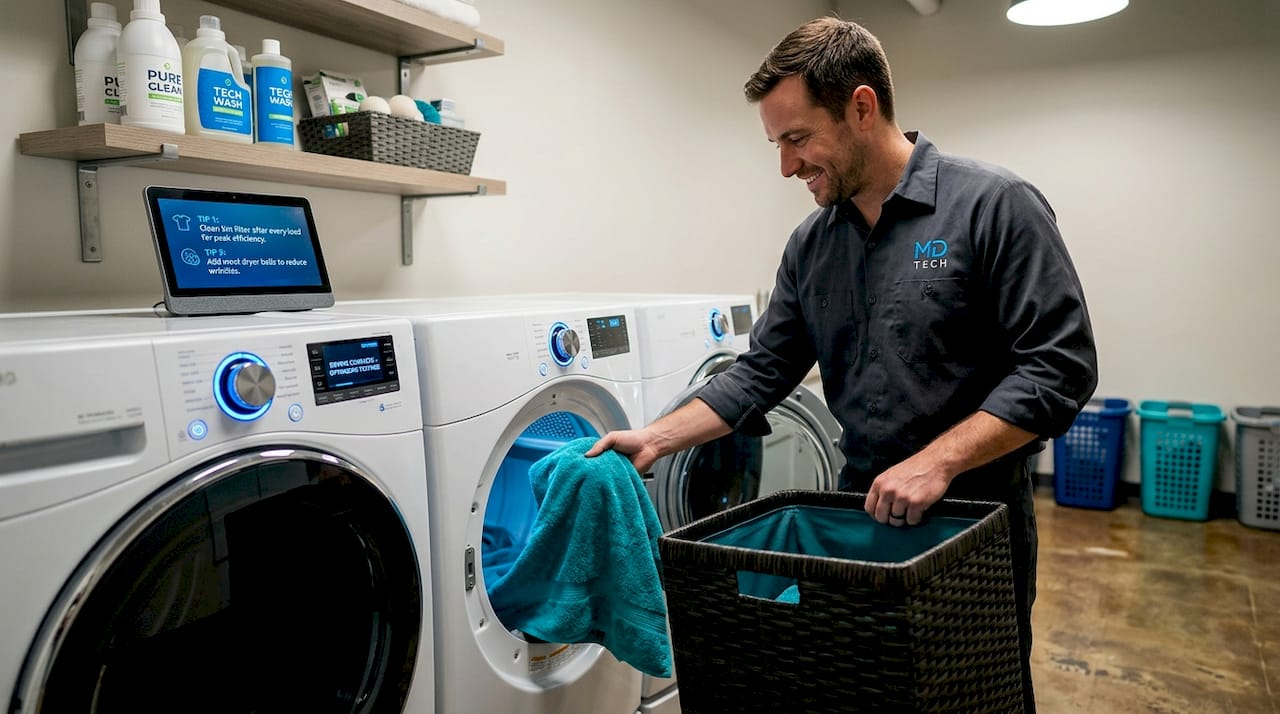
Samsung’s 2026 Bespoke AI laundry system goes a step further. The AI Wash & Dry+ suggests off-peak hours for laundry to maximize savings with local utility TOU rates, which is exactly the kind of feature that pays off in Southern California where peak rates can be double off-peak rates. Using a companion app, you can approve or adjust the suggested schedule with one tap.
Both models carry Energy Star certification, which means they use measurably less energy than non-certified units. That certification also often qualifies you for rebates through Southern California Edison or SoCalGas programs.
Smart laundry appliance benefits include:
- Automatic cycle adjustment based on load weight and fabric type
- App-based scheduling to run during cheapest utility rate windows
- Remote start and status notifications from your phone
- Maintenance alerts before minor issues become repairs
A well-maintained washer and dryer also lasts years longer. Reading regular appliance maintenance tips before your first laundry cycle can save you a service call later.
Pro Tip: Log into your utility provider’s website and download your TOU rate schedule. Set your laundry app to run cycles during super-off-peak hours, usually between 10 p.m. and 6 a.m. on weekdays. This single habit can reduce your laundry energy cost by 30% or more in high-rate periods.
Smart refrigerators with AI food management to reduce waste
Beyond laundry, smart appliances like refrigerators now bring AI to food management for added convenience.
The Samsung Bespoke AI Refrigerator Family Hub is the most capable food management tool currently available for home use. The refrigerator tracks 40+ food items using AI Vision and cloud intelligence to identify regionally specific ingredients. In practice, this means the fridge recognizes a carton of oat milk versus regular milk, tracks expiration patterns, and builds a digital inventory you can check from a grocery store aisle.
What makes this genuinely useful rather than gimmicky is the recipe suggestion engine. When the fridge detects you have chicken, bell peppers, and onions approaching their use-by dates, it surfaces recipes built around those exact items. For busy households in Orange County or LA, that feature alone can cut weekly food waste noticeably.
The built-in Bixby voice assistant responds to natural language, so you can ask “What’s expiring this week?” or “Add milk to my shopping list” without touching a screen. Personalized daily widgets on the display show your most-used items and reminders, keeping meal planning visible without requiring you to open an app.
Key features worth noting:
- AI Vision uses optical character recognition (OCR, the technology that reads text from images) to identify packaged goods
- Internal cameras let you view fridge contents from your phone while shopping
- Recipe suggestions pull from a large database and filter by what you already own
- Family Hub display doubles as a calendar, photo board, and entertainment screen
Pair this fridge with good habits using kitchen appliance cleaning tips and a regular maintenance schedule to keep the AI sensors functioning accurately for years.
Energy-saving smart thermostats for climate control
In addition to kitchen and laundry, smart thermostats are essential for managing home comfort efficiently.
The Google Nest Learning Thermostat is one of the best smart appliances for homeowners who want hands-off energy management. It controls HVAC remotely and learns your schedule, adjusting temperature automatically when you leave home. Most homeowners install it themselves in under 30 minutes using the included wiring guide.
The savings are real and documented. Nest thermostats deliver average savings of 9.6% on gas heating and 17.5% on electric cooling, which translates to $131 to $145 annually in the average home. In Southern California, where summer cooling seasons stretch from May through October, the cooling savings carry extra weight.
| HVAC system type | Nest compatibility | Estimated annual savings |
|---|---|---|
| Central forced air (gas heat) | Full | 9.6% on heating costs |
| Central AC (electric cooling) | Full | 17.5% on cooling costs |
| Heat pump | Full | Moderate savings, varies |
| Baseboard electric heat | Partial | Lower savings, check compatibility |
| Mini-split systems | Limited | Requires third-party adapter |
The Nest’s Auto-Away feature is particularly valuable for property managers overseeing multiple units. When no one is detected in the home, the thermostat shifts to an energy-saving temperature automatically, without any tenant action required.
Pairing a smart thermostat with a professional HVAC tune-up ensures the system the Nest controls is actually running efficiently. Understanding the role of HVAC in home comfort also helps you get the most from the thermostat’s scheduling features.
Other innovative smart appliances for Orange and LA homes
We’ve covered core kitchen, laundry, and climate control. Let’s look at some other smart appliances making a practical impact locally.
The LG SIGNATURE LSGU6339X is one of the more impressive smart kitchen gadgets available today. The 6.3 cu. ft. smart gas range uses an AI Gourmet Camera for real-time cooking monitoring and efficient convection baking. The camera tracks browning and doneness levels, then adjusts oven temperature or alerts you when food is ready. For LA homeowners who entertain frequently, this feature changes how dinner parties work.
The Rachio 3 Smart Sprinkler Controller is a less obvious but equally impactful example. The Rachio 3 installs easily and integrates with Alexa and Google, and it saves water by building irrigation schedules around local weather data. In drought-prone Southern California, where water rates continue to climb and outdoor watering restrictions are common, this controller pays for itself faster than almost any other smart home device on this list.
Both appliances reward planning:
- Confirm smart home hub compatibility before purchasing
- Read the manufacturer installation guide fully before beginning setup
- Register the appliance immediately to activate firmware updates and warranties
- Use the companion app tutorial to configure automation features from day one
A clear appliance installation guide and a thorough installation checklist make setup far less stressful, especially for gas appliances that require additional safety checks.
Pro Tip: Before buying any smart appliance, check whether it requires a 2.4 GHz or 5 GHz Wi-Fi connection. Older routers and mesh networks often assign bands automatically, and some appliances lose connectivity if they end up on the wrong band. Five minutes of router configuration can prevent hours of troubleshooting.
Comparison of smart appliances: features and benefits
To summarize, this comparison table highlights features and benefits across top smart appliances covered.
| Appliance | AI capability | Energy savings | Install difficulty | Best for |
|---|---|---|---|---|
| LG DLEX6700B dryer | AI Sensor Dry, moisture detection | ~20% vs conventional | Easy, standard hookup | Families with high laundry volume |
| Samsung Bespoke AI Fridge | Food tracking, recipe suggestions | Reduces food waste and overbuying | Moderate, door panel alignment | Households focused on meal planning |
| Google Nest Thermostat | Schedule learning, Auto-Away | Up to 17.5% cooling savings | Easy, DIY-friendly | Any home with central HVAC |
| LG SIGNATURE Gas Range | AI Gourmet Camera, convection | Efficient heat distribution | Moderate, gas line required | Frequent entertainers and cooks |
| Rachio 3 Sprinkler | Weather-based scheduling | Significant water cost reduction | Easy, 30 minutes or less | Properties with irrigation systems |
Understanding the importance of appliance maintenance alongside this comparison keeps your investment working at peak performance. You can also review ways to extend appliance lifespan to protect what you spend.
Why smart appliance investment goes beyond convenience
Most articles about smart appliances stop at the feature list. Here is what they miss: buying a smart appliance and using it smartly are two completely different things.
The Nest thermostat is a perfect example. The Auto-Away and scheduling features unlock the majority of energy savings, which means homeowners who install it but never set a schedule or enable Auto-Away see a fraction of the advertised savings. The hardware is only half the equation. Your behavior and setup choices determine the actual return on investment.
This matters especially in Orange and Los Angeles Counties, where time-of-use billing structures make timing everything. A Samsung washer that could run at midnight but gets used at 6 p.m. every day is no smarter than a standard model. The AI scheduling feature is irrelevant if no one activates it.
The deeper truth about smart appliance benefits is that they compound over time, but only with maintenance. A refrigerator with AI Vision loses accuracy if the internal sensors get dirty. A dryer’s moisture detection degrades if lint buildup is not cleared regularly. Smart appliance features and long-term appliance health are directly connected. The technology works best when it is paired with consistent care, including professional checkups.
A regular maintenance schedule is not optional for smart appliances. It is the difference between an appliance that performs as advertised for 12 years and one that underperforms within three.
Discover expert appliance repair and installation in Orange and LA Counties
Your smart appliances represent a serious investment in comfort, efficiency, and long-term savings. Protecting that investment starts with professional installation and routine maintenance from technicians who know these systems.
MDTECH Appliance Repair serves homeowners and property managers across Orange and Los Angeles Counties with expert installation, repair, and maintenance for Samsung appliances and many other leading brands. Whether you need help with a first-time setup or a diagnostic check on an existing unit, our licensed technicians know how smart appliances work and what keeps them performing at their best. Follow our appliance installation guide for a smooth setup, and use our preventive maintenance program to stay ahead of repairs before they cost you.
Frequently asked questions
What are some examples of smart appliances that save energy?
Top examples include LG’s AI dryer saving 20% energy, Samsung’s AI refrigerator, and Google Nest thermostats, all of which use sensors and automation to reduce energy consumption without sacrificing performance.
How do smart thermostats help reduce energy costs?
Smart thermostats learn your daily routine and lower heating or cooling when the home is empty, producing average savings of 9.6% heating and 17.5% cooling annually, which is especially valuable during Southern California’s long cooling season.
Can smart appliances integrate with voice assistants?
Yes, most current smart home devices including Samsung refrigerators, Google Nest thermostats, and the Rachio 3 work with Alexa and Google Assistant, giving you hands-free control over your home systems.
Are smart appliances easy to install for homeowners?
Many are designed for DIY installation. The Rachio 3 installs in 30 minutes or less, and Google Nest includes a step-by-step wiring guide. Gas ranges and some refrigerators benefit from professional installation to ensure safety and proper operation.