
A noisy range hood fan almost always comes down to one of five things: a clogged grease filter, loose screws or panels, a clattering damper, restricted ductwork or a worn blower motor. The sound itself tells you which. A rattle points to loose parts, a squeal or grind points to the motor, and a roar with weak suction points to airflow. Filters and loose panels are quick to sort out. Motors, blower wheels and ducts are where our licensed technicians step in across Orange County and Los Angeles County, with hood repair that fixes the cause instead of masking the sound.
TL;DR
- Identify the sound first: rattle, clank, squeal, grind, whistle or a rushing roar each point to a different part.
- A greasy filter and loose screws are the two quick checks. Wash or replace the filter, then snug the fasteners with the power off.
- Grinding, squealing or humming that gets worse over time means worn motor bearings. Sealed motors are replaced, not oiled.
- A hood rated at 7 sones is typical, not defective. Most of the noise reduction in an existing kitchen comes from the ducting and the fan, not from the hood’s looks.
- If the noise survives a clean filter and tight screws, book a technician so the motor, blower and duct are checked together.
Table of Contents
- Start by listening: what the noise is telling you
- The quick checks that are safe to do yourself
- When the noise is the blower motor or the fan
- When the noise is in the duct
- Is the hood just loud by design? Understanding sones
- Repair or replace: how age fits in
- Get your hood quiet again in Orange County and Los Angeles County
- Our view on range hood noise
- FAQ
- Sources
Start by listening: what the noise is telling you
Turn the hood on at each speed and stand where you normally cook. Notice whether the sound is mechanical (metal, scraping, ticking) or airflow (rushing, whistling). Then note where it is loudest. Noise at the filter area suggests clogged mesh. Noise at the motor suggests bearings. Noise running along the ducting suggests leaks or loose parts, which is the same pattern AppliancePartsPros-style troubleshooting uses to narrow it down.
Here is a plain-language map.
| What you hear | Most likely cause | Who should fix it |
|---|---|---|
| Light rattle or buzz that changes with speed | Loose filter, loose panel or loose mounting screws | You, with the power off |
| Roaring with weak suction | Clogged filter or restricted duct | Filter: you. Duct: a technician |
| Whistling | Tight or leaking duct joint, undersized duct | A technician |
| Clanging or slamming, often on windy days | Stuck or loose damper in the exterior vent | A technician |
| Squeal, grind or hum that worsens over time | Worn motor bearings or a damaged blade | A technician |
| Wobbling thump | Bent or unbalanced fan blade | A technician |
If the noise only began recently, the cause is usually a single part. If the hood has always been loud, the issue is more likely the duct design or the hood’s rating, which we cover below.
The quick checks that are safe to do yourself
Before touching anything, switch the hood off at the wall switch and, if the hood is hardwired, at the breaker. Let any light bulbs cool.
1. The grease filter
A filter loaded with grease restricts airflow, and the motor strains against it. Consumer Reports advises washing or replacing filters every one to three months, and more often if you cook with a lot of oil or high heat. Many metal mesh filters can be washed in hot soapy water. Dry them fully and click them back in firmly. A filter that is not seated tightly will buzz on its own, even when it is clean.
2. Loose parts
KitchenAid notes that unusual noise or vibration can often be traced to a loose filter, a misaligned retainer or a shifted panel, which can be tightened or repositioned. Check the screws that hold the hood to the cabinet or wall and the ones around the fan housing. A hood that has run for years can shake its fasteners loose a little at a time.
3. The damper
The damper is the flap in the exterior vent that opens when the fan runs and closes when it stops. Family Handyman describes a stuck damper’s clatter as something that fades shortly after the hood is turned off, and a loose one as metal slamming against the unit in wind. It also notes that rodents getting in through the vent can cause clanging. A flap that bangs when the wind picks up is a sign that its foam backing has deteriorated. Reaching the exterior vent often means a ladder and a roofline, so this is a good one to hand to us.
If you have done these three things and the noise is unchanged, stop there. What is left is inside the hood or in the duct.
When the noise is the blower motor or the fan
The blower motor spins the fan wheel that pulls air through the hood. As its bearings wear, it will grind, squeak or hum, and the sound gets worse over time rather than better. Our guide to what a blower motor is explains what the part does and why it fails. The same principle applies to fan motors in other appliances: a worn bearing is diagnosed by sound and by how the fan spins, which is the idea behind this fan motor failure diagnosis for refrigeration equipment.
Two details matter for a range hood in particular.
Blade seating. Broan-NuTone’s support page says a noisy motor is often a fan blade seating problem: with the filter removed, the motor post should protrude through the blade about 1/4 inch. A blade that has slipped on its shaft will wobble and slap. Checking this means opening the hood and handling the motor assembly, which is the point where most homeowners prefer a technician.
Oiling. Older motors with oil spouts can sometimes be quieted for a while with a few drops of motor oil. Most newer motors are sealed and have no oil spout, and putting lubricant into sealed bearings can do more harm than good. Those motors are replaced. A sealed motor or bearing is not a repair to attempt at the kitchen counter, and loose wiring near it is a reason to leave the cover on.
Our technicians handle fan repair and blower repair for residential hoods, including replacing a worn motor or a damaged blade so the hood runs smoothly again.
When the noise is in the duct
If a hood is noisy and also seems to pull weakly, look past the hood itself. The Home Ventilating Institute (HVI), the trade body that certifies residential ventilation ratings, says range hoods should be ducted to the outside with metal duct. It recommends smooth metal over flexible metal, because the ridges in flexible duct create turbulence and cut airflow, and says the duct should be sized to match the fan’s original ducting and run as short and straight as possible.
In practice, ductwork noise has a few common sources:
- Crushed or corrugated flex duct that whistles or roars under high airflow.
- A duct smaller than the hood’s outlet, which forces the fan to push through a bottleneck.
- A long run with several elbows, each adding turbulence.
- Loose joints that vibrate against framing or leak air with a hiss.
HVI also points out that installed sound depends heavily on the duct type, the fittings, the distance to the occupied space and the wall or ceiling construction. Two identical hoods can sound very different in two kitchens. The fix is usually correcting the duct, not swapping the hood. We do duct repair and vent repair as part of hood service, so the exterior flap and the run in between get looked at in one visit.
Is the hood just loud by design? Understanding sones
Manufacturers rate hood loudness in sones, a unit of perceived loudness. HVI describes it as a linear scale: doubling the sone value doubles perceived loudness, and one sone is about the sound of a quiet refrigerator.
Broan-NuTone maps the scale to everyday sounds: 1 sone is a refrigerator, 3 is face-to-face conversation, 4 is a typical TV volume, 5 is a busy restaurant and 6 is an arena sporting event. It also notes that sone ratings are usually measured at maximum airflow, so the high setting is the loudest the hood will ever be.
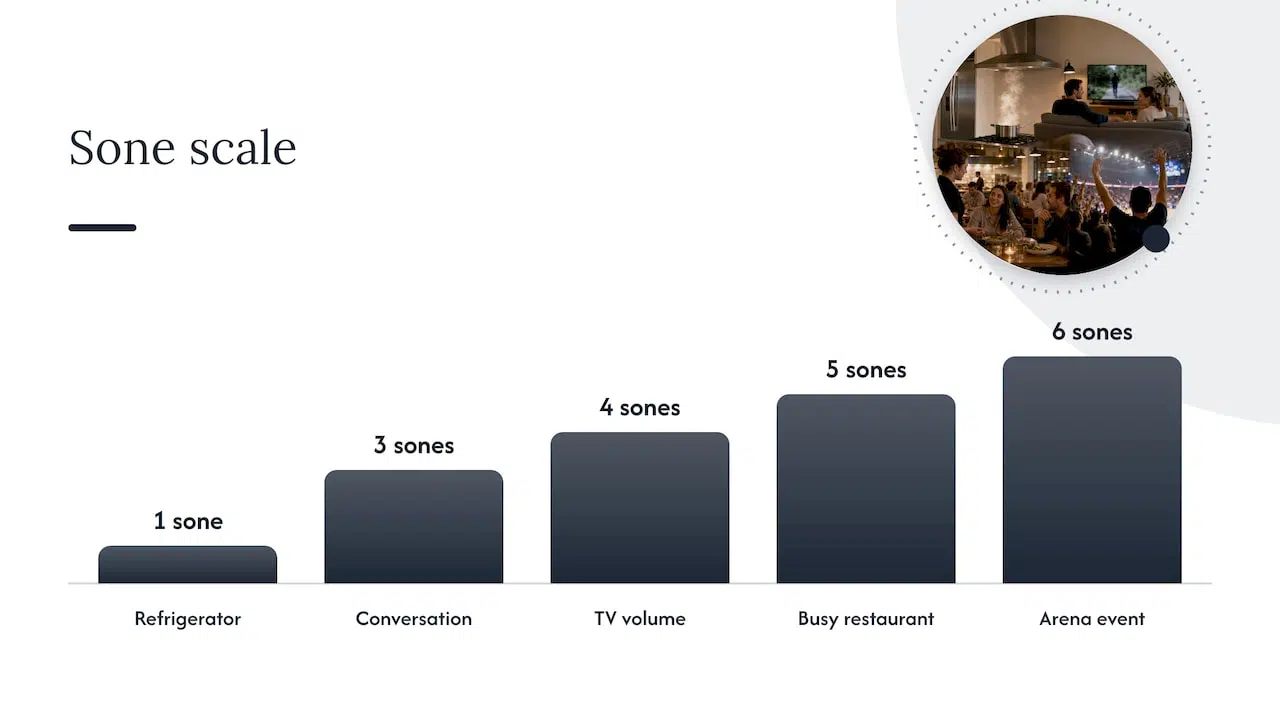
So is 7 sones loud? On that scale, yes, it is above a busy restaurant. It is also common, since many builder-grade hoods land in the 6 to 10 sone range. If your hood is loud on high but smooth, steady and free of rattles, it may be working as designed.
For comparison, the ventilation research group ROCIS recommends a hood rated 3 sones or less at 200 cfm or more, with a low setting at 100 cfm or less and 2 sones or lower. Cfm means cubic feet per minute, the volume of air the fan moves.
A few ways to live with the sound you have:
- Use the lowest speed that clears the smoke and steam. ROCIS suggests running the hood at the speed that removes smoke, odors and steam, then leaving it on for 10 to 20 minutes after cooking, or until the surfaces have cooled.
- Look for two or more fan speeds. Consumer Reports recommends a high speed for cooking and a very low, quiet speed for ventilating afterward.
- Keep the duct short, smooth and correctly sized, since that is where much of the installed noise is decided.
The same ROCIS brief says noise is the main reason people do not run their hoods at all, and that many existing hoods with propeller-type fans and small ducts are not very effective and are too noisy. That is a good reason to deal with the noise instead of living with it: a hood you avoid turning on is not clearing cooking pollutants from your kitchen.
Repair or replace: how age fits in
InterNACHI’s life expectancy chart lists a range or oven hood at about 14 years, and notes that life depends on use, maintenance and quality. Use that as a rough guide, not a deadline.
- Under about ten years, a single noise: repair is usually the sensible route. A motor, blade, damper or duct fix returns the hood to normal.
- Older hood, loud on every setting, weak suction: the combination of an aging motor and an undersized duct is often better solved by installing a new hood with a lower sone rating and correcting the duct at the same time. Our hood installation service covers that.
- Premium brand hood: a motor swap is often worth it. We service luxury kitchen brands, including Dacor, and you can see the full list on our brands page.
If you choose a new hood, HVI’s brochure notes there are no government standards for rating hood performance in the US, so only HVI-certified products have independently verified airflow, sound and energy ratings. It also advises pairing a low-sone hood with properly sized, properly installed ductwork.
Get your hood quiet again in Orange County and Los Angeles County
If the filter is clean, the screws are tight and the noise is still there, the next step is a technician who can check the motor, blade, damper and duct in one visit. We repair and install residential kitchen appliances across Orange and Los Angeles counties, and you can book online for kitchen appliance repair, including range hoods.
For a hood that needs a new motor, a new duct run or a full replacement, our appliance installation services cover the setup after the repair decision is made. Our licensed technicians work with major and luxury brands, and our appliance repair services page lists what else we handle in the same visit.
Our view on range hood noise
Most homeowners we talk to about a loud hood have already done the obvious things. They have washed the filter and tightened a screw or two. What remains is almost never one part in isolation.
A hood is a system: the motor, the blade, the damper and the duct all shape what you hear. Fixing only the visible piece can leave the real cause running. That is why we look at the whole path from the hood to the roof or wall cap, and why our technicians handle the motor, blower, fan, vent and duct together.
We are licensed, we focus on clear communication so you know what is wrong before work begins, and we keep safety first around wiring and gas appliances in the same kitchen. A quiet hood also means you will actually use it, and that is what keeps cooking smoke and steam out of your home.
If your hood is noisy, the sound is telling you something. We would rather listen to it with you.
MDTECH
FAQ
Why is my range hood so noisy all of a sudden?
A sudden change usually means one part has shifted or failed: a filter that is not seated, a loose screw, a damper stuck open or a blade knocking against the housing. Check the filter and fasteners first with the power off. If the sound is a grind or squeal, the motor bearings are the likely cause and the hood should be serviced.
Is 7 sones loud for a range hood?
It is louder than a typical TV volume and above a busy restaurant on the Broan-NuTone sone scale, but many standard hoods fall in that range at full speed. Running on a lower setting, and keeping the ductwork smooth and short, brings the sound down in daily use.
Can a range hood be lubricated to stop the squeal?
Only older motors with an oil spout can take oil, and the effect is temporary. Most newer motors are sealed, and lubricating sealed bearings can do more harm than good, so those motors are replaced. A technician can tell you which type your hood has.
Why does my range hood make noise when it is off?
The usual causes are a damper that flaps in wind, a loose flap in the exterior vent or something that has entered the vent. Family Handyman says a stuck damper’s clatter stops shortly after the hood is turned off, while a loose one slams in windy weather. Vent repair addresses it.
Sources
- Noisy range or exhaust hood troubleshooting guide
- How to Fix a Noisy Vent Hood Damper, Family Handyman
- Motor makes noise, Broan-NuTone support
- What do the CFM and Sone ratings mean, Broan-NuTone support
- FAQs, Home Ventilating Institute
- HVI Range Hood brochure
- Kitchen Range Hoods Supplement 2, ROCIS
- Kitchen Range Hoods Issue Brief, ROCIS
- Range Hood Buying Guide, Consumer Reports
- Range hood care and maintenance, KitchenAid
- Standard Estimated Life Expectancy Chart, InterNACHI