
A Kenmore dryer that tumbles but blows cold air has lost its heat, not its motor, because the drum and the heat source run on separate parts. On an electric model the usual suspects are the power supply, a blown thermal fuse or a burned-out heating element. On a gas model they are the gas supply, the igniter and the gas valve coils. Some checks take five minutes and cost nothing. The rest involve 240-volt wiring or gas, and that is where a licensed technician should take over. If you live in Orange County or Los Angeles County, you can book our technicians online for a Kenmore diagnosis.
TL;DR
- A Kenmore dryer can spin without heating: the drum motor and the heater are separate circuits, so a no-heat dryer is not a dead dryer.
- Start with the two house breakers or fuses, the lint filter and the outside vent. On gas models, also confirm both gas shutoff valves are fully open.
- Repeated blown thermal fuses almost always point to a restricted vent, so the vent has to be dealt with along with the part.
- Median electric-dryer repair costs reported by Consumer Reports run from $118 to $188 depending on the dryer’s price tier, so most heating repairs on a dryer under about 10 years old make sense.
- Never open the cabinet, test live terminals or touch gas connections unless you are trained: if you smell gas, leave and call from outside.
Table of Contents
- Why a Kenmore dryer runs but does not heat
- Five-minute checks before you call anyone
- The vent is the part most people skip
- Kenmore electric dryer: what usually fails
- Kenmore gas dryer: no heat, or heat that starts then stops
- What a safe test actually involves
- Is it worth repairing a Kenmore dryer that will not heat?
- Booking a Kenmore dryer repair in Orange County or Los Angeles County
- Our view: a no-heat dryer deserves a whole-system diagnosis
- FAQ
- Sources
Why a Kenmore dryer runs but does not heat
A dryer has two jobs: turn the drum and make hot air. The motor does the first. On an electric model a heating element does the second, and on a gas model a burner does. Either one can fail while the drum keeps turning, which is why you can hear a perfectly normal cycle and still pull out soaking clothes.
Kenmore is a brand name, not a single factory. Kenmore dryers have been built by different manufacturers over the years, so part layouts differ between a Kenmore 600 series, a Kenmore Elite and an older 70 series. The troubleshooting logic, however, is the same across them: heat needs power or gas, airflow, working safety devices and a working heat source.
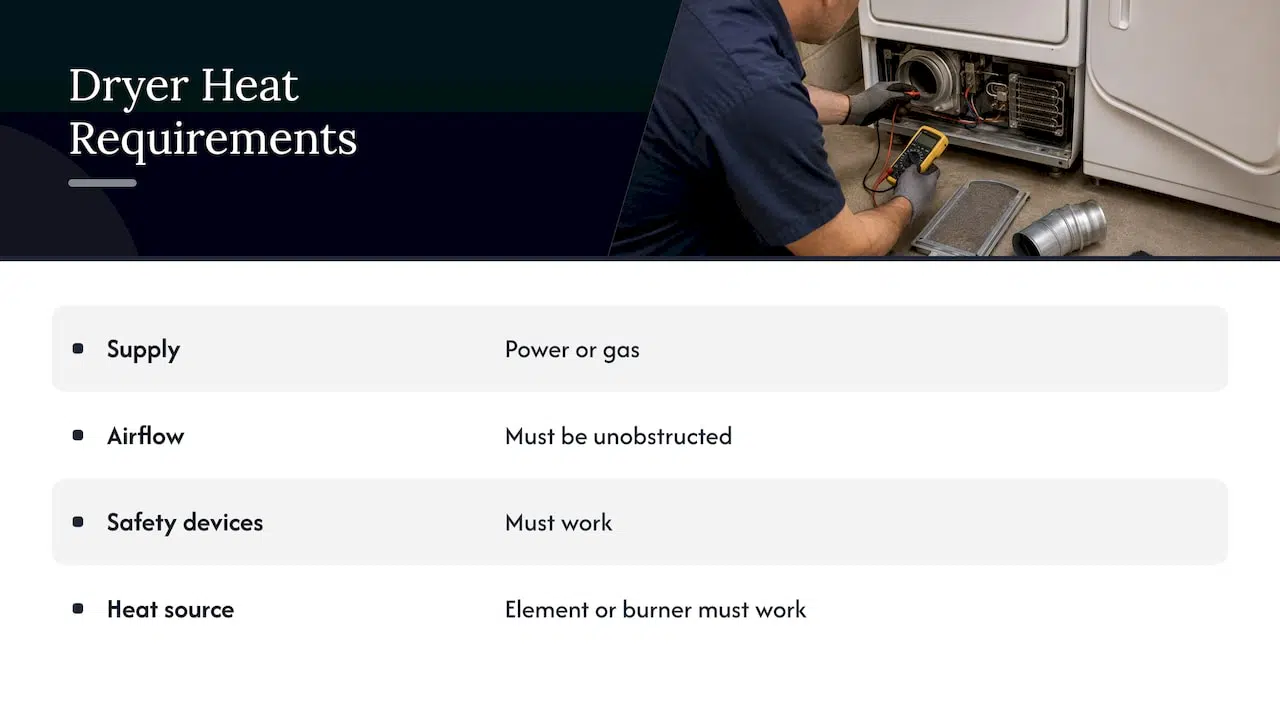
There are also gentler explanations. A cycle set to Air Fluff uses no heat by design, and a normal cool-down phase at the end of a cycle blows unheated air. Rule those out before anything else, as the Dufresne dryer troubleshooting guide lists them alongside blown fuses, lint blockages and gas supply problems.
Five-minute checks before you call anyone
These are the checks Kenmore’s own owner materials point to, and none of them require opening the dryer.
- Confirm the cycle. Make sure the dryer is not on Air Fluff or a no-heat setting, and that the cycle has not simply reached its cool-down stage.
- Check the breakers. An electric dryer needs 240 volts, supplied through two household fuses or a double-pole breaker. The Kenmore user guide says that if only one of the two is lost, the drum may turn but you may not have heat. Reset the breaker or replace both fuses with the same rating. Never install a larger fuse. If the breaker trips again, stop and call a technician or an electrician.
- Clean the lint filter. Remove lint after every load, and rinse the filter in warm water with a little soap if it has a waxy film from dryer sheets, then dry it fully before putting it back.
- Test the airflow. Run the dryer for five to ten minutes, then hold your hand under the outside exhaust hood. The Kenmore guide says to feel for air movement there. Weak or no airflow means the vent is restricted.
- Gas models: check both shutoff valves. The Kenmore Use & Care manual for gas models says to confirm that both gas shutoff valves are fully open. If your dryer runs on propane, an empty LP tank gives the same symptom.
If you smell gas at any point, do not turn anything on or off. Leave the home and call 911 or your gas utility from outside. In much of Southern California that is SoCalGas, reachable 24 hours a day at 800-427-2200.
The vent is the part most people skip
A clogged vent does two harmful things at once. It makes clothes take cycle after cycle to dry, and it overheats the dryer until a safety device shuts off the heat. That is why a no-heat dryer so often turns out to be a vent problem wearing a part problem’s clothes.
It is also a fire issue. The National Fire Protection Association estimated that U.S. fire departments responded to about 15,970 home fires a year involving clothes dryers or washing machines in the 2010 to 2014 period it studied, which is why a repair that leaves the vent clogged is only half a repair. The Dufresne guide recommends inspecting and cleaning the duct annually and using 4-inch rigid metal exhaust duct rather than foil or vinyl accordion duct, which traps lint.
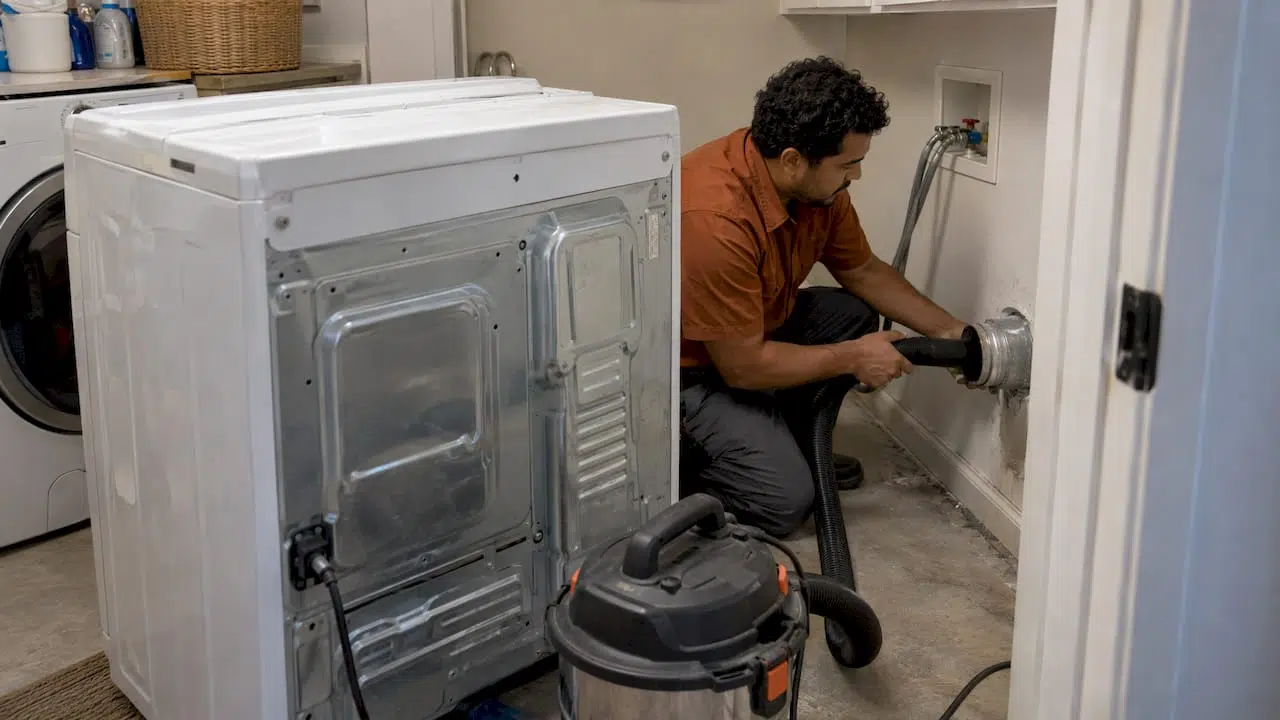
Long vent runs are common in Orange County townhomes and condos, where the dryer sits in an interior closet and the duct snakes through a wall to the roof or exterior. Those runs collect lint faster than a short run, so they deserve a closer look whenever heat problems appear. Our guide to routine dryer vent cleaning explains what regular cleaning prevents.
Kenmore electric dryer: what usually fails
If the breaker is fine and the vent is clear, the fault is inside the machine. Technicians work through the same chain, and it helps to know what each part does so a quote makes sense to you.
| Part | What it does | Typical sign when it fails |
|---|---|---|
| Thermal fuse | One-time safety device that cuts heat or power if the dryer overheats | Dryer runs with no heat, or stops completely |
| High-limit thermostat | Resettable safety switch that cycles heat off at high temperature | Intermittent heat, repeated blown fuses |
| Heating element | Coil that makes heat by resisting current | Clothes need several cycles, then no heat at all |
| Terminal block and power cord | Delivers the 240 volts | One leg missing, weak or no heat |
| Motor centrifugal switch | Tells the heater the motor is up to speed | Motor runs but heater never switches on |
A few things are worth understanding about this list.
The thermal fuse is a symptom as much as a cause. iFixit’s electric dryer troubleshooting page calls a blown thermal fuse a relatively frequent culprit and a sign of other problems: lint in the ducts or blower wheel restricts airflow, the dryer overheats, and the fuse sacrifices itself. Replace the fuse without fixing the airflow and the new one can blow too. The same page recommends replacing the high-limit thermostat at the same time, since intermittent failures of that thermostat can cause blown fuses.
A thermal cutoff is not a reset button. A professional appliance training source describes the thermal cut-off as a non-resettable fuse wired in series with the self-resetting high-limit thermostat. If it blows, it has to be replaced and the cause found.
The power can be the whole story. iFixit’s Kenmore guide says a loss of 240 volts or a failed safety device in the heating circuit is often behind a dryer that runs without heat. Confirming it means measuring voltage at the terminal block with the back panel off, which is live-circuit work. We leave that to licensed technicians.
Heating elements wear out gradually. A weakening element often shows up first as clothes needing two or three cycles. A burning smell can mean the element is arcing, and that is a reason to stop using the dryer until it is looked at.
Some faults are hidden. A faulty motor centrifugal switch can let the motor run while the heater stays off, and on many models the switch is not sold separately, so the motor may need replacing. That is an example of a diagnosis you do not want to guess at.
Kenmore gas dryer: no heat, or heat that starts then stops
Gas dryers add an ignition system, which adds failure points. The sequence is: the igniter glows, the gas valve opens, the burner lights, a flame sensor confirms it, and the cycle continues. If any link breaks, you get a dryer that tumbles with no heat, or one that heats briefly and quits.
The usual patterns, based on the Whirlpool technical sheet for a comparable gas dryer, are:
- Igniter does not glow at all. The igniter may be open, there may be no line voltage at the burner, or the motor centrifugal switch may be at fault.
- Igniter glows but gas never lights. The gas valve coils are the likely cause, and they are normally replaced as a set.
- Igniter stays red hot but the flame never appears or does not hold. The flame sensor is the part the technical sheet points to.
- Heat comes and goes. The thermal cut-off or high-limit thermostat may be tripping from poor exhaust, so the vent comes back into the picture.
The Whirlpool technical sheet gives an igniter resistance range of 50 to 500 ohms for that model, and says to check the exhaust system if the thermal cut-off reads open. Those numbers exist for technicians with a meter and the right procedure, and they differ between models. On gas, the margin for error is small: a wrongly seated connection or a mis-set valve is a safety problem, not an inconvenience. Kenmore’s own Use & Care guide says not to attempt servicing unless it is in the guide’s instructions or published repair steps you understand and have the skills to carry out.
What a safe test actually involves
You may see videos that walk through testing a thermal fuse or heating element with a multimeter. It is worth knowing what they involve, because the steps explain why most homeowners hand this off.
- The dryer has to be unplugged, and wire positions photographed before anything is disconnected.
- iFixit’s guide says to pull at least one spade connector off a component before testing it, because leaving both attached can backfeed and give a false “good” reading.
- The element is checked for continuity, a resistance of about 10 ohms and no continuity to the metal housing. The fuse and thermostats are checked for continuity, and an open reading means replacement.
- Voltage checks at the terminal block are done live, with 240 volts present.
A wrong reading leads to the wrong part, and a wrong part means a second repair. Parts are also matched to the exact model number, and a Kenmore model number can point to Whirlpool, LG or Frigidaire hardware inside. Stop and book service if you see a temperature sensor error code, if the breaker keeps tripping, if you smell burning, or if the dryer involves gas lines.
Is it worth repairing a Kenmore dryer that will not heat?
For most heating faults, yes, if the dryer is not near the end of its life. Consumer Reports’ repair data, published in August 2026, puts median electric-dryer repair costs at $118 for dryers under $700, $160 for $700 to $900 models and $188 above $900. Those are medians across brands and repair types, so your own quote may sit above or below them, and gas dryers can price differently.
The same article frames the decision as repair cost against the machine’s original value. A $188 repair on a three-year-old $2,200 dryer is probably a sound investment, while a $118 repair on a nine-year-old $600 electric dryer may make little financial sense.
A practical way to apply it:
| Situation | Usual call |
|---|---|
| Under about 10 years old, single failed part (fuse, element, igniter) | Repair |
| Premium or Elite model of any age within its normal life | Repair is usually worth pricing |
| Over 10 to 13 years old with a motor, control board or multiple failures | Compare against replacement |
| Vent was the cause and the dryer is otherwise sound | Clean the vent and the dryer may need nothing else |
Dryer lifespan figures from appliance companies cluster around 10 to 13 years, with careful lint and vent maintenance stretching some machines further. Treat those as rough guides, not guarantees. Our page on repair versus replacement goes through the same decision for any appliance.
Booking a Kenmore dryer repair in Orange County or Los Angeles County
Our licensed technicians repair residential appliances in Orange County and Los Angeles County, and you can book online. For a no-heat Kenmore, our appliance repair page is the place to start. If a replacement turns out to be the better call, our team also handles appliance installation, including gas dryer hookups.
It helps to have your model number ready, usually on a label inside the door frame or on the back panel, along with whether the dryer is gas or electric and what you have already checked. If you have been through the breaker, lint filter and vent checks above, say so when you book. If you are still working out what is wrong, our dryer troubleshooting steps and our page on dryers that spin without heating cover the same ground in more detail.
Our view: a no-heat dryer deserves a whole-system diagnosis
The most common mistake we can describe is treating the symptom. A dryer that stopped heating has a reason, and the part that failed is often only the last domino. A thermal fuse that blew because the vent was packed with lint will blow again if all that happens is a swap.
That is why we think a no-heat repair should be handled as a whole-system job: power, airflow, safety devices and the heat source, in that order. It is also why we care about licensed technicians doing the work. A 240-volt circuit or a gas connection is not a place for guesswork, and our service is built around fast response across Orange and Los Angeles counties so that the dryer is not out of action for long.
If your Kenmore is not heating, book a visit and let us find the actual cause, so the repair lasts.
MDTECH
FAQ
Why does my Kenmore dryer spin but blow cold air?
The drum motor and the heat source are separate, so one can work without the other. Common causes are a tripped breaker or blown house fuse on electric models, a blown thermal fuse, a failed element, or a gas supply or ignition fault on gas models. Start with the breaker, lint filter and vent.
Why does my Kenmore gas dryer start to heat and then stop?
A short burst of heat that fades often points to a restricted vent causing the high-limit thermostat or thermal cut-off to trip. It can also come from a weak igniter or flame sensor that cannot keep the burner lit. Because gas is involved, have a licensed technician diagnose it.
Can a clogged vent really stop my dryer from heating?
Yes. Restricted airflow makes the dryer overheat, and its safety devices cut the heat to protect it. Feeling for strong airflow at the outside hood after five to ten minutes of running is a simple first check, and a vent that is clogged should be cleaned before or alongside any part replacement.
Is it worth fixing a heating element in a dryer?
Usually, when the dryer is under about 10 years old, since median electric-dryer repairs reported by Consumer Reports run $118 to $188. Weigh the quote against what the dryer originally cost and its age. A technician can confirm that the element is the real fault and check the vent so the new part is not stressed.
Sources
- Kenmore Electric or Gas Dryer User Guide
- Kenmore 796.71622310 Use & Care Manual
- NFPA: Home Fires Involving Clothes Dryers and Washing Machines
- iFixit: Electric Dryer Not Heating
- iFixit: How to Troubleshoot a Kenmore Electric Dryer That Won’t Heat
- Appliance Tech Academy: Dryer Circuit Analysis
- Whirlpool WED94HEXW1 Technical Sheet
- Consumer Reports: Should You Repair or Replace Your Broken Clothes Dryer?