
Induction is the better cooktop for most kitchens: it heats faster, holds temperature more precisely, stays cooler on the surface and is a bit more efficient. A standard radiant electric cooktop costs less up front and works with every pan you already own. If you have an electric range or cooktop today, switching is usually a straight swap on the same 240V circuit. Below is how the two compare on what matters, including the costs, the cookware and the wiring check that decides whether a switch is simple.
TL;DR
- Induction heats the pan directly with a magnetic field. A radiant electric cooktop heats an element under the glass, and the element heats the pan.
- Induction wins on speed, control, cleanup and burn risk. Radiant electric wins on purchase price and cookware flexibility.
- Induction needs magnetic cookware. A magnet that sticks firmly to the bottom of a pan tells you it will work.
- Both typically run on a 240V circuit, so replacing an electric cooktop with induction is often simple. Going from gas may need new wiring.
- Expect to pay roughly $350 to $700 more for induction than for a comparable radiant electric model.
Table of Contents
- How each cooktop actually heats food
- Induction vs electric cooktop at a glance
- Speed and control
- Energy use and running cost
- Safety and cleaning
- Cookware: what works on induction
- The downsides of induction, and how to handle them
- Wiring and installation: check before you buy
- Which one should you choose?
- Our perspective
- Need a cooktop installed or repaired?
- FAQ
- Sources
How each cooktop actually heats food
The difference starts under the glass. Both types usually have a smooth ceramic-glass top, so they look alike. What happens beneath is different.
A radiant electric cooktop uses electric heating elements under a flat ceramic-glass surface to heat pots and pans with radiant heat. The element glows, the glass gets hot, and the pan warms from the glass. The heat has to travel through several layers before it reaches your food. The older coil electric stove works the same way, only with exposed metal coils. The D.C. Department of Energy and Environment notes that electric stoves are recognized by metal coils or a flat ceramic or glass top, and that only 50 to 70 percent of the heat goes into the cookware.
An induction cooktop works differently. According to Consumer Reports, magnetic coils below the ceramic glass surface generate heat directly in the pan. ENERGY STAR describes it as heating cookware directly with electromagnetic energy, and says the surface is not hot to touch without a pan on it. The only heat in the glass is what comes back from the pan.
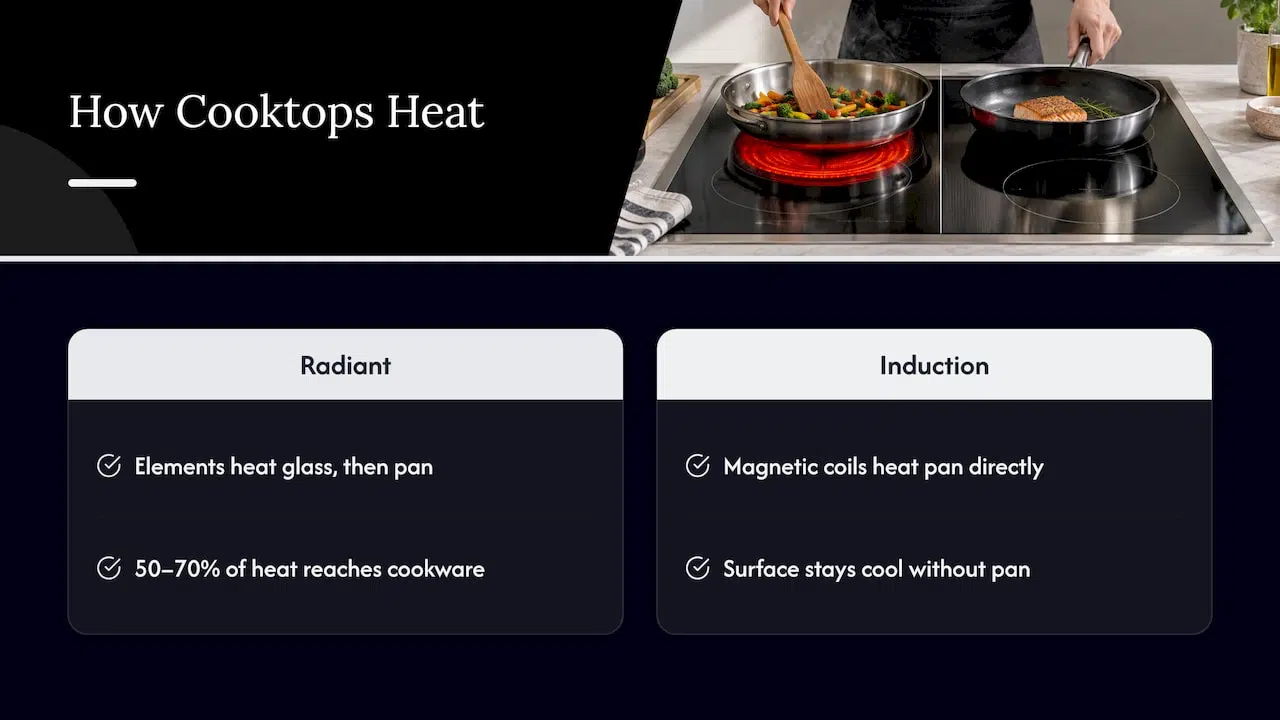
That is also the answer to the “induction vs ceramic cooktop” question. A ceramic cooktop is the glass surface, and it can sit on top of either technology. What you are really choosing is the heat source beneath it: a radiant element or an induction coil.
Induction vs electric cooktop at a glance
| Factor | Induction | Radiant electric (smooth top) |
|---|---|---|
| Heat source | Magnetic field heats the pan itself | Element under glass heats the glass, then the pan |
| Heating speed | Fastest of the common technologies | Slower to heat and slower to cool |
| Temperature control | Responds quickly when you lower the setting | Lags, because the element stays hot |
| Efficiency | About 85% of energy reaches the cookware | Lower; about 5 to 10 percent less efficient than induction |
| Surface heat | Cooler, since only the pan heats | Stays hot after you turn it off |
| Cleanup | Spills do not bake on as easily | Spills can burn onto the hot glass |
| Cookware | Magnetic only | Any flat-bottomed pan |
| Typical price | $900 to over $2,000 | $550 to $1,200 |
The price range and efficiency figures come from The Spruce, and the 85 percent figure from ENERGY STAR, both cited in the sections below.
Speed and control
This is where induction pulls ahead most clearly. Consumer Reports testing found that high-power induction burners can boil water roughly 20 to 40 percent faster than the best gas and radiant electric models it tested. ENERGY STAR calls induction the fastest cooking technology among electric cooking options.
Control is the other half. NYSERDA, New York’s state energy agency, says induction gives precise temperature control and responds when you lower the temperature. With a radiant element, turning the dial down does not instantly cool the element, so a simmer can overshoot and a sauce can scorch while you wait for the element to catch up. That matters most for melting chocolate, holding a gentle simmer, and searing then dropping the heat quickly.
One fair note for radiant: Consumer Reports’ testing lead, Kenneth Sutton, points out that many people assume gas is quickest, yet high-performance radiant electric cooktops often beat gas on boiling time. A good radiant cooktop is a quick appliance. Induction is simply quicker and more responsive.
Energy use and running cost
Induction transfers about 85 percent of its energy to the cookware, according to ENERGY STAR. Radiant electric sends only 50 to 70 percent of heat into the pan, per the D.C. agency’s guide. The practical gap between induction and a conventional electric cooktop is smaller than the gap between induction and gas: about 5 to 10 percent more efficient than electric.
For a typical household, that is a modest saving on the electric bill, not a reason alone to buy. Think of it as a bonus on top of speed and control. Some of the benefit also shows up in the kitchen: less wasted heat means the room stays cooler in summer, which matters in many Southern California homes where the air conditioner is already working hard.
Safety and cleaning
Because induction heats the cookware, the cooktop surface stays relatively cool and the risk of burns is reduced, according to the U.S. Department of Energy. NYSERDA adds that an induction cooktop cannot start or keep running when the cookware is removed. A radiant cooktop can stay hot for a while after you switch it off, which is a real consideration with children or a busy kitchen. Most radiant models have a hot-surface indicator light, so watch for it.
Cleaning follows from the same physics. Iowa State University Extension notes that with induction, spills outside the pan will not bake onto the surface, so cleanup is easy. On a radiant top, a boil-over lands on glass that is already hot and can bake into a stubborn film. For general upkeep, our guide to kitchen appliance cleaning tips covers what to use and what to avoid.
Indoor air is another point. NYSERDA says induction cooktops, combined with ventilation, help preserve indoor air quality. Running the range hood is still a good habit with either electric type.
Cookware: what works on induction
This is the one real adjustment. Induction needs cookware a magnet will cling to. Cast iron, enameled cast iron and some stainless steel work, and a magnet is the simple test. Radiant or coil electric cooktops accept any type of pan.
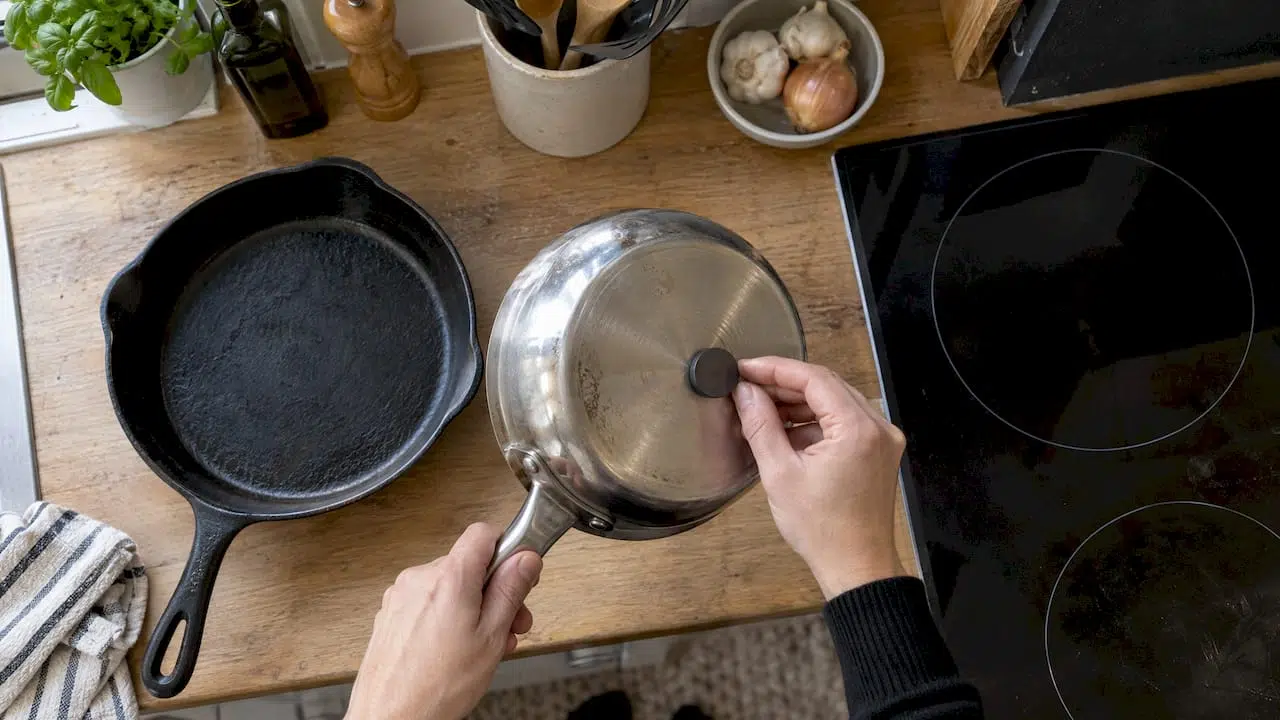
So, can you use cast iron on induction? Yes. A flat-bottomed cast iron, stainless steel or enameled cast iron pan works. Lift pans rather than sliding them, since cast iron is heavy and rough bottoms can mark the glass.
What cannot you cook on induction? It is not a food question, it is a pan question. Pure aluminum, copper, glass and ceramic cookware will not heat unless the base has a magnetic layer. If a pan fails the magnet test, it will sit cold on the surface. Before you buy, go through your cabinet with a magnet. If most of your pans pass, the switch costs you nothing extra. If not, budget for a few new pieces.
The downsides of induction, and how to handle them
Induction costs more up front. The Spruce puts induction cooktops at $350 to $700 more than radiant electric models, and the typical range is $900 to over $2,000 against $550 to $1,200 for radiant. Two published examples show the spread on 30-inch models: a Frigidaire electric cooktop listed at $599, and an Empava four-burner induction cooktop with a sale price of $449.19. Entry-level induction can come in under mid-range radiant, and sale prices change, so check the current listing. At the high end, a Wolf 36-inch transitional cooktop carried a 2019 MSRP of $2,390.
A few practical points are worth knowing before you buy:
- Noise. Iowa State notes that buzzing or humming at high power is common and can often be reduced by using heavy, flat-bottomed pans.
- Glass care. The same source says the glass can scratch if pans are slid across it and can crack if a heavy pot is dropped, the same care any ceramic-glass top needs.
- Cookware. Some existing pans may not work, as covered above.
None of these is a reason to avoid induction. They are habits to set up on day one: heavy flat pans, lifting instead of sliding, and a magnet check at the store.
Wiring and installation: check before you buy
This step decides how smooth the project is. Induction and electric cooktops typically require 220/240V electricity, and an existing electric stove-oven combination is already supplied at that voltage. Portable two-burner induction units use a standard 120V, 20-amp outlet.
If you are replacing an electric cooktop, the circuit is usually already there. The D.C. guide says switching from gas to induction may require an electrical wiring or panel upgrade, while homes with an electric stove or oven likely will not need one. Consumer Reports estimates a simple gas-to-induction installation with a new outlet and line at 3 to 4 hours of electrician time at $50 to $100 per hour. Local rates in Orange County and Los Angeles County can differ, so treat that as a national benchmark. Our page on 240V wiring or a gas line for induction walks through the circuit question if you are coming from gas.
Cutout size matters too. Measure the opening, the depth below the counter and the clearance to the oven or drawer underneath, because induction units have electronics that need airflow. If you are planning an outdoor kitchen as well, run the power layout for both at the same time so you do not open walls twice.
On incentives, Consumer Reports notes that the Inflation Reduction Act provides incentives for electric cooktops and ranges, including induction, for eligible buyers. Eligibility and availability change, so confirm the current rules before you count on a rebate.
Which one should you choose?
Choose induction if you:
- cook often and want fast boiling and a steady simmer
- have young children or want a cooler surface
- hate scrubbing burnt-on spills
- already own cast iron or magnetic stainless pans
Choose radiant electric if you:
- are working to a tight budget
- have a lot of aluminum, copper or glass cookware you want to keep
- are replacing a failed cooktop and want the lowest cost swap
If you are torn, ask which costs you more: the extra purchase price now, or the daily friction of slow heat and baked-on spills. Most people who cook daily find the second one adds up. If gas is also on the table, our comparison of gas vs electric appliances covers that decision.
Our perspective
Most of the cooktop calls we handle have little to do with the cooktop itself. They come from the circuit behind it, the cutout around it, or a connection that was never checked at install. A good cooktop on a poor installation still gives you trouble.
That is why we tell homeowners in Orange County and Los Angeles County to decide in two steps. First, confirm what power is at the wall and what size opening you have. Then choose the cooktop. Induction is a strong choice for most households, and with the right wiring it performs the way it is designed to.
Our licensed technicians install and repair kitchen appliances, and we explain what we are doing and why before work begins. If you want the new cooktop checked, connected and tested properly the first time, that is the job we do every week.
MDTECH
Need a cooktop installed or repaired?
We install and repair kitchen appliances across Orange County and Los Angeles County, including electric and induction cooktops. Our licensed technicians check the circuit, the cutout and the connection, then make sure everything runs before they leave. You can book online, and we do not publish fixed prices because each job depends on your kitchen, so you get a quote for your specific setup. See our appliance installation services to get started.
Already have a cooktop that misbehaves? Our cooktop repair page explains what we fix, and our kitchen appliance repair service covers the rest of the kitchen. If you are weighing a new purchase against fixing what you have, repair vs replacement is a useful place to start.
FAQ
Is induction better than a regular electric cooktop?
For most cooks, yes. Consumer Reports says induction offers faster heating, more precise control and 5 to 10 percent greater energy efficiency than electric smoothtops, and its glass cools faster. The tradeoffs are a higher price and the need for magnetic cookware.
What are the disadvantages of an induction cooktop?
The main ones are cost, magnetic-only cookware, and glass that can scratch or crack if mistreated. Some models hum at high power. Heavy, flat-bottomed pans and lifting instead of sliding handle most of these.
Can I use cast iron on induction?
Yes. Cast iron and enameled cast iron both work, as do some stainless steel pans. Use the magnet test on any pan you are unsure about, and lift rather than drag heavy pans across the glass.
Do I need new wiring to switch from electric to induction?
Usually not. Induction and electric cooktops both typically use a 220/240V supply, and a home with an existing electric stove or oven is generally ready. Switching from gas is where a new outlet or line may be needed, so have an electrician check the circuit first.
Is a ceramic cooktop the same as induction?
No. Ceramic describes the glass top, which is used on both radiant and induction models. The difference is the heat source underneath: an electric element or an induction coil.
Sources
- Picking the Best Cooktop for Your Kitchen, Consumer Reports
- How to buy the best cooktop, Consumer NZ
- Induction vs. Electric Cooktop: Which Should You Buy?, Consumer Reports
- The Buyer’s Guide to Induction Cooktops, NYSERDA
- Making the Switch to Induction Stoves or Cooktops, U.S. Department of Energy
- Cooking: Stovetops and Ranges, D.C. Department of Energy and Environment
- ENERGY STAR Certified Electric Cooking Products factsheet
- Induction Cooking: What You Need to Know, Iowa State University Extension
- CR’s Complete Guide to Induction Cooking, Consumer Reports
- Induction Cooktop vs. Electric, The Spruce
- Best Electric Cooktops of 2026, Consumer Reports
- Residential Cooktop Performance and Energy
- Frigidaire 30-inch electric cooktop FFEC3025UB
- Empava 30-inch induction cooktop IDC30
- Wolf CE365T/S specification sheet