
For most home cooks who want faster boiling, tighter temperature control, and cleaner indoor air, induction is the stronger pick. Gas still wins if you cook with a wok, char peppers over open flame, or need a stove that works when the power goes out. The right answer depends less on trends and more on your circuit, your cookware, and how you actually cook.
TL;DR:
- Induction heats pans faster and responds more precisely to adjustments, but requires ferromagnetic cookware and may need significant electrical upgrades.
- Gas cooktops excel with open-flame techniques, are compatible with any cookware, and work during power outages but produce indoor pollutants linked to respiratory risks.
- Induction generally costs more to repair due to electronics, while gas repairs are simpler and often cheaper, mainly mechanical.
- Proper ventilation is essential for gas ranges to remove combustion byproducts, whereas induction requires less vigorous venting, reducing installation costs.
- Households with respiratory concerns should favor induction for cleaner indoor air, but existing gas infrastructure might favor gas for immediate and flexible installation.
Table of Contents
- Induction vs Gas Cooktop: A Quick Head-to-Head
- How Much Faster Is Induction at Boiling and Simmering?
- Is Gas or Induction Better for Indoor Air Quality?
- What Does It Cost to Install Induction or Gas?
- Will My Pots and Pans Work on an Induction Cooktop?
- How Often Do Gas and Induction Cooktops Need Repairs?
- How Do You Decide Between Induction and Gas?
- How Loud Is an Induction Cooktop Compared to Gas?
- Does Your Cooktop Choice Change Your Range Hood Needs?
- Which Cooktop Cooks Better for Different Dishes?
- What Homeowners Ask Us Before Choosing a Cooktop
- Get Your Cooktop Installed or Converted the Right Way
- Sources
- FAQ
Induction vs Gas Cooktop: A Quick Head-to-Head
Here’s how the two technologies stack up across the factors that actually change your daily cooking experience:
- Speed: Induction boils water noticeably faster because heat transfers directly into the pan rather than into the air around it.
- Control: Induction responds instantly to dial changes, similar to an electronic switch; gas flame adjusts fast but overshoots more easily at low simmer.
- Cookware: Gas works with any pan; induction requires ferromagnetic cookware, which rules out pure aluminum, copper, and most glass.
- Cleanup: Induction’s flat glass surface wipes clean in seconds; gas grates and burner caps need regular scrubbing.
- Air quality: Induction produces no combustion byproducts in the kitchen; gas releases pollutants tied to respiratory concerns.
- Installation: Induction typically needs a dedicated 240V circuit; gas needs a proper line, shutoff valve, and ventilation.
- Power outages: Gas cooktops with standing pilot or manual ignition still work without electricity; induction does not.
- Repairs: Gas repairs tend to be mechanical and cheaper; induction repairs involve electronics that cost more.
Weeknight family cooks benefit most from induction’s speed and easy cleanup. Serious searers and wok cooks usually stay loyal to gas for direct flame contact. Pastry and sauce cooks who need rock-steady low heat tend to prefer induction. Off-grid or outage-prone households should lean toward gas or a dual-fuel range.
How Much Faster Is Induction at Boiling and Simmering?
Boil-speed comparisons consistently show induction getting water to a rolling boil faster than a comparable gas burner, largely because the cooktop generates a magnetic field that heats the pan itself instead of heating air and cookware surface first, as testing from Tasting Table demonstrates. That direct transfer is also why induction wastes so little energy: the Department of Energy notes that induction converts a much higher share of input energy into usable heat than an open gas flame, where a good portion escapes around the sides of the pan.
Gas flames flicker with drafts, burner cleanliness, and pot placement, so a “low” simmer can quietly climb or die out. If you make risotto, custards, or delicate pan sauces often, that stability shows up in the final dish.
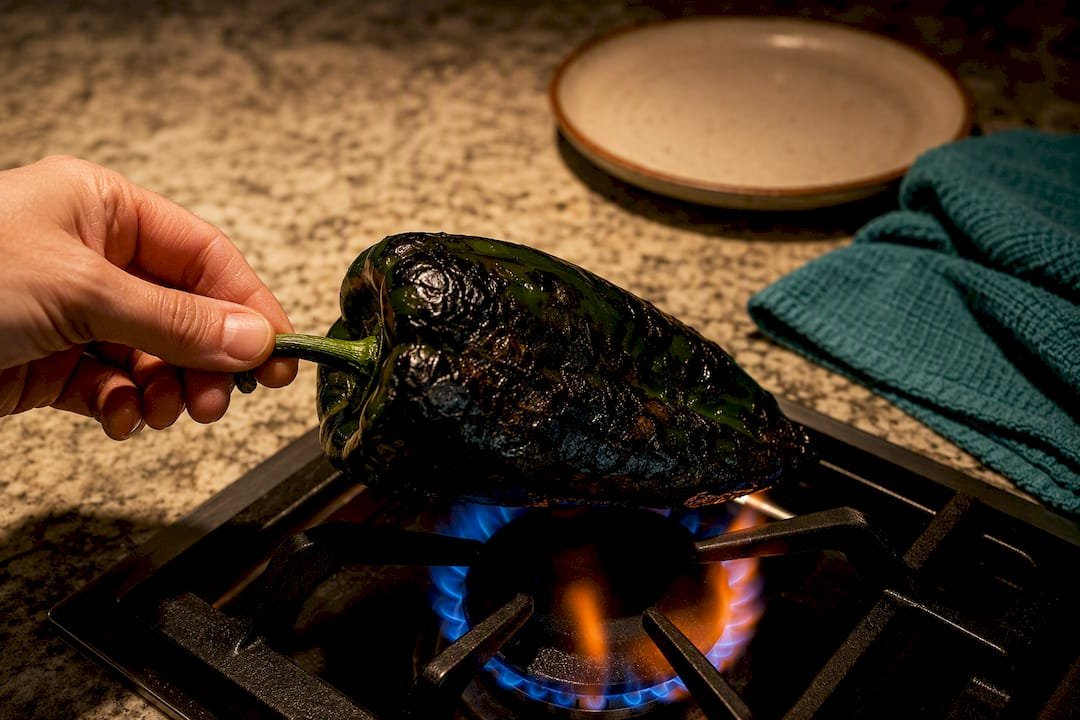
Where gas still has the edge: open-flame techniques. Charring a poblano directly over the burner, tossing a wok with visible flame licking the pan sides, or torching the edge of a tortilla just doesn’t translate to a flat glass surface. Physics limits induction here. No amount of wattage replicates a flame you can see and steer.
Is Gas or Induction Better for Indoor Air Quality?
Gas stoves burn fuel indoors, and burning fuel produces byproducts that don’t just vanish. Peer-reviewed research has linked gas stove emissions to elevated indoor pollutants associated with respiratory health risks, and the Consumer Product Safety Commission conducted its own review of gas-stove safety risks and pollutant exposure, recommending further evaluation rather than an outright ban. Separate environmental science analysis has also flagged methane leakage and combustion byproducts from gas cooking as a factor in both indoor exposure and broader climate impact.
The pollutants worth knowing by name:
| Pollutant | Source | Health concern |
|---|---|---|
| Nitrogen dioxide (NO2) | Combustion byproduct of burning natural gas | Linked to worsened asthma symptoms, especially in children |
| Benzene | Trace compound released during gas combustion | Classified as a carcinogen at sustained exposure |
| Fine particulates | Byproduct of flame combustion and splatter | Associated with respiratory irritation |
Practical mitigation matters more than panic. Run your range hood every time you cook, not just for smoky dishes. Choose a hood rated to actually vent your burner output, not a decorative one. Crack a window when simmering for long stretches. Appliancesrepairmdtech’s gas appliance safety checklist walks through connection and ventilation checks worth doing annually, regardless of which fuel you use.
For households with asthma, young kids, or anyone with a respiratory condition, switching to induction removes the combustion question entirely. That’s a medically reasonable move, not an overreaction.
What Does It Cost to Install Induction or Gas?
Installation costs hinge on what your house already has, not on the appliance price tag.
Induction requirements:
- A dedicated 240V circuit, typically rated 40 to 50 amps depending on the model, per installation guidance from Masters Wholesale.
- An electrician to run new wiring if your kitchen currently only has a 120V outlet near the range.
- No gas line work needed, which simplifies permitting in homes without existing gas service.
Gas requirements:
- A gas line with a proper shutoff valve, sized correctly for the burner’s BTU load.
- A licensed plumber or gas technician to inspect or run the line, plus a permit in most jurisdictions.
- Confirmation of adequate ventilation per local code, since combustion appliances have stricter requirements than electric ones.
If your house is already wired for a 240V electric range or already plumbed for gas, that infrastructure tips the decision hard in one direction. Retrofitting the missing utility is usually the biggest line item, not the cooktop itself. Operating costs then come down to your local electricity and gas rates, which vary enough by region that a national dollar comparison isn’t reliable. A typical conversion project runs a few days once permits clear. For homeowners going from electric to gas, Appliancesrepairmdtech’s guide on how to convert an electric range to gas covers the realistic timeline and safety steps involved.
Will My Pots and Pans Work on an Induction Cooktop?
Run a refrigerator magnet across the bottom of your cookware. If it grips firmly, the pan works on induction, a test confirmed by cookware testing at Tasting Table. Cast iron and most modern stainless steel pass. Pure aluminum, copper, and glass fail unless the manufacturer built in a magnetic base plate.
- Round-bottom woks lose full-surface contact on flat induction glass; a flat-bottom wok or an induction wok adapter ring solves most of this.
- Gas accepts any pan shape or material without exception, which matters if you own inherited copper or specialty aluminum cookware.
- Cleanup favors induction: a damp cloth handles the flat glass, while gas grates and burner caps need periodic scrubbing.
- Controls differ in feel: gas uses a physical knob you can adjust by touch without looking; induction relies on touch sliders or digital dials that take a session or two to learn.
How Often Do Gas and Induction Cooktops Need Repairs?
Gas cooktops rely on mechanical parts: igniters, burner valves, and gas lines. These fail in predictable ways and cost less to fix because the components are simple and widely stocked. Induction cooktops hide their complexity under sealed glass: control boards, inverters, and induction coils are electronics, and when they fail, the repair often means replacing an expensive board rather than a $20 valve.
Common gas faults include a clicking igniter that won’t light, a burner that won’t hold flame, or a worn valve. Common induction faults include a cooktop that won’t power on, error codes tied to the control board, or a coil that stops heating one zone while others work fine. Repair costs typically run higher on the induction side because the parts are proprietary and less commonly stocked by generalist parts suppliers.
Pro Tip: Schedule a preventative check on any gas connection every year, even if nothing seems wrong. Slow gas leaks and worn valve seals rarely announce themselves before they become a real hazard.
- Before any conversion, existing gas line pressure and electrical panel capacity should be verified first.
- Every gas conversion should include a leak test and ventilation check before final sign off.
- Our gas oven and stove repair and installation guide covers what a proper install checklist should include.
How Do You Decide Between Induction and Gas?
Work through these steps in order, since each one can eliminate an option before you even compare features:
- Check your power and gas access. Do you have a 240V outlet near the cooktop, or an existing gas line? Whichever utility already exists shrinks your installation cost dramatically.
- Match your cooking style. Wok cooking, flame-charring, and pan-flambé technique favor gas; sauces, simmering, and speed favor induction.
- Factor in health constraints. Anyone managing asthma or another respiratory condition should weigh induction’s combustion-free operation seriously.
- Set a real budget. Include potential electrical or gas line work, not just the appliance sticker price.
- Confirm your cookware is ready. Run the magnet test on your existing pots before buying, so you’re not replacing your entire set on day one.
| Buyer priority | Best fit |
|---|---|
| Fastest boil times and easy cleanup | Induction |
| Wok cooking and open-flame technique | Gas |
| Asthma or respiratory sensitivity in the home | Induction |
| Outage-prone area or off-grid setup | Gas |
| Both worlds without picking one | Dual-fuel range |
A dual-fuel range with induction on some burners and gas on others makes sense for cooks who genuinely use both techniques weekly, not just occasionally.
How Loud Is an Induction Cooktop Compared to Gas?
Gas burners are essentially silent except for the soft hiss of flame and the click of an igniter cycling. Induction cooktops introduce a different kind of noise: a low electronic hum from the internal fan that cools the electronics, and occasionally a faint buzz or click when cookware doesn’t sit perfectly flat on the surface.
That hum gets more noticeable at high power settings, since the cooling fan works harder as the coil generates more heat. Some higher-end induction models manage this well with quieter fan designs, while budget models can produce a rattle if a pan’s bottom isn’t fully flat or is warped. Cookware also plays a role: thin, lightweight pans sometimes vibrate slightly against the glass at certain power levels, creating a buzzing sound that disappears the moment you switch to heavier cast iron or clad stainless.
Neither noise level is loud enough to disrupt conversation across a kitchen, but the character of the sound differs enough that some cooks notice it immediately after switching from gas. If you’re sensitive to background electronic hum, particularly in an open-concept home where the kitchen sits near a living space, it’s worth asking to hear a demo unit running at high power before you buy. Gas remains the quieter option in an absolute sense, but the gap is smaller than most people expect, and it rarely factors into buyer satisfaction the way speed or cleanup does.
Does Your Cooktop Choice Change Your Range Hood Needs?
Gas cooking demands more ventilation capacity than induction, and that difference affects both your hood purchase and your ongoing utility use. Combustion byproducts, released heat, and grease-laden moisture all need to leave the kitchen, which is why gas ranges are typically paired with hoods rated for higher CFM (cubic feet per minute) airflow. Skimping on hood capacity over a gas range means pollutants linger in the kitchen air longer, compounding the exposure concerns already tied to combustion byproducts.
Induction still benefits from a good hood, mainly to handle steam, smoke from searing, and cooking odors, but the ventilation requirement is less strict since there’s no open flame generating combustion gases. That translates into a real cost difference: a properly sized gas-rated hood with strong CFM output and ducting to the exterior generally costs more to install than a lighter-duty hood suited to induction, especially if ductwork needs to be added where none existed.
If you’re keeping your existing gas range and hood setup, confirm the hood actually vents outside rather than recirculating filtered air back into the kitchen, since recirculating hoods do little against NO2 or fine particulates. If you’re switching to induction, you can often get away with a smaller, quieter hood, which also shrinks the cutout and ducting work an installer needs to do. Either way, hood capacity belongs in your budget conversation from the start, not as an afterthought once the cooktop is already installed.
Which Cooktop Cooks Better for Different Dishes?
Neither technology wins across every dish, and pretending otherwise does home cooks a disservice.
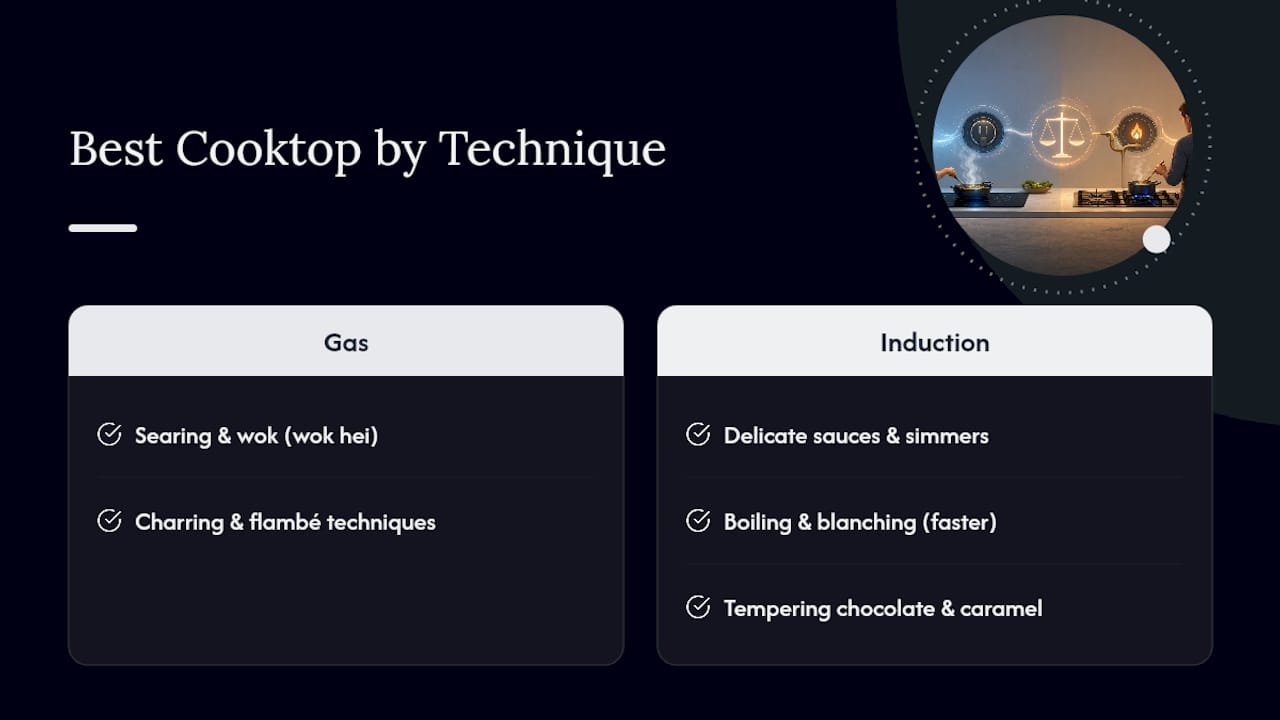
Searing and stir-fry: Gas has the edge here because visible flame licks up the sides of a wok or pan, adding a char flavor professional cooks call “wok hei.” Induction can sear well on a flat pan bottom, but it can’t replicate flame contact on curved surfaces.
Sauces and delicate simmers: Induction wins clearly. Hollandaise, custards, and reduction sauces need exact, stable low heat, and induction’s wattage control beats a flickering gas flame every time.
Boiling pasta or blanching vegetables: Induction gets water to a boil faster, which matters when you’re cooking on a schedule. The Department of Energy’s efficiency data explains why: more of the energy goes directly into the pot instead of escaping around it.
Baking-adjacent stovetop work, like tempering chocolate or making caramel, favors induction’s precision. Flame-based techniques, like charring vegetables directly or flambéing a dish tableside, only work on gas.
Rewiring America’s comparison of induction and gas performance reaches a similar conclusion: the best cooktop depends heavily on which techniques dominate your weekly cooking, not on which one wins in a lab test.
What Homeowners Ask Us Before Choosing a Cooktop
Most customers ask about power availability before they ask about brand or price, and that’s the right instinct. We check panel capacity, existing gas lines, and ventilation before recommending either option. For readers weighing a switch, our gas conversion workflow and installation guides outline what a safe, code-compliant setup actually involves.
— MDTECH
Get Your Cooktop Installed or Converted the Right Way
Choosing between induction and gas is only half the decision. The other half is making sure your electrical panel, gas line, or ventilation setup can actually support the cooktop you want, and that’s where a lot of DIY plans stall out. Appliancesrepairmdtech handles the part homeowners in Orange County and Los Angeles County can’t safely do themselves: verifying circuit capacity, running or inspecting gas lines, and signing off on a setup that meets code.
Technicians can assess whether a kitchen is ready for a 240V induction circuit or whether an existing gas line needs upgrading before a new range goes in. If you’re leaning toward gas, our electric-to-gas range conversion service typically completes in a few days once permits are in hand. If you already know installation is the next step, our step-by-step appliance installation guide covers what to expect, or you can book a site visit directly to get a firm timeline for your kitchen.
Sources
This comparison draws on boil-speed testing from Tasting Table, efficiency data from the U.S. Department of Energy, peer-reviewed health research on gas stove emissions, the CPSC’s gas-stove safety study, and chef-perspective reporting from Bloomberg.
- Induction vs gas stove: how fast water boils (Tasting Table)
- Making the switch to induction stoves or cooktops (U.S. Department of Energy)
- PubMed article on gas stove emissions and health associations
- CPSC study on gas-stove risks (full report)
FAQ
Do chefs prefer induction or gas?
It’s split. High-end chefs increasingly adopt induction for precision and cooler kitchens, while many line cooks and restaurants stick with gas for durability and open-flame technique, according to Bloomberg’s reporting.
What can’t you cook on induction?
Techniques that depend on visible flame contact, like charring vegetables directly over a burner or achieving wok hei in a round-bottom wok, don’t translate to induction’s flat glass surface.
Is gas or induction healthier?
Induction is the healthier choice for indoor air quality since it produces no combustion byproducts, while research has linked gas stove emissions to pollutants tied to respiratory health risks.
What’s the biggest downside of induction cooktops?
Cookware compatibility is the main limitation. It only works with ferromagnetic pans, and repairs tend to cost more because the internal electronics sit under sealed glass rather than being simple mechanical parts.
Does induction cooktop cost more to install than gas?
It depends on your existing wiring. Induction needs a dedicated 240V circuit rated for 40 to 50 amps, so a kitchen without that circuit faces added electrical work, while a home already wired for it installs at low added cost.