
For most homeowners in mild-to-moderate climates who also need air conditioning, a heat pump wins on total cost and comfort. In very cold regions, or wherever natural gas is cheap and abundant, a furnace or a dual-fuel setup that pairs both systems usually makes more financial sense. The right call hinges on your local electricity and gas rates, your winter design temperature, and whether you’re replacing one system or two.
TL;DR:
- Heat pumps become less efficient as outdoor temperatures drop, often requiring electric resistance backup or a dual-fuel system for colder climates.
- Upfront costs for heat pumps are higher than furnaces alone but can be more economical when replacing both an air conditioner and heating system, especially with incentives.
- Operating costs depend heavily on local electricity and gas rates; heat pumps are more cost-effective in mild climates with moderate winters.
- Proper sizing based on a Manual J load calculation and verifying ductwork and panel capacity are essential before installation.
- Federal tax credits and utility rebates significantly reduce the initial price gap between heat pumps and furnaces, affecting the overall economic decision.
Table of Contents
- Heat Pump vs Furnace at a Glance
- How They Work: Combustion vs Heat Transfer
- Comparing Operating Costs With COP and AFUE
- Upfront Equipment and Installation Costs
- Cold-Climate Performance and Backup Heat Strategies
- Maintenance, Lifespan, and Safety Over Time
- Incentives, Rebates, and Tax Credits That Change the Math
- How to Choose: A Short, Practical Checklist
- The Bottom Line on Heat Pump vs Furnace
- MDTECH’s Field Perspective on Installation Pitfalls
- Get an Accurate Heat Pump or Furnace Quote
- Sources
- FAQ
Heat Pump vs Furnace at a Glance
A furnace burns fuel, usually natural gas, to heat air and push it through ductwork. A heat pump moves heat instead of generating it, pulling warmth from outdoor air (even cold air) and pumping it inside, then reversing the cycle in summer to cool your home. That reversal is the single biggest practical difference: a furnace only heats, while a heat pump replaces both your furnace and your air conditioner in one box.
Here’s how the basics stack up:
- Fuel source: furnaces run on natural gas, propane, or oil; heat pumps run on electricity.
- Cooling: furnaces provide none; heat pumps cool your home in summer.
- Upfront cost: furnaces typically cost less to install alone; heat pumps cost more but replace two systems.
- Operating cost: heat pumps often win in mild climates; furnaces often win where gas is cheap and winters are brutal.
- Lifespan: both typically last around 15 to 20 years with regular service.
- Safety: furnaces carry combustion and carbon monoxide risk; heat pumps don’t burn anything.
Climate is the tiebreaker more often than price. Mild winters favor heat pumps almost every time; sustained sub-zero stretches tilt the math back toward gas or a dual-fuel hybrid. The decision checklist later in this guide walks through how to apply that rule to your own house.
How They Work: Combustion vs Heat Transfer
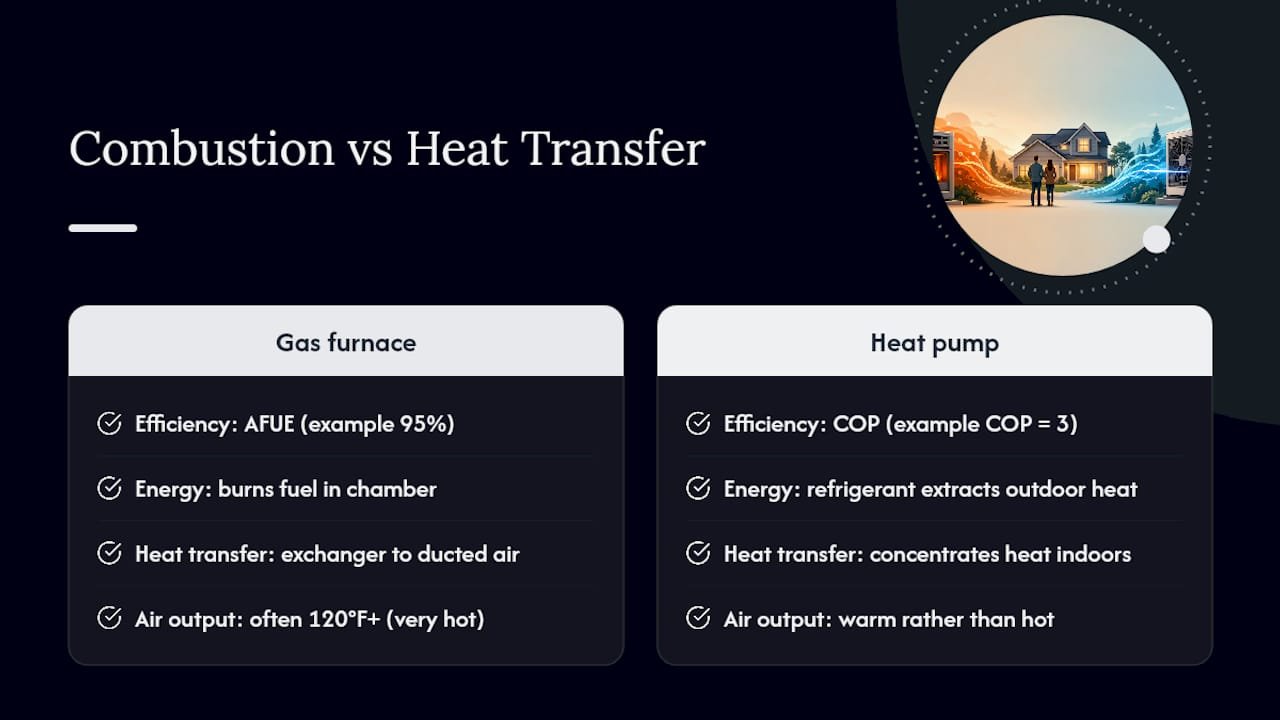
A furnace burns fuel in a combustion chamber, then a heat exchanger transfers that heat into air blown through your ducts. Its efficiency is measured by AFUE, or Annual Fuel Utilization Efficiency, which tells you what percentage of fuel energy becomes usable heat. A furnace rated at 95% AFUE turns 95 cents of every dollar’s worth of gas into heat inside your home. The rest escapes as exhaust, which is why combustion systems need venting and periodic safety inspection.
A heat pump works more like a refrigerator running in reverse. It uses a refrigerant cycle to extract heat from outdoor air, even at temperatures well below freezing, and concentrate it indoors. Its efficiency is measured by COP (coefficient of performance) for instantaneous output and HSPF or the newer HSPF2 for seasonal heating performance. A COP of 3 means the unit delivers three units of heat for every unit of electricity it consumes, which is why heat pumps routinely beat electric resistance heat and often beat gas on a cost-per-BTU basis.
The practical outcomes matter more than the acronyms. Furnace air comes out noticeably hot, often 120°F or higher. Heat pump air feels warm rather than hot, and the same unit cools your home in July. There’s no flame, no flue, and no combustion byproduct to vent.
Comparing Operating Costs With COP and AFUE
The real question isn’t which system is “more efficient” in the abstract. It’s which one costs less to run at your electricity rate and your gas rate. That takes a simple formula:
- Furnace cost per unit of heat = your gas price ÷ AFUE (as a decimal).
- Heat pump cost per unit of heat = your electricity price ÷ COP.
- Compare the two results directly, in the same units, using your utility’s actual rate structure.
Run the numbers for a mild climate: if electricity costs about average rates and the heat pump holds a typical COP at that outdoor temperature, effective cost per unit of heat delivered is competitive. In colder scenarios, a heat pump’s COP may drop, reducing its advantage unless it is a cold-climate model, which can help maintain efficiency and keep costs lower compared to gas.
Statistic: The Department of Energy notes that modern heat pumps can cut heating electricity use by about 75% compared with electric resistance heat, making them one of the most efficient heating technologies available today.
Solar panels change the equation again. If you generate your own electricity, a heat pump’s fuel cost drops toward zero for as many hours as your panels produce, shortening payback substantially compared with a system that still needs metered gas.
Upfront Equipment and Installation Costs
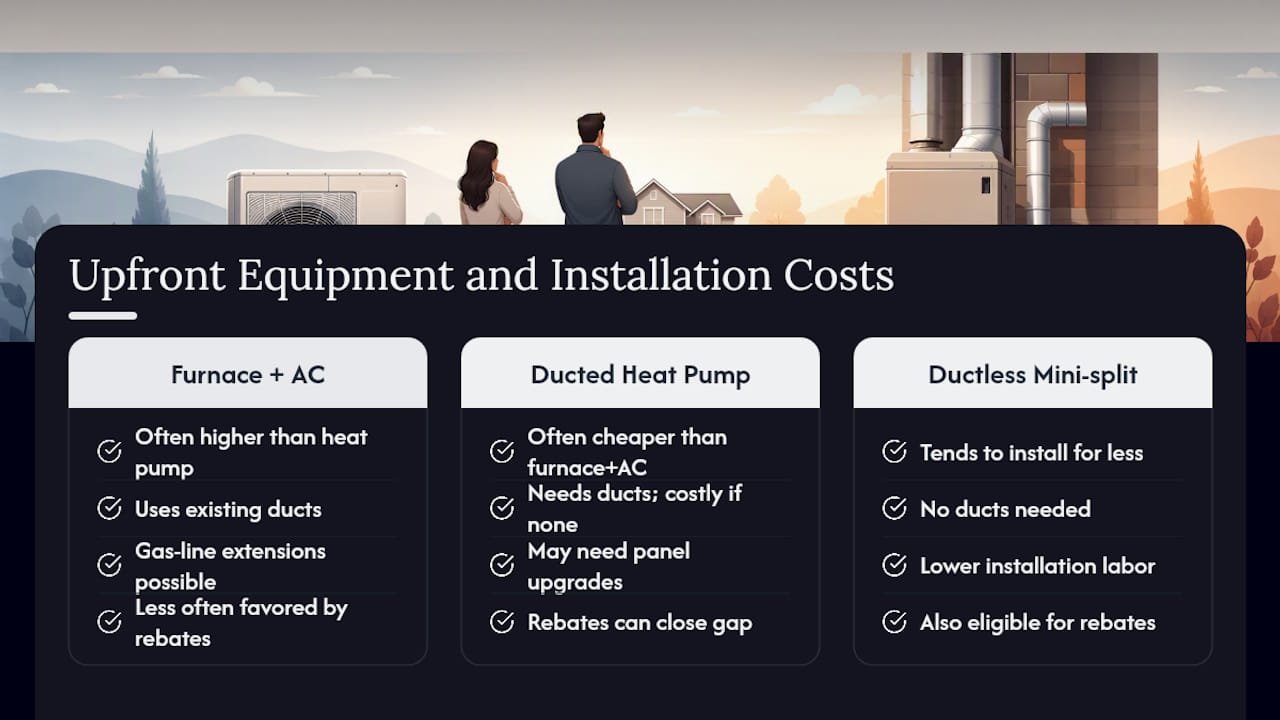
Installed heat pump systems typically run higher than a furnace alone, but the comparison isn’t apples to apples unless you account for what each system replaces. EnergySage’s cost analysis frames it correctly: if you’re already due for a new air conditioner, the honest comparison is furnace-plus-AC against a single heat pump, not furnace-alone against heat pump-alone. Under that lens, heat pumps frequently come out ahead on combined capital cost.
Ductless mini-split heat pumps tend to install for less than central, ducted systems, especially in homes with no existing ductwork, since running new ducts through walls and ceilings adds real labor cost. Gas furnace installs stay cheaper on paper, but watch for hidden add-ons: gas-line extensions, electrical panel upgrades for a heat pump’s higher amperage draw, permit fees, and any ductwork modifications needed to match airflow to the new equipment.
Incentives can erase a meaningful chunk of that price gap, which is exactly why the 10-year cost comparisons run by AC Direct often favor heat pumps once rebates and tax credits are applied, even when the sticker price looks higher at the counter.
Cold-Climate Performance and Backup Heat Strategies
Heat pump capacity drops as outdoor temperature drops, and that curve is the crux of the cold-climate debate. A standard heat pump rated at 100% capacity at 47°F might only deliver 50 to 60% of that output at 5°F. Cold-climate heat pumps with variable-speed inverter compressors hold capacity much deeper into freezing temperatures than older fixed-speed units, which is why the technology has expanded heat pump viability into regions that used to rule it out entirely.
When outdoor temperature drops below a heat pump’s efficient operating range, most systems lean on electric resistance strips as backup. Those strips work, but they’re expensive to run, essentially reverting to costly electric heat during the coldest snaps of the year.
A dual-fuel system solves this by pairing a heat pump with a gas furnace and letting a thermostat or control board switch automatically once temperatures fall past a set point. It runs cheap, efficient heat pump heating most of the year and only fires the furnace when outdoor conditions make gas the cheaper option.
- Ask any contractor to show capacity curves at 47°F and 5°F, not just a single rated output number.
- Confirm the system is sized to your home’s Manual J design temperature, not a rough square-footage estimate.
- Have the dual-fuel switchover point set to match your actual utility rates, not a generic factory default.
Pro Tip: Don’t let a contractor size your heat pump off square footage alone. A proper Manual J load calculation accounts for insulation, windows, and your area’s coldest design day, and it’s the single biggest factor in whether your system keeps up during a cold snap.
Maintenance, Lifespan, and Safety Over Time
Both systems average 15 to 20 years of service life with regular professional maintenance, though heat pumps that run year-round for both heating and cooling sometimes see more wear on compressors than furnaces that only work half the year.
- Furnaces typically require annual combustion inspection, burner cleaning, and a carbon monoxide safety check.
- Heat pumps usually need coil cleaning, refrigerant level checks, and filter changes at similar intervals.
- DOE guidance recommends annual professional service for both systems, with homeowners managing filter changes between visits.
- Rising energy bills, uneven heating, or a unit older than 15 years running frequent repairs all signal it’s time to compare repair cost against replacement.
The safety difference is straightforward: furnaces involve an open flame and exhaust gases, so cracked heat exchangers or blocked flues create real carbon monoxide risk. Heat pumps burn nothing, which removes that failure mode entirely. Our furnace maintenance checklist covers the combustion-specific checks a heat pump never needs.
Incentives, Rebates, and Tax Credits That Change the Math
Federal incentives under the Inflation Reduction Act currently support heat pump purchases through tax credits, and many utilities layer additional rebates on top, sometimes worth thousands of dollars combined. State-level programs vary widely, and furnace incentives exist too, though usually at smaller dollar amounts tied to high-efficiency models.
Check the DSIRE database and your local utility’s website by ZIP code before assuming either system’s sticker price is final. Incentives shift often, and the gap they close between a heat pump’s higher upfront cost and a furnace’s lower one can be the deciding factor in an otherwise close call.
How to Choose: A Short, Practical Checklist
Before you call a contractor, pull together the numbers that actually drive this decision, including how your building shell and insulation impact your heating choice (How New Interior Doors Improve Energy Efficiency in Older Portland Homes):
- Your electricity rate ($/kWh) and gas rate ($/therm) from a recent utility bill.
- Your region’s winter design temperature, which any local HVAC contractor can pull from ASHRAE data.
- The condition of your existing ductwork, since that affects mini-split versus central system costs.
- Whether gas service is already run to your home or would need to be added.
Once you have those, run the cost-per-BTU comparison from the efficiency section above, and ask at least two contractors for a Manual J load calculation alongside their bid. Rank your priorities honestly: lowest monthly bill, lowest emissions, comfort consistency, or resale value all point toward slightly different answers.
Pro Tip: Get at least two Manual J calculations from separate contractors before signing anything. If the numbers vary wildly, that’s a signal one of them is guessing rather than measuring your home’s actual heat loss.
If your climate stays mild most of the year and you need cooling anyway, lean heat pump. If you’re in a harsh cold region with cheap gas already piped in, lean furnace or dual-fuel.
The Bottom Line on Heat Pump vs Furnace
The decision comes down to your climate and your rates, not brand loyalty to either technology. Heat pumps win on efficiency and versatility almost everywhere except sustained deep-cold climates, where a furnace or dual-fuel setup still holds an edge. Start by pulling your utility rates and getting a Manual J calculation before you commit to either system.
MDTECH’s Field Perspective on Installation Pitfalls
Every install we’ve evaluated runs into the same three snags: undersized electrical panels that can’t handle a heat pump’s amp draw, ductwork sized for a furnace’s higher static pressure rather than a heat pump’s gentler airflow, and permit delays nobody budgeted time for. Verify panel capacity and duct compatibility before signing a contract, and ask specifically who pulls the permit and when.
— MDTECH
Get an Accurate Heat Pump or Furnace Quote
You can get a local assessment and an actual Manual J load calculation before committing to equipment, not just a sales pitch for whatever’s in stock. Licensed technicians serve homeowners with heat pump and furnace installation, gas conversion work, and ongoing maintenance that keeps either system running its full lifespan.
If you’re comparing bids right now, ask us for a second opinion alongside whatever your first contractor quoted. We’ll walk your ductwork, check your panel capacity, and give you a straight answer on whether a heat pump, furnace, or dual-fuel setup fits your house. Book an assessment through our HVAC repair and installation page and get a technician on-site with real numbers instead of a rough estimate.
Sources
- Heat pump vs. furnace: Which heating system is best for your home? — EnergySage
- Heat Pump vs. Gas Furnace in 2026: The Real Cost Comparison for U.S. Homeowners — AC Direct
FAQ
Which Is Better, a Furnace or a Heat Pump?
Neither wins universally. Heat pumps typically deliver lower operating costs and double as air conditioners in mild-to-moderate climates, while furnaces hold the edge in very cold regions with cheap natural gas.
What Are the Disadvantages of Heat Pumps?
Heat pump capacity drops as outdoor temperature falls, requiring expensive electric resistance backup or a dual-fuel furnace pairing in harsh cold, and upfront installation costs run higher than a furnace alone.
Why Replace a Furnace With a Heat Pump?
A heat pump replaces both your furnace and your air conditioner with one system, often lowers combined operating costs in moderate climates, and removes combustion and carbon monoxide risk from your home entirely.
How Much Does It Cost to Repair a Heat Pump?
Heat pump repair costs vary by the failed component, from a simple capacitor swap to a compressor replacement, and a technician needs to diagnose the specific fault before quoting an accurate price.
Is a Heat Pump Worth It in a Cold Climate?
A cold-climate heat pump with a variable-speed compressor can work well in freezing temperatures, but pairing it with a furnace in a dual-fuel setup often gives the most reliable and cost-effective result during extreme cold.