
Most Samsung refrigerator problems fall into four categories: cooling failures, ice maker jams, water leaks, and error codes. Before calling a technician, a few targeted checks can resolve the majority of these issues at home. Here is what to look at first.
Common Samsung refrigerator problems and their quickest first fixes:
- Fridge not cooling: Check that vents inside the compartment are not blocked by food containers, and verify the unit is not stuck in Cooling Off Mode (also called Demo or Shop Mode), which disables the compressor while leaving the display active.
- Ice maker not producing ice: Inspect for frost buildup behind the ice maker housing. A solid block of ice inside the tray usually means a moisture jam, not a motor failure.
- Water pooling inside the fridge: A clogged defrost drain is the most common cause. Flush it with warm water.
- Beeping or unusual noises: A door left ajar triggers most beeping alerts. Metallic grinding, however, points to a fan blade obstructed by ice.
- Error codes on the display: Hold “Power Freeze” and “Power Cool” simultaneously for several seconds to perform a basic reset. Note that most Samsung models have no dedicated reset button; this button combination is the standard method, though the exact pairing varies by model.
Pro Tip: Keep the two rear vents inside the fresh food compartment clear at all times. Overstocking the fridge is one of the most common reasons for warm spots, and it costs nothing to fix.
Avoid changing temperature settings repeatedly. Temperature adjustments take up to 3 hours to stabilize, so frequent changes prevent the system from ever reaching its target and create the impression of a malfunction. Always consult your model’s manual for model-specific button sequences before attempting any reset.
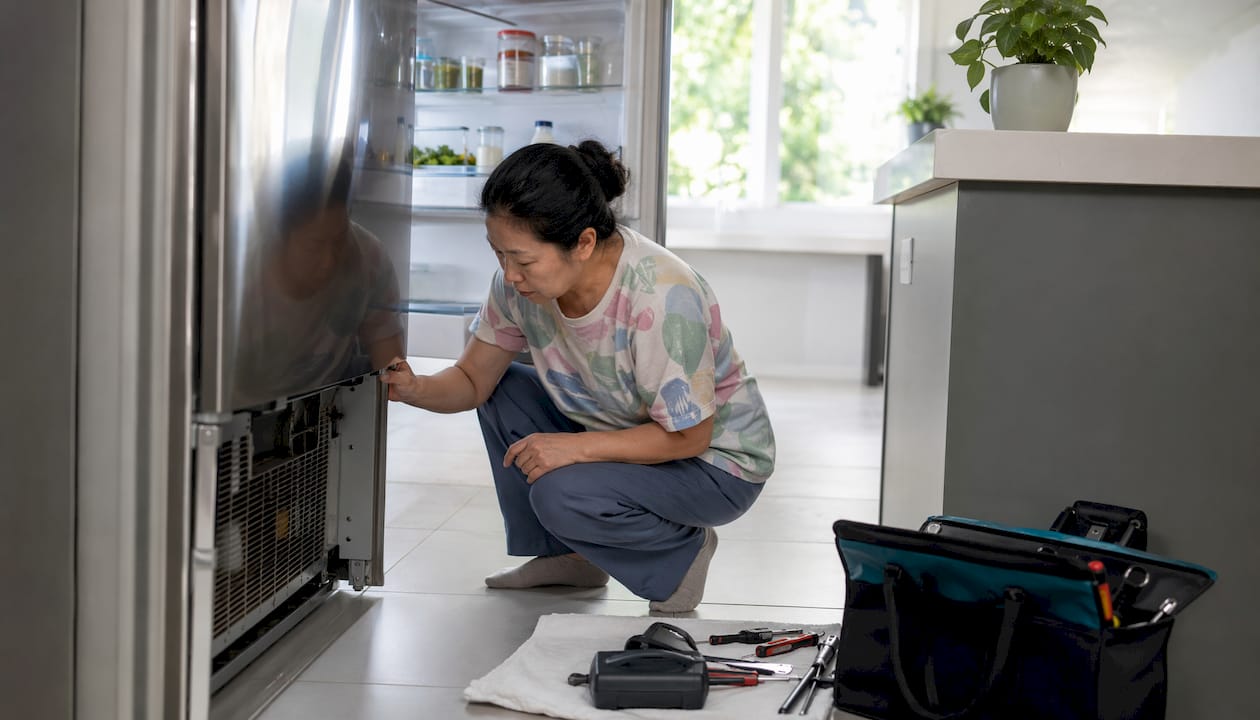
How to troubleshoot Samsung refrigerator cooling problems
A warm fresh food compartment with a still-cold freezer is one of the most reported Samsung refrigerator issues, and it is almost never a compressor failure at the outset. Airflow obstruction rather than component failure causes most perceived cooling problems. The fix is often free.
Step-by-step cooling diagnosis:
- Check for Demo Mode first. If the display works but the fridge is warm, press and hold the top two buttons for 8 seconds to exit Demo Mode. Unplugging the unit will not clear this mode on its own.
- Inspect internal vents. Remove any items pressed against the rear vent panel inside the fridge. Cold air flows from the freezer through this vent; blocking it creates warm zones even when the freezer is fine.
- Listen for the evaporator fan. Open the freezer door and press the door switch manually. If the fan does not spin up, the motor has likely failed and needs replacement.
- Check the evaporator coils. Remove the rear panel inside the freezer. Heavy frost coating the coils means the defrost system has failed, not the compressor.
- Clean the condenser coils. Located at the back or bottom of the unit, dirty coils reduce overall cooling capacity. Vacuum them every six months.
- Test the door gasket. Close the door on a piece of paper. If you can pull the paper out easily, the gasket is not sealing and warm air is entering continuously.
Error codes tied to cooling failures:
- 22E / 22C: Evaporator fan motor error
- 5E: Fresh food compartment temperature sensor fault
- PC ER: Communication error between control boards, which can disrupt temperature management
Pro Tip: After cleaning coils or clearing vents, wait a full 3 hours before judging whether cooling has improved. Checking after 30 minutes and concluding the repair failed is one of the most common reasons homeowners call for service unnecessarily.
Sealed system faults (compressor or refrigerant issues) do exist but are far less common than airflow or defrost failures. If the freezer is also warm and all the above checks pass, that is when a licensed technician with refrigerant handling certification needs to step in. You can find Samsung refrigerator repair guidance and professional service options through Appliancesrepairmdtech.
How to fix Samsung ice maker problems: no ice, leaks, and jams
Ice maker malfunctions are the single most frequently reported Samsung refrigerator complaint, alongside cooling failures and water leaks. The good news is that the root cause is usually moisture, not a dead motor.
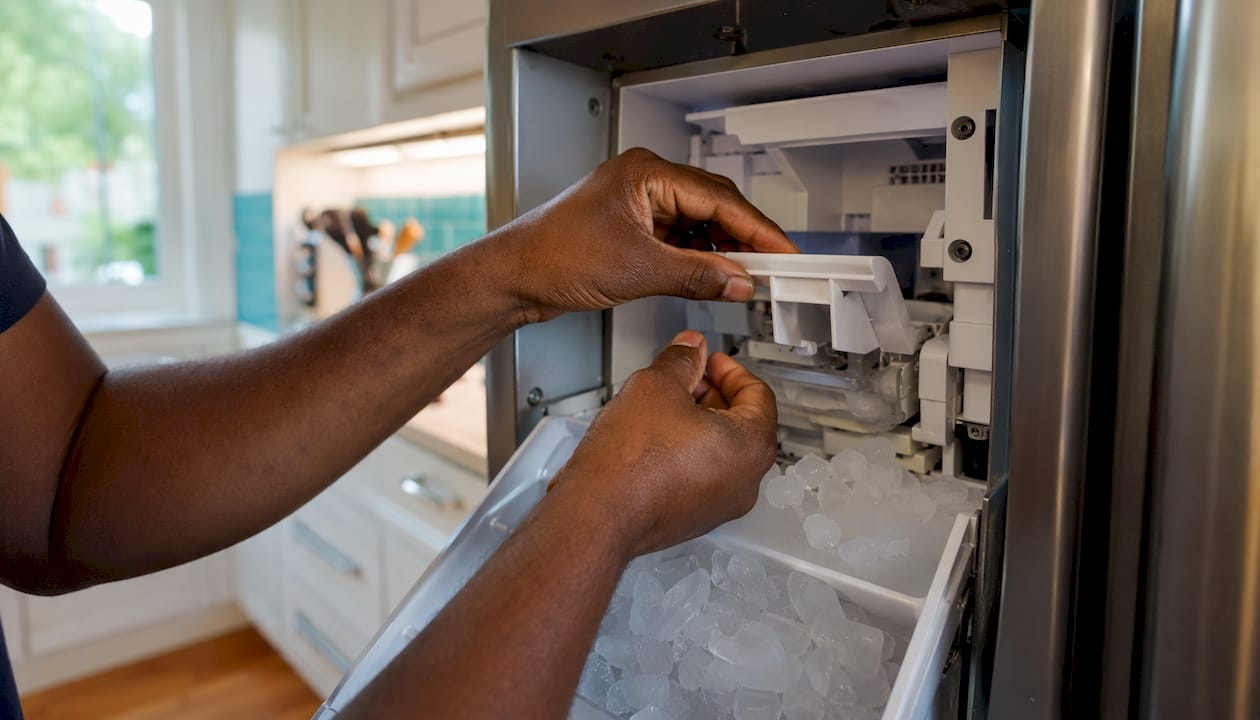
Frost buildup behind the ice maker housing is the key diagnostic indicator. When moisture enters the ice maker assembly during the defrost cycle, it refreezes around the mechanism and jams the ejector arms. The motor gets blamed, but replacing it without addressing the ice block just repeats the problem.
Common ice maker symptoms and their causes:
- No ice at all: Fill tube may be frozen solid, blocking water delivery to the tray.
- Ice forms as one solid block: Moisture ingress has frozen the entire tray mechanism together.
- Ice clumps in the bucket: Partial melting and refreezing during defrost cycles.
- Water dripping into the fresh food compartment: Ice dam has formed and is overflowing.
- Frost visible behind the ice maker panel: Defrost cycle moisture is refreezing inside the housing.
How to diagnose and fix the ice maker:
- Unplug the refrigerator and leave both doors open for an extended period to fully thaw any ice blockage without risk of damaging components. This thaws any ice blockage fully without risk of damaging components.
- After thawing, check the fill tube (the small tube that delivers water to the ice tray). If it was frozen, thaw it with warm water before restarting.
- Inspect the ejector arms and motor for physical damage. If the arms bent from ice pressure, the assembly needs replacement.
- Check whether your model qualifies for Samsung’s insulation kit (part number DA82-02367A), released to address moisture ingress on affected French door models manufactured between 2014 and 2021. Contact Samsung directly to verify eligibility.
- On flex-tray models, press and hold the reset button under the ice maker until the motor starts. On heated-tray models, remove the ice bucket, locate the rectangular reset button, and hold it for 10–15 seconds until you hear a beep.
Never replace the ice maker motor before confirming the jam is cleared. A new motor installed into a frozen assembly will fail just as fast.
How to find and fix water leaks and door seal problems
Water inside or under a Samsung refrigerator almost always traces back to one of three sources: a clogged defrost drain, a faulty door gasket, or a water line issue. Pinpointing the location narrows the fix immediately.
Where the leak is tells you what to check:
- Water pooling at the bottom of the fresh food compartment: Clogged defrost drain. This is by far the most common cause.
- Water under the refrigerator: Either a drain pan overflow or the unit is not level, causing condensate to run forward.
- Water behind the refrigerator: Loose or cracked water supply line connection.
- Dripping from the ceiling of the fridge section: Ice dam in the defrost drain tube has backed up and is overflowing into the compartment.
Step-by-step leak repair:
- Locate the defrost drain at the back of the freezer floor. On French door models, remove the rear interior panel to access it.
- Pour warm water slowly into the drain opening to melt any ice blockage. Follow with a pipe cleaner or turkey baster to flush debris.
- If the drain clogs repeatedly, Samsung offers a drain strap kit designed to prevent ice dam formation in the tube.
- Inspect the water filter housing for cracks and confirm the filter is seated correctly. A filter installed at an angle will leak at the connection point.
- Check the door gasket by running your hand along the seal while the door is closed. Any cold air escaping means warm, humid air is entering and condensing inside, which eventually drips.
For a deeper look at refrigerator water leaks, Appliancesrepairmdtech covers the full diagnostic process including less obvious sources like cracked drain pans.
Proper leveling also matters. A refrigerator tilted forward causes the doors to swing open on their own and allows condensate to pool at the front instead of draining to the rear pan. Adjust the front leveling legs so the unit tilts very slightly backward.
How to read Samsung refrigerator error codes and run diagnostics
Samsung refrigerators display error codes on the control panel when a sensor or component reports a fault. Knowing what each code means cuts diagnostic time significantly and tells you whether a reset will fix it or a part needs replacing.
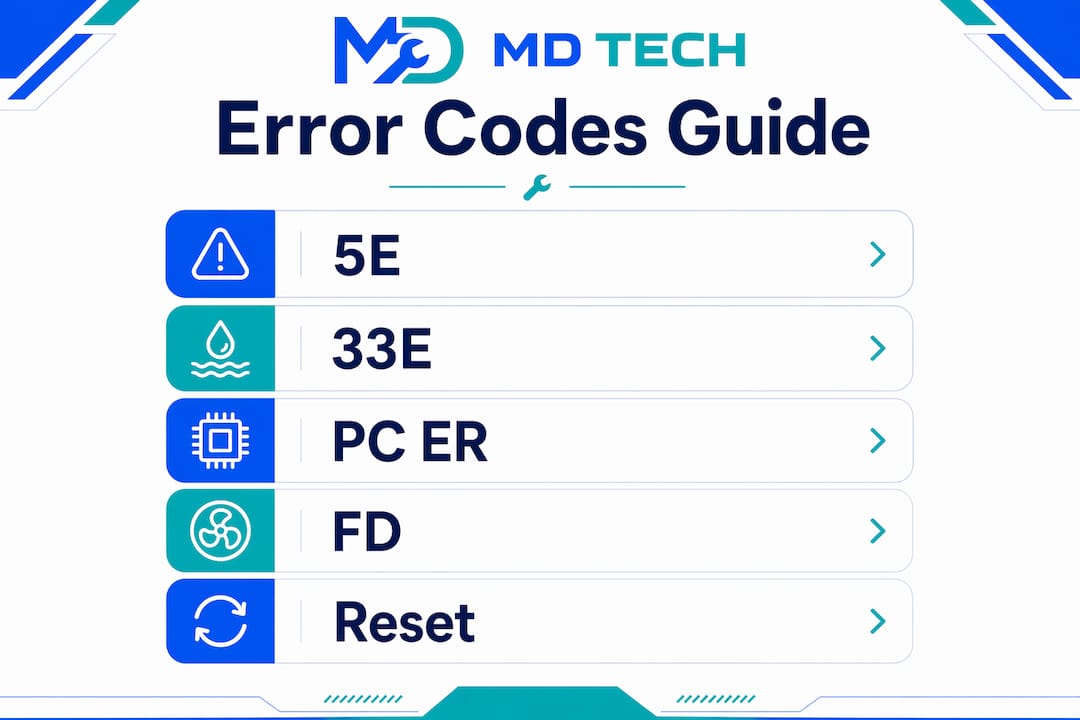
Common error codes and what they mean:
| Error Code | Meaning | First Step |
|---|---|---|
| 5E | Fresh food temperature sensor fault | Unplug for 5 minutes; if it returns, test the thermistor |
| 22E / 22C | Evaporator fan motor error | Listen for fan in freezer; check for ice blocking blades |
| 33E | Ice pipe heater fault | Reset wire harness; press Lighting + Energy Saver for 5–10 seconds |
| PC ER | Communication error between boards | Unplug for 10 minutes; inspect wire harness at door hinge |
| — | Power safety mode after outage | Perform a hard reset using button combination |
| OF OF / O FF | Demo Mode active | Hold upper left and middle left buttons for 8 seconds |
| — | Ice maker sensor fault | Enter diagnostic mode to clear; inspect sensor wiring |
How to enter diagnostic mode on Samsung French door models:
Press and hold the top left and top right buttons simultaneously for about 8 seconds. Listen for a beep confirming the unit entered diagnostic mode, then wait roughly 30 seconds for internal checks to complete. On Family Hub models, access “Self Check” directly through the Fridge Manager menu on the touchscreen.
One detail most homeowners miss: control boards retain error codes even after the underlying issue is resolved. A simple power cycle does not erase stored logs. Diagnostic mode must be activated to clear them, otherwise the error code keeps displaying and looks like an ongoing fault when the component is actually fine.
Forced service mode lets you run specific tests, including forced defrost (FD), to check whether the defrost heater and thermostat are functioning. Enter it by holding the upper left and middle right buttons for 8 seconds. Cycle through options with any button, stop on the mode you want, and exit by selecting the blank screen option after FD and waiting for the beeping to stop. Do not leave the unit in forced service mode unattended.
For 33E (ice pipe heater fault), try resetting the wire harness before ordering parts. For PC ER, inspect the wire harness running through the door hinge area, a known failure point on French door models where repeated opening and closing pinches the wires over time.
When you need a professional Samsung refrigerator technician
Some Samsung refrigerator faults are genuinely beyond what a homeowner should attempt. Knowing where that line is saves both money and safety risk.
Stop and call a technician immediately if:
- You smell burning plastic or electrical odor. Disconnect power first, then call.
- The compressor runs constantly but neither compartment cools, pointing to a refrigerant leak or compressor failure.
- Frost or leaks return within days of your fix, meaning the root cause was not resolved.
- The control board or display is completely unresponsive after a hard reset.
- You need to handle refrigerant. EPA Section 608 certification is legally required to purchase and handle refrigerants in the United States.
What professionals handle that DIY cannot:
Sealed system repairs (compressor replacement, refrigerant recharge, evaporator coil replacement) require specialized tools and certifications. Control board replacement on Family Hub models involves calibrating the touchscreen system after installation. These are not tasks where a YouTube video and a screwdriver are sufficient.
Samsung’s warranty covers the compressor for 10 years on most models. Before paying for any compressor-related repair, check your purchase date and model number against Samsung’s warranty terms. A repair that costs several hundred dollars out of pocket may be fully covered.
Pro Tip: Take a photo of the error code on the display before resetting the unit. Technicians use that code to order the correct part before arriving, which cuts the repair to a single visit instead of two.
Appliancesrepairmdtech’s licensed technicians serve Orange County and Los Angeles County, California, with same-day appointment availability for urgent Samsung refrigerator issues. The team handles everything from evaporator fan replacements to sealed system diagnostics, with no guesswork on parts. If you are weighing whether to repair or replace, the repair vs. replacement guide on the Appliancesrepairmdtech site lays out the cost thresholds clearly.
For expert Samsung appliance service in Southern California, book a repair appointment with Appliancesrepairmdtech and get a licensed technician to your door fast.
Key Takeaways
Most Samsung refrigerator problems trace back to airflow obstruction, moisture-driven ice jams, or a clogged defrost drain, and the majority can be resolved at home before a technician is needed.
| Point | Details |
|---|---|
| Reset method | Hold “Power Freeze” and “Power Cool” for 8–10 seconds; no universal reset button exists on most models. |
| Cooling fix first step | Check for Demo Mode and blocked vents before assuming compressor failure. |
| Ice maker root cause | Frost behind the housing signals moisture ingress, not motor failure; defrost before replacing parts. |
| Error code persistence | Power cycling does not clear stored codes; diagnostic mode must be activated to erase error logs. |
| Call a pro when | Refrigerant handling, sealed system faults, or burning smells require a licensed technician immediately. |