
Neither pipe wins everywhere. PEX is flexible tubing joined with mechanical fittings, and it routes around obstacles easily. CPVC is rigid pipe joined with solvent cement, and it holds up well against chlorine-based water disinfectants and keeps pressure high through its fittings. Which one fits your house depends on your water, your layout, your climate and your local plumbing code. In Orange County and Los Angeles County, a licensed plumber who handles both repair and installation can weigh all four before a wall is opened. That is the service we offer at MDTECH.
TL;DR
- PEX bends around obstacles and uses mechanical connections. CPVC is rigid, solvent-welded and resistant to chlorine, chloramines and chlorine dioxide.
- CPVC fittings lose less pressure. PEX can need larger tubing in high-demand, multi-fixture homes.
- Installation speed depends on the layout, not the material alone: CPVC was faster in trunk-and-branch systems and PEX in mini-manifold systems.
- California allows both, but cities add their own rules, inspections and product-certification requirements.
- The right choice is the one matched to your water, layout and city. Ask a licensed plumber to confirm it before work starts.
Table of Contents
- The core difference: how each pipe is built and joined
- Side-by-side comparison
- Water chemistry: the factor most comparisons skip
- Pressure and flow
- Installation: layout beats material
- Freezing: a smaller issue in Southern California, but not zero
- Cost and lifespan
- California code: what to confirm before you choose
- How to choose: a practical decision guide
- What each pipe means when something leaks
- Perspective
- Get the right pipe installed or repaired
- FAQ
- Sources
The core difference: how each pipe is built and joined
PEX is cross-linked polyethylene, a flexible polymer tubing. HUD’s residential design guide describes it as a high-temperature, flexible pipe joined with mechanical connections such as crimp, clamp or expansion fittings. Because it bends, a plumber can snake it through framing and around obstructions with fewer fittings. There is no solder, no open flame and no solvent cement.
CPVC is chlorinated polyvinyl chloride. It is stiff, comes in straight lengths and is typically joined with solvent cement. The same HUD guide notes that rigid pipe generally needs more elbows and fittings to turn corners than flexible tubing does. CPVC’s socket-style fittings, however, create less pressure drop than PEX fittings.
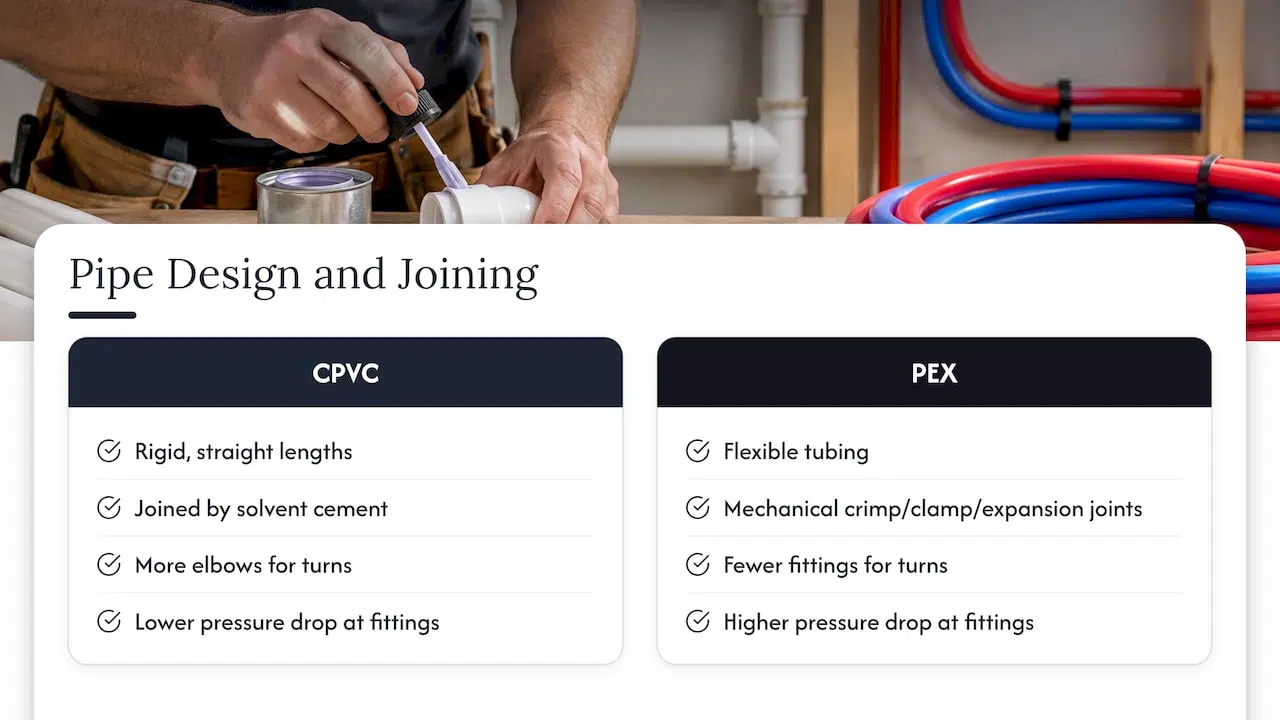
That single contrast explains most of the rest of this comparison. Flexibility favors PEX in tight, complicated framing. Rigidity and smooth fittings favor CPVC where flow and water chemistry matter.
Side-by-side comparison
| Factor | PEX | CPVC |
|---|---|---|
| Form | Flexible tubing | Rigid pipe |
| Joining | Crimp, clamp or expansion fittings | Solvent cement |
| Routing | Bends around obstacles, fewer fittings | More elbows and fittings |
| Chlorine and chloramine resistance | Can be affected by oxidizing disinfectants | Resistant to chlorine, chloramines and chlorine dioxide |
| Fitting pressure drop | Greater | Lower |
| Freeze tolerance | Better tolerance, but not freeze-proof | Rigid, can crack when frozen |
| Typical material cost | Generally higher for comparable systems | Generally lower for comparable systems |
The cost and chemistry rows depend on your project and your water. The sections below explain each one.
Water chemistry: the factor most comparisons skip
Most California homes receive disinfected municipal water. The disinfectant matters because it can attack some plastics over decades.
ASPE’s professional journal reports that CPVC is resistant to chlorine, chloramines and chlorine dioxide in drinking water. It also reports that PEX performance can be affected by water conditions: temperatures above 140°F, pressures above 80 psig and oxidizing disinfectants. HUD makes a similar point, noting that water conditions may accelerate PEX degradation.
Two practical takeaways follow:
- Check your water heater setting and your house pressure. A pressure-reducing valve and a sensible heater temperature keep either system inside the ranges the manufacturers design for. Both are routine checks on a plumbing visit.
- Know your disinfectant. Your water utility’s annual quality report states whether it uses chlorine or chloramine. That is useful information for any pipe decision.
If you are comparing plastic against metal for corrosion and mineral buildup, the same logic applies to metals: the water decides which one lasts. Choosing between 304 vs 316 stainless steel turns on the same question of how a material responds to its environment.
Pressure and flow
Pressure is where CPVC’s smooth socket fittings pay off. ASPE reports that a half-inch 90-degree PEX expansion fitting can create up to six times the pressure drop of a CPVC fitting. In a house with several bathrooms and fixtures running at once, that can mean upsizing the PEX tubing to keep flow strong at the last shower.
This is a design question, not a defect. A plumber sizing a system for your fixtures and your water demand accounts for it. In a small house with one or two bathrooms, the difference rarely matters. In a large two-story home with a long run to a back bathroom, it deserves a closer look.
Installation: layout beats material
Contractors argue about speed constantly, and the honest answer is that it depends on the layout. A controlled time study by NAHB’s Home Innovation Research Labs, cited by ASPE, found that CPVC installed about 15% faster than PEX in trunk-and-branch layouts. PEX installed 10% faster in mini-manifold layouts.
So a home plumbed with a central trunk line and branches suits CPVC. A home plumbed with a manifold and individual home runs to each fixture suits PEX. A plumber who knows your framing can tell which approach fits.
For repairs, think about what is already in your walls. Connecting new pipe to old pipe requires the right transition fittings, and the joining method must match the material. That is why a repair on an existing system is best handled by someone who works with every common pipe type. If your home has copper and you are weighing a switch, our guide to copper versus PEX covers that comparison.
Freezing: a smaller issue in Southern California, but not zero
PEX is often praised for freeze resistance because it can expand. The independent Plumbing Perspective article gives a more careful picture: neither flexibility nor material alone makes a pipe freeze-proof. It reports typical short-term burst pressures of 475 psi for PEX and 1,250 psi for plumbing-size CPVC.
In Orange County and the Los Angeles basin, hard freezes are uncommon. Homes in higher-elevation foothill and mountain areas of Los Angeles County see them more. Pipes in attics, exterior walls and unconditioned garages are the exposed ones. Insulating them and knowing where your main shutoff is protect you whatever the material. Our overview of common plumbing emergencies explains what to do when a pipe fails.
Cost and lifespan
ASPE reports that CTS SDR 11 CPVC is generally less expensive than PEX for comparable systems, and adds that material and labor depend on the project layout and installer skill. That matches what homeowners see on bids: the cheaper pipe on paper is not always the cheaper job once labor, fittings and wall access are counted.
When comparing quotes, ask each plumber for the same scope in writing:
- Pipe type and the specific fitting system.
- Whether permits and inspections are included.
- How walls, ceilings and drywall will be opened and repaired.
- Water heater connections and shutoff valves.
- The warranty on workmanship.
Published lifespans for plastic pipes vary by manufacturer, water conditions and installation quality, so treat any single number with care. Water temperature, pressure and disinfectant levels, as described above, affect how long either system lasts.
California code: what to confirm before you choose
Both pipes are legal in California. City of Milpitas guidance identifies CPVC and PEX as permitted materials under California Plumbing Code Table 604.1 and requires potable-water pipe, tubing, fittings, solvent cements and sealants to meet NSF 61. California approved PEX for the plumbing code effective August 2009 after an environmental review.
That approval is statewide, but cities can add to it. Oakland’s local amendment, for example, requires PEX to be used only with chemically compatible products and protected from chemicals that could degrade it or reach drinking water. In Los Angeles, a city ordinance lists plan-check triggers for potable-water systems, including specified PEX or CPVC systems. Your city or county building department decides what applies to your address.
A short checklist for any repipe:
- Pipe, fittings and joining components carry the required certification. HUD says potable-water PEX systems must meet NSF/ANSI 61 and NSF/ANSI 14, and homeowners should verify certification for the specific pipe, fittings and joining components.
- The installer follows the manufacturer’s instructions for the exact product.
- A permit is pulled where required, with testing and rough and final inspections.
- PEX is protected from sunlight and chemical contact as the manufacturer and local code require.
The permit and inspection steps belong to the building department. A plumber who works in your city regularly knows how to schedule them and what the inspector will look for. We serve Orange County and Los Angeles County, so these local steps are part of the job.
How to choose: a practical decision guide
Choose CPVC when:
- Your water is treated with chlorine or chloramine and you want a pipe designed to resist those disinfectants.
- Your house is plumbed in a trunk-and-branch layout.
- You want high flow through long runs with fewer pressure losses at fittings.
- Budget is tight and the layout favors straight runs.
Choose PEX when:
- Walls are finished and the pipe has to snake through existing framing.
- You want a manifold system with home runs to each fixture.
- Parts of the house are exposed to occasional cold.
- You want to avoid solvent cement, solder and flames in an occupied home.
Ask for a professional assessment when:
- You have a mix of old copper, galvanized or plastic in the walls.
- You see recurring pinhole leaks, discolored water or low pressure.
- You are planning a remodel that moves bathrooms or the kitchen.
- Your city has local plumbing amendments you are not sure about.
If you are choosing between all three common materials, our copper versus PEX guide adds the metal side of the decision. For repair-focused homeowners, the plumbing repair guide explains how common leaks are diagnosed.
What each pipe means when something leaks
Most homeowners meet their pipe for the first time when it fails. A few patterns are worth knowing:
- A weeping joint on solvent-welded pipe or a mechanical fitting is usually a joint problem, not a pipe problem. The fix is a proper cut-out and a new fitting of the right system.
- Low pressure at the far end of a house can come from fitting losses, undersized tubing, a partly closed valve or a failing pressure regulator. Diagnosis comes before replacement.
- Stains, damp drywall or a rising water bill can signal a hidden leak. Shut off the water at the main and call a licensed plumber promptly.
We repair leaking supply lines in homes across Orange County. See our page on plumbing pipe repair in Orange County for what we handle.
Perspective
Homeowners often ask us which pipe is better, as if one answer fit every house. In our experience of plumbing repair and installation, the better question is which pipe suits this house, this water and this city.
A pipe is only as good as its fittings, its sizing and the way it is joined. We look at the layout, the water pressure, the heater setting and what is already in the walls before recommending anything. Our licensed technicians handle plumbing repair and plumbing installation, so a pipe decision is made with the repair or installation in mind, not in the abstract.
Our advice is to settle the scope first: what is failing, what is behind the drywall and what your city requires. Then match the material to the job. That is how we approach every plumbing visit in Orange County and Los Angeles County.
MDTECH
Get the right pipe installed or repaired
If you are planning a repipe, a remodel or a repair, we offer plumbing repair and plumbing installation in Orange County and Los Angeles County, with online booking. Our licensed technicians can look at your layout and your existing pipe before you commit to a material.
See our plumbing and appliance repair services or start from our main page to book a visit.
FAQ
Is CPVC or PEX better for hot water?
Both are used for hot and cold supply. ASPE reports that PEX performance can be affected by temperatures above 140°F, so your water heater setting matters. CPVC is also designed for hot water service. Your plumber can confirm the right product for your heater and system pressure.
Is PEX allowed in California homes?
Yes. California approved PEX for the state plumbing code effective August 2009. City of Milpitas guidance lists both PEX and CPVC as permitted under California Plumbing Code Table 604.1. Local amendments and inspections vary by city, so confirm what applies to your address.
Which is cheaper, CPVC or PEX?
ASPE reports that CPVC is generally less expensive than PEX for comparable systems. Real costs depend on layout, wall access and installer skill, so compare written quotes with the same scope.
Does PEX or CPVC give better water pressure?
CPVC’s socket fittings cause less pressure drop. ASPE reports that a half-inch PEX expansion elbow can create up to six times the drop of a CPVC fitting. Larger PEX tubing can offset this in homes with many fixtures.
Can pipes freeze in Orange County or Los Angeles?
Hard freezes are uncommon at lower elevations, but they can occur in foothill and mountain areas. Pipes in attics, garages and exterior walls are the most exposed. Insulating them and knowing your main shutoff location helps with either material.
Sources
- Design Guide: Residential PEX Water Supply Plumbing Systems (HUD)
- Choosing Plumbing Systems for Residential Construction Projects (ASPE Pipeline)
- How Freezing Causes Pipe Failure and What You Can Do to Prevent It (Plumbing Perspective)
- California Plumbing Code non-administrative amendments (Oakland)
- PEX Tubing Passes California Environmental Review (BuildingGreen)